
90837 vs 90834: Choosing the Right Psychotherapy Code
Bill 90834 when you deliver 38 to 52 minutes of psychotherapy, and 90837 when you deliver 53 minutes or more. The code follows the minutes you actually spent in psychotherapy, not the length of the appointment slot. This guide compares 90837 vs 90834, shows how to document each visit, and explains where payers push back and how add-on codes work. For the wider picture, read our mental health billing guide.
| Key takeaways Time decides the code: 38 to 52 minutes is 90834, and 53 minutes or more is 90837.A 50-minute session is 90834, even when the appointment slot was an hour.The note must show how long the psychotherapy lasted. |
90837 vs 90834: time ranges at a glance
CPT assigns one code to each time band. The Medicare contractor guidance from First Coast Service Options lists the same bands, and the AMA publishes the CPT code set these codes come from.
| Code | Psychotherapy time | Add-on with an E/M visit |
| 90832 | 16 to 37 minutes | 90833 |
| 90834 | 38 to 52 minutes | 90836 |
| 90837 | 53 minutes or more | 90838 |
| None | Under 16 minutes | Not reportable |
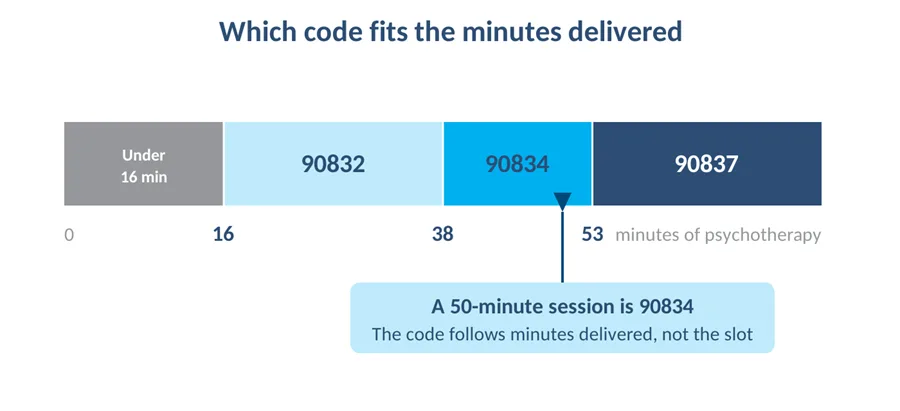
Text summary: under 16 minutes is not reportable, 16 to 37 is 90832, 38 to 52 is 90834, and 53 or more is 90837. Commercial payers usually follow CPT, but each sets its own rules in the provider manual.
How to choose between 90834 and 90837
- Record start and stop times. Write when psychotherapy began and ended, plus total minutes. Medicare contractor guidance says the record must show the length of the encounter.
- Count only psychotherapy minutes. A one-hour slot with 48 minutes of therapy is 90834.
- Match the minutes to the band. Use the table above, and never round 50 minutes up to 90837.
- Link a diagnosis to the service. CMS tells billers to indicate the specific sign, symptom or complaint for every service billed.
Sample note for a 90837 visit
Sample (fictional data). Change the times, intervention and plan to match your own visit.
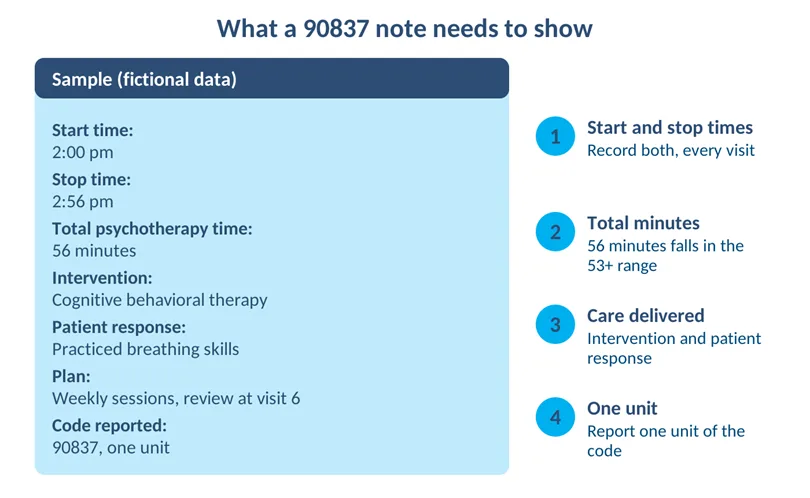
Text summary: the sample note lists a 2:00 pm start, a 2:56 pm stop, 56 total minutes, the intervention, the patient’s response, the plan and one unit of 90837.
Payer scrutiny and common denial triggers
Because 90837 covers the longest session, payers often review it more closely. Some commercial payers add authorization rules, frequency limits or records requests, so check each manual and contract. Our denial management service looks for the patterns behind recurring denials.
First Coast states that 90832 through 90838 are reported with one unit, with partial hospitalization as the exception, and that extra units outside that setting are denied. It also bars prolonged service code G2212 with 90837. Our partial hospitalization billing guide covers the exception.
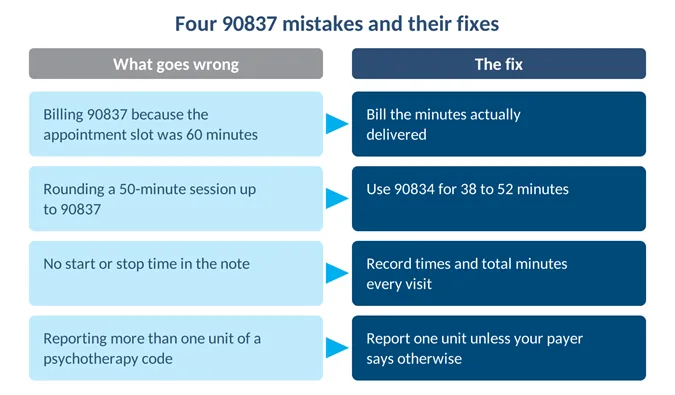
Text summary: bill delivered minutes, use 90834 for 38 to 52 minutes, record times every visit, and report one unit.
Add-on codes and special cases
- With an E/M visit: report 90833, 90836 or 90838. The E/M service must be significant and separately identifiable.
- Interactive complexity: 90785 is a separate add-on with its own requirements.
- Crisis and telehealth: crisis psychotherapy has its own codes, 90839 and 90840. The CMS Medicare mental health booklet lists these codes as telehealth-eligible; payer modifiers vary, as our modifier 95 vs GT guide explains.
- Testing: psychological testing uses separate timed codes, covered in our neuropsychological testing billing guide.
Frequently asked questions
What time qualifies for 90837?
90837 requires 53 minutes or more of psychotherapy. A Medicare contractor lists the same band as CPT. Count only the time you spend delivering psychotherapy, and record start and stop times so the note supports the code if a payer requests records.
Can I bill 90837 for a 50-minute session?
No. Fifty minutes falls in the 38 to 52 minute band, so the correct code is 90834. Billing 90837 would overstate the service and invites denials or recoupment if records are reviewed. Bill the time you delivered, even when the appointment was scheduled for an hour.
Can I bill more than one unit for a long session?
First Coast, a Medicare contractor, states that psychotherapy codes 90832 through 90838 are reported with one unit outside partial hospitalization, and extra units are denied. G2212 is not allowed with 90837. For unusually long sessions with commercial payers, read the payer’s policy first.
Can I bill psychotherapy and an E/M visit on the same day?
Yes, when the clinician can bill E/M services and both are provided. Report the E/M visit with the matching add-on: 90833, 90836 or 90838. The E/M service must be significant and separately identifiable from the psychotherapy, and the record should show each service and its time separately.
What should a 90837 note include?
Include start and stop times, total psychotherapy minutes, the intervention used, the patient’s response and the plan. CMS also expects the claim to indicate the specific sign, symptom or complaint for each service billed. A note without a time record is hard to defend if a payer requests records.
Final Considerations
Choosing between 90837 vs 90834 comes down to minutes delivered and a note that proves them. Build start and stop times into every template, check each payer’s manual for 90837 limits, and review your code mix regularly. If you want a second set of eyes on your psychotherapy claims, send a message through our contact page. Our team replies within 24 hours.
Sources: First Coast Service Options psychotherapy services guidance (updated August 2026); AMA CPT; CMS Medicare Mental Health booklet (MLN1986542, March 2026). This article is general information, not legal or billing advice. Confirm current rules with each payer.