
Secondary Insurance Billing and Coordination of Benefits: Who Pays First, How Much and What to Submit in 2026
Secondary insurance billing is the process of submitting the balance left after a primary payer pays to a patient’s second health plan. Coordination of benefits (COB) rules decide which plan pays first and cap combined payment, so the two plans together never pay more than the covered amount.
Who pays first when a patient has two health plans, and what happens to the balance the first plan leaves behind? Getting the answer wrong means denied claims, patients billed too early and secondary money never collected. This guide covers secondary insurance billing and coordination of benefits: the order rules, the payment math, a claim-by-claim process, three tracking calculations and a ten-question self-assessment checklist.
Secondary billing key numbers at a glance
Several figures in this guide come from published CMS material, while the turnaround and capture targets are practical conventions. Table 1 separates the two so a practice can see which numbers are rules and which are goals. Review the practical rows monthly, and review the published rows whenever a payer or patient reports a change in coverage.
Key numbers cheat sheet
| Metric | Practical target/range | Review frequency | Source type |
| Working-aged Medicare patient with employer plan | Employer plan pays first when the employer has 20 or more employees | Each visit | Published standard |
| Disabled Medicare patient under 65 with employer plan | Employer plan pays first when the employer has 100 or more employees | Each visit | Published standard |
| ESRD coordination period | Employer plan pays first for 30 months, then Medicare | Each new ESRD patient | Published standard |
| Medicare Secondary Payer questionnaire records | Keep responses 10 years after the date of service | Annual audit | Published standard |
| Medicare general claim filing limit | 12 months from the date of service | Per claim | Published standard |
| Secondary claim turnaround | Within 1 to 3 business days of the primary remittance | Weekly | Practical target |
| Secondary payment capture rate | Commonly targeted near 98% of eligible secondary balances | Monthly | Practical target |
Source type: Published standard = stated in CMS Medicare Secondary Payer (MSP) MLN booklet (July 2025) or by a Medicare Administrative Contractor (Noridian). Practical target = commonly cited across industry sources and Aspect Billing Solutions’ working guidelines; no CMS, AMA, AAPC, MGMA or HFMA rule sets these numbers.
Secondary insurance billing and coordination of benefits: what do they mean?
Secondary insurance billing is the second claim a practice files for the same visit, and coordination of benefits is the rule set that makes it fair. The primary payer processes the claim first. The secondary payer then considers what remains, and a tertiary payer, if any, receives whatever is left after that. Coordination of benefits (COB) keeps total payments at or below the covered amount.
Medicare adds its own vocabulary. The Medicare Secondary Payer (MSP) rules decide when another plan, such as an employer plan, must pay before Medicare does. A crossover claim is the claim Medicare forwards to a secondary insurer after processing it. The CMS Coordination of Benefits and Recovery provider page explains that MACs process claims for either primary or secondary payment, and that providers should ask patients about other coverage.
In billing audits, a common pattern is that the front desk records a second insurance card but never records which plan is primary. The claim then goes to whichever plan was entered first. Capturing the order at check-in, with the policyholder and relationship, prevents most of the denials that follow.
Which plan pays first? The order-of-benefits rules
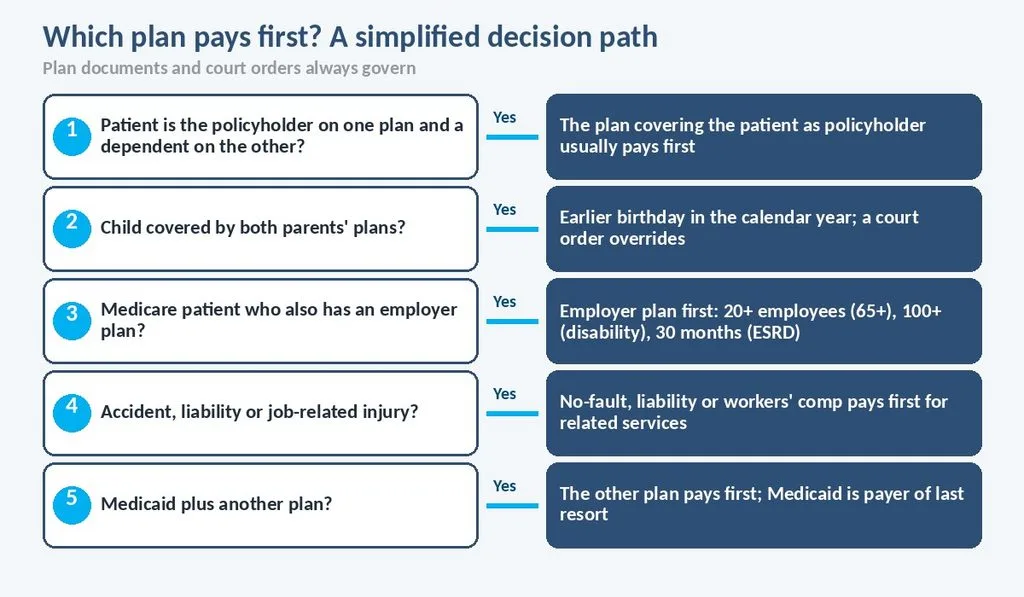
The plan that covers the patient as an employee or policyholder generally pays before a plan that covers the patient as a dependent. Several exceptions override that default, including the birthday rule for children, court orders after divorce and the Medicare Secondary Payer rules. Table 2 summarizes the most common situations, with plan documents as the final authority.
Order-of-benefits quick reference
| Situation | Usually pays first | Usually pays second | Source type |
| Adult covered by own employer plan and a spouse’s plan | Own employer plan | Spouse’s plan | Common COB rule |
| Child covered by both parents’ plans, parents married | Parent whose birthday falls earlier in the calendar year | Other parent’s plan | State agency (Connecticut OHA) |
| Child of divorced or separated parents | Plan named in the court order; otherwise custodial parent’s plan | Custodial parent’s spouse, then non-custodial parent’s plan | State agency (Connecticut OHA) |
| Medicare patient 65 or older, still working | Employer plan if the employer has 20 or more employees | Medicare | CMS MLN006903 |
| Medicare patient under 65 with a disability | Employer plan if the employer has 100 or more employees | Medicare | CMS MLN006903 |
| Medicare patient with ESRD | Employer plan for the first 30 months | Medicare after 30 months | CMS MLN006903 |
| Accident, liability or no-fault claim | No-fault or liability insurer for accident-related services | Health plan or Medicare | CMS MLN006903 |
| Job-related injury | Workers’ compensation | Health plan or Medicare | CMS MLN006903 |
| Medicaid and another plan | The other plan | Medicaid, as payer of last resort | Mississippi Division of Medicaid |
Sources: CMS Medicare Secondary Payer MLN booklet (July 2025); Connecticut Office of the Healthcare Advocate (birthday rule); Mississippi Division of Medicaid (payer of last resort). The own-plan-before-spouse’s-plan default is a common COB convention, so confirm it in the plan documents. Retiree coverage and COBRA follow plan-specific rules.
The birthday rule for children
The birthday rule assigns primary coverage for a child to the parent whose birthday falls earlier in the calendar year, ignoring the year of birth. The Connecticut Office of the Healthcare Advocate also notes that a tie goes to the plan that has covered a parent longer, and that a court order overrides the rule for divorced or separated parents.
Medicare as secondary payer
Medicare is not always primary. The CMS Medicare Secondary Payer booklet says an employer plan pays first for a working patient aged 65 or older when the employer has 20 or more employees. Disability uses a 100-employee threshold, and ESRD uses a 30-month coordination period. Accident, liability and workers’ compensation insurers also pay before Medicare for related services.
Medicaid as payer of last resort
Medicaid is the payer of last resort, and the Mississippi Division of Medicaid states the principle plainly: by law, Medicaid pays only after other available coverage. Practices should report other insurance on the claim, and state rules on filing and denials differ, so check the state Medicaid manual before billing. Injury cases add liability coverage, as the personal injury billing overview explains.
How much does the secondary payer actually pay?
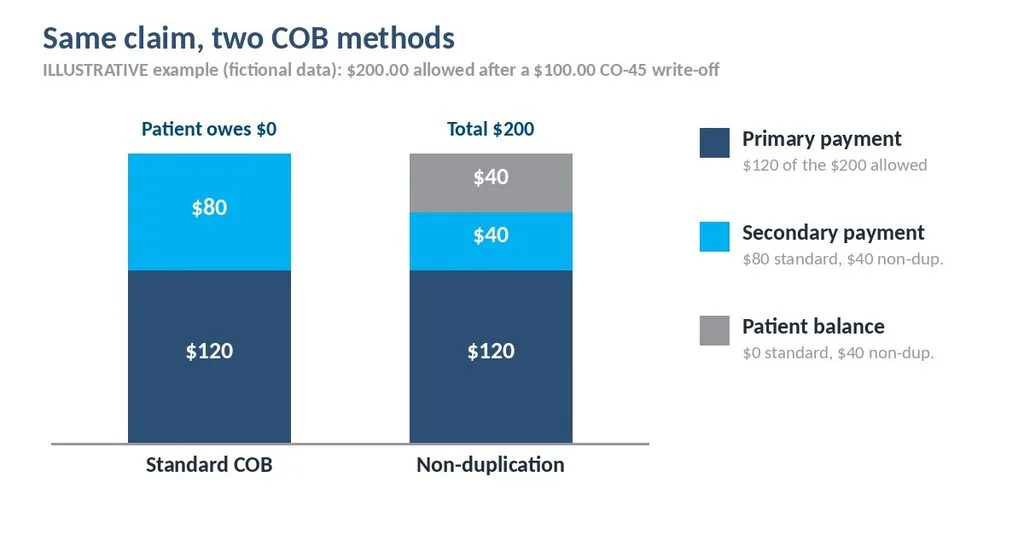
The secondary payer rarely pays the entire remaining balance automatically. Its payment depends on the plan’s COB method and on its own allowed amount. Under a standard method, the secondary pays the lesser of the remaining balance and what it would have paid as primary. Under non-duplication, it subtracts the primary payment from its normal benefit.
Illustrative secondary payment under two COB methods (fictional data)
| Step | Standard COB | Non-duplication |
| Billed charge | $300.00 | $300.00 |
| Primary allowed amount (CO-45 write-off $100.00) | $200.00 | $200.00 |
| Primary payment | $120.00 | $120.00 |
| Patient responsibility after primary (PR) | $80.00 | $80.00 |
| Secondary’s normal benefit if it were primary | $160.00 | $160.00 |
| Secondary payment | $80.00 (lesser of $80 balance and $160) | $40.00 ($160 benefit minus $120 paid) |
| Remaining patient balance | $0.00 | $40.00 |
Illustrative: fictional amounts and hypothetical plan designs. Actual COB methods vary by plan and contract, so read the secondary plan’s provider manual or call the payer. Check: $120 + $80 + $100 write-off = $300 (standard); $120 + $40 + $40 patient + $100 = $300 (non-duplication).
Illustrative scenario (not an actual client record): a $300.00 charge has a $200.00 allowed amount. The primary pays $120.00, leaving $80.00 of patient responsibility. A standard secondary pays that $80.00, while a non-duplication secondary pays $40.00 and leaves $40.00. Both are correct, so the practice must know each plan’s method before billing the patient anything.
Medicare crossovers follow a more predictable path. Suppose Medicare allows $200.00, the deductible is met and Medicare pays 80%, or $160.00. The remaining $40.00 is the 20% Part B coinsurance. A Medigap policy usually covers that amount, so the patient owes $0.00 for the covered service. Check the plan’s actual terms first, because Medigap benefits vary by lettered plan.
How do you bill secondary insurance step by step?
Bill secondary insurance in a fixed sequence, and stop at the first step that fails. A fixed order keeps the primary remittance, the claim and the patient statement consistent. Practices using a clearinghouse can automate parts of steps four and five, but staff still need to review secondary exceptions that the system cannot match.
- Verify coverage and order at check-in. Confirm both plans, the policyholder, the relationship and the primary designation. The eligibility verification guide shows what to check and when.
- Bill the primary payer first. Report all known coverage on the claim, using the other-insurance fields on the CMS-1500 or the other-payer loops on the electronic 837P.
- Post the primary remittance. Record the payment, each adjustment and the patient responsibility lines by group code, as covered in the CO-45 denial code guide.
- Check for automatic crossover. Medicare and some payers forward claims to the secondary. If the remittance does not say so, file the secondary claim manually.
- Submit the secondary claim with primary payment details. Include the primary payer’s paid amount and adjustments, and attach the remittance or EOB when the secondary payer requires paper.
- Post the secondary remittance. Record payment and adjustments, then check whether a tertiary payer exists.
- Bill the patient last. Send a statement only for amounts coded as patient responsibility after every payer has processed the claim.
The electronic claim carries the primary payer’s figures in claim adjustment segments (CAS), and the CMS booklet warns that a missing or incorrect claim adjustment reason code can cause a Medicare denial. The X12 reason code list defines CARC 22 (care may be covered by another payer per COB) and CARC 23 (impact of prior payer adjudication, used with group code OA).
Timing matters as well. Medicare’s general limit is 12 months from the date of service, per Noridian’s timely filing guidance. Commercial contracts vary: some count from the date of service and others from the primary payer’s remittance date. Read each contract, and do not assume the secondary clock restarts when the primary pays.
How does secondary billing differ for Medicare, Medicaid and commercial plans?
Each payer type differs in who forwards the claim, what the secondary needs and which rules apply. Table 4 compares them. It is illustrative except where a source is named, because contracts, state programs and plan designs vary. Confirm current rules in each payer’s provider manual before changing a workflow.
Payer differences in secondary billing (illustrative except where a source is named)
| Payer type | How the secondary claim moves | What to send or check | Watch for |
| Original Medicare as primary | Medicare can cross claims over to a secondary insurer that has a COBA agreement with CMS | Confirm the crossover on the remittance; file manually if absent | Medigap claim never arrives |
| Original Medicare as secondary | Primary payer bills first; Medicare then pays after accounting for the patient’s deductible and coinsurance | Primary payment and adjustment data per CMS MLN006903 | Wrong adjustment codes cause a denial |
| Medicare Advantage | Plan-specific; plans stand in for Original Medicare and Medigap generally does not pair with them | The plan’s own COB and filing rules | Assuming traditional crossover |
| Medicaid | State-specific; billed after other coverage as payer of last resort | Other insurance information and the primary remittance | State filing windows |
| Commercial plans | Usually filed manually or through a clearinghouse | Primary EOB or electronic payment data; contract rules | Non-duplication methods |
Sources: CMS COB and Recovery provider page and COBA Trading Partners page (crossover and COBA); CMS MLN006903 (Medicare as secondary); Mississippi Division of Medicaid (payer of last resort). Illustrative where no source is named; actual terms vary by payer and state.
Credentialing choices shape which payers a practice can bill at all, so a Medicare or Medicaid enrollment gap can block a secondary claim. The Medicare versus Medicaid credentialing comparison explains how the enrollments differ. Deductible and coinsurance amounts are captured at the front desk, and the patient responsibility collection guide covers that step.
Which numbers show whether secondary billing is working?
Three short calculations show whether secondary billing is timely, complete and worth the effort. Each example below is illustrative, opens with its formula and can be rerun with a practice’s own counts. Replace every sample figure with real data before drawing a conclusion, and split results by payer group before changing a process.
Example 1: secondary claim turnaround
Formula: average turnaround = total days from primary remittance to secondary submission ÷ number of secondary claims. Illustrative scenario (not an actual client record): five claims go out after 1, 2, 2, 3 and 12 days, totaling 20 days. The average is 20 ÷ 5 = 4.0 days, but the 12-day claim shows where the process stalls.
Example 2: secondary payment rate, blended and by group
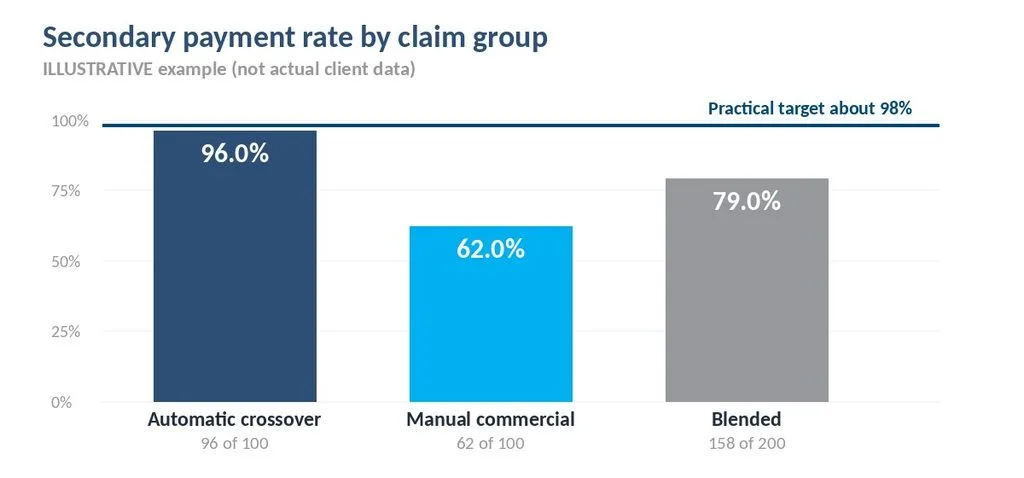
Formula: secondary payment rate = secondary claims paid ÷ eligible secondary claims × 100. Illustrative scenario (not an actual client record): automatic crossover claims pay 96 of 100, or 96.0%. Manually filed commercial claims pay 62 of 100, or 62.0%. Blended, 158 ÷ 200 = 79.0%, which hides the group where the workflow fails.
Example 3: dollars at stake
Formula: monthly exposure = unbilled secondary claims × average expected secondary payment. Illustrative scenario (not an actual client record): 20 secondary claims sit unbilled with an average expected payment of $80.00. The exposure is 20 × $80 = $1,600 each month, before any patient is billed the wrong amount. Quantify this with a monthly report from the practice management system.
How to use these numbers correctly
Compare like with like: crossover claims against crossover claims, and commercial manual filings against their own history. One missed benchmark is a signal to investigate, not a verdict. When the payment rate drops, check the claim sample for missing primary adjustment data first, then for coverage-order errors, and only then for payer-side issues. The underpayment guide helps with the last category.
How long does it take to improve secondary billing?
Partial improvement often appears within 30 to 60 days of fixing coverage capture and crossover checks, and a full cleanup commonly takes 90 to 120 days. These are general planning ranges, not guarantees. Quick gains come from working the unbilled secondary list. Slower gains come from correcting old coverage data and retraining front-desk staff, so results vary by payer mix and volume.
Which secondary billing mistakes cause the most damage?
Most secondary billing losses trace to six repeatable mistakes, and each has a practical fix. Review them quarterly, and assign each fix to a named owner. Our team often sees the same mistake repeat for months because the denial lands in a generic queue, so route coordination problems to their own work list.
- Skipping the order check. Confirm primary and secondary status at each visit when coverage may have changed, as the front-end RCM workflow recommends.
- Billing the patient too early. Wait for the secondary remittance when the patient has secondary coverage and the first plan reported patient responsibility.
- Leaving out primary payment details. Attach or transmit the primary payment and adjustment data so a CARC 16 style rejection, described in the CO-16 guide, does not stall the claim.
- Assuming crossover always works. Check each remittance for a forwarding notice, and file manually when none appears.
- Using stale coverage data. Re-verify when a patient reports a job, birthday-rule or divorce change.
- Forgetting the tertiary payer. Check for a third plan after the secondary pays, and track filing limits for each payer.
Quick summary
- Secondary billing sends the remaining balance to a patient’s second plan after the primary pays.
- Coordination of benefits rules set the order and cap combined payment.
- The birthday rule, court orders and MSP thresholds (20 employees, 100 employees, 30 months) change who pays first.
- A commonly cited practical target is secondary claims out within 1 to 3 business days and a capture rate near 98%.
- Bill the patient only after every payer has processed the claim.
- Track the payment rate by payer group, because a blended rate can hide one failing group.
Self-assessment: is your secondary billing process reliable?
Answer yes or no to each question, using last month’s data wherever a question mentions a rate. The scoring guide below the list shows what the total suggests and what to do next. A “no” is a to-do item, not a failure.
- Do you record which plan is primary, and why, at every visit?
- Do you ask patients about other coverage at each visit or each new problem?
- Do you keep Medicare Secondary Payer questionnaire responses for 10 years?
- Do you bill the primary payer before any secondary payer?
- Do you check each remittance for an automatic crossover notice?
- Do you send secondary claims within 1 to 3 business days of the primary remittance?
- Do you include primary payment and adjustment data on every secondary claim?
- Is your secondary payment capture rate near 98%?
- Do you hold patient statements until all payers have processed the claim?
- Do you track the secondary payment rate separately by payer group?
Scoring guide
| Yes answers | What it suggests | Next step |
| 9-10 | Secondary billing looks reliable | Keep the check-in order capture and the monthly payer-group review |
| 6-8 | Gaps worth closing | Fix the “no” items first and re-measure in 60 days |
| 0-5 | Revenue and compliance risk | Rebuild coverage capture, crossover checks and secondary follow-up |
Scoring is a practical guide, not a published standard.
When does outside billing support make sense?
Outside support makes sense when coordination errors keep recurring despite staff effort, and the signs usually appear in unbilled secondary balances before they appear in write-offs. Consider help when several of these five signals are already present, since each one compounds the others:
- Secondary claims regularly go out more than a week after the primary remittance.
- Patients receive statements for balances that a secondary plan later pays.
- Nobody can say how many secondary balances are unbilled right now.
- Coordination-of-benefits denials return in the same payer group month after month.
- Front-desk turnover keeps breaking the coverage-order capture routine.
When evaluating a partner, look for payer-group reporting on secondary payment rates, a written coverage-order process, crossover monitoring and signed HIPAA safeguards. Aspect Billing Solutions is one example. It provides HIPAA-compliant, end-to-end medical billing and coding, credentialing, eligibility verification and prior authorization, denial management, A/R follow-up and compliance support, with a dedicated agent assigned to each provider. Results vary by practice.
A medical billing audit is a practical first step, because it measures the unbilled secondary list and the payment rate by payer group. Related reading on how eligibility verification impacts revenue shows why coverage data drives the first claim. The revenue cycle management service page describes the full approach, and the services overview lists each service.
Final Considerations
Secondary insurance billing and coordination of benefits come down to three habits: capture the coverage order at check-in, send complete secondary claims quickly and bill the patient only when every payer is finished. Most of the money lost here is not denied; it is simply never billed.
Firm published standards in this guide are the MSP thresholds (20 employees, 100 employees, 30 months), the 10-year record retention for MSP responses, Medicare’s 12-month filing limit and Medicaid’s payer-of-last-resort status. The 1 to 3 day turnaround, the 98% capture target, the timeframe ranges and every worked example are practical or illustrative.
The natural next question is how many secondary balances are sitting unbilled today. To find out, ask Aspect Billing Solutions for a secondary billing review and bring a month of remittances so the review can compare each payer group with its own history.
Frequently asked questions
What is secondary insurance billing?
Secondary insurance billing is the submission of a claim to a patient’s second health plan after the primary payer has processed the claim. The secondary plan considers the remaining balance and its own COB rules. The practice should bill the patient only for what remains after both plans pay.
What is coordination of benefits?
Coordination of benefits is the set of rules that decides which health plan pays first when a patient has more than one plan. It also limits total payment so the plans together do not pay more than the covered amount. Order depends on factors such as policyholder status, age and Medicare rules.
Does Medicare automatically bill the secondary insurance?
Medicare can forward claims to a secondary insurer that has a coordination of benefits agreement with CMS, but not every plan participates. Check the remittance for a crossover notice. When none appears, file the secondary claim manually and send the primary payment details the secondary payer requires.
What is a good secondary claim turnaround time?
Many practices aim to submit secondary claims within one to three business days of the primary remittance. This is a commonly cited practical target, not a CMS rule. Faster submission leaves more room before filing limits, which matter because Medicare’s general limit is 12 months from the date of service.
What is a good secondary payment capture rate?
A common practical target is collecting near 98% of eligible secondary balances, with lower performance investigated by payer group. No CMS, MGMA or HFMA rule sets this number. Compare crossover claims with manual filings separately, because a blended rate can hide one weak workflow.
Can a patient be billed before the secondary insurance pays?
A practice should generally wait until all payers have processed the claim and bill only the remaining patient responsibility. Billing earlier risks charging amounts the secondary plan would pay. Medicare beneficiaries may be billed only for amounts coded as patient responsibility, so read the group codes first.
Sources and methodology
(a) Published standards and definitions from named bodies
- CMS, Medicare Secondary Payer MLN booklet MLN006903 (July 2025): employer plan thresholds of 20 and 100 employees, ESRD 30-month period, 10-year retention of MSP responses, billing and claim adjustment requirements, no-fault, liability and workers’ compensation order.
- CMS, Coordination of Benefits and Recovery provider services page, and COBA Trading Partners page (crossover and COBA agreements).
- Connecticut Office of the Healthcare Advocate, Birthday Rule (child coverage order, tie-breaker and divorced-parent rules).
- Mississippi Division of Medicaid, Third Party Liability and Recoveries (Medicaid as payer of last resort).
- X12, Claim Adjustment Reason Codes (CARC 16, 22 and 23 descriptions) and Claim Adjustment Group Codes.
- Noridian Healthcare Solutions, Timely Filing (Medicare 12-month general filing limit).
(b) Named benchmarking data providers
None. No MGMA, HFMA or other benchmarking-provider figures are cited in this article.
(c) Practical or illustrative targets from general industry sources
- The 1 to 3 business day turnaround and the 98% capture target are commonly cited across industry sources and Aspect Billing Solutions’ working guidelines, not mandates.
- The 30 to 60 day and 90 to 120 day improvement ranges are general planning ranges, not guarantees.
- All worked examples, including the payment calculations and plan designs behind them, are labeled illustrative and use fictional data.
(d) Survey or study data
None. No survey or study data are cited in this article.
Results vary by practice, payer and state. Figures and rules reflect information available in October 2026, and code lists, payer policies and fee schedules change often.