
PR-1, PR-2, PR-3 Denial Codes: A Biller’s Guide to Deductible, Coinsurance and Copay Balances
PR-1, PR-2 and PR-3 denial codes are patient-responsibility adjustments: group code PR paired with claim adjustment reason codes 1 (deductible), 2 (coinsurance) and 3 (co-payment). They are not true denials. The payer processed the claim and assigned those dollars to the patient, which makes them billable only after a few checks.
Review note: the Medicare figures in this guide reflect the 2026 amounts CMS announced in November 2025, and plan-year deductibles reset on different dates by payer. Confirm each patient’s benefits for the date of service before you post or bill a balance.
A remittance full of PR-1, PR-2 and PR-3 lines rarely looks urgent, yet it hides some of the largest recoverable dollars in a practice. Those amounts only become revenue when someone estimates them, collects them and bills them correctly. This guide explains what each code means, how the codes differ from CO-45, how Medicare, Medicare Advantage, Medicaid and commercial plans change the rules, and where billers get patient balances wrong. A 10-question checklist near the end scores your process.
The Numbers Behind Patient Responsibility Balances
Seven figures explain why PR balances keep growing and why they are harder to collect: four published rules or survey results, two collection benchmarks and one practical target. Table 1 lists each with its source type.
Key numbers for PR-1, PR-2 and PR-3 balances
| Metric | Practical target / range | Review frequency | Source type |
| Medicare Part B annual deductible (2026) | $283, then 20% coinsurance on most Part B services | Yearly | Published standard (a): CMS |
| Medicare Advantage out-of-pocket limit (2026) | No more than $9,250 in network; $13,900 in and out of network combined | Yearly | Published standard (a): CMS limits as reported by KFF |
| Average single-coverage deductible, employer plans (2025) | $1,886; 88% of covered workers have a general deductible | Yearly | Survey (d): KFF, 2025 |
| Deductible at smaller firms (10 to 199 workers) | $2,631 on average, versus $1,670 at larger firms | Yearly | Survey (d): KFF, 2025 |
| Copay collection at time of service | Fell from about 90% (2019) to 56% (2022) | Monthly | Benchmark (b): MGMA data |
| Collection of patient-due balances at time of service | Rose from about 15% (2019) to 39% (2022) | Monthly | Benchmark (b): MGMA data |
| Estimate and collect before the visit | Quote deductible and coinsurance before the visit and track copay and deductible collections separately | Monthly | Practical target (c) |
Source labels: (a) federal rule or CMS-published figure; (b) named benchmarking data provider; (c) practical target commonly used across industry sources, not a mandated standard; (d) named survey or study. Check your own payer contracts and plan documents; figures here are examples, not guarantees.
What Do PR-1, PR-2 and PR-3 Actually Mean on a Remittance?
PR is the group code, and the number after it is the reason. On an electronic remittance advice (ERA/835), PR means patient responsibility, while CARC 1, 2 and 3 name the type of cost-sharing: deductible, coinsurance or co-payment.
PR-1, PR-2 and PR-3 compared
| Code | X12 description | What happened | Usual next step |
| PR-1 | Deductible Amount | The patient has not yet met the plan’s deductible, so the allowed amount applies to it | Bill any secondary payer, then the patient |
| PR-2 | Coinsurance Amount | The patient owes a percentage of the allowed amount after the deductible | Bill the secondary payer if one exists, then the patient |
| PR-3 | Co-payment Amount | The plan charges a flat fee for the visit | Compare it with the copay collected at check-in |
Descriptions follow the X12 claim adjustment reason code list; check the current list in your remittance software.
Why PR lines are not really denials?
A denial means the payer refused all or part of a claim for a reason the practice may fix. A PR line means the payer paid what the plan requires and assigned the rest to the patient. Billing teams that treat PR-1 as a denial waste appeal effort; the useful question is whether the amount is correct, not whether the payer is wrong. Real denials, such as the common reasons for claim denials, need a different workflow.
How PR differs from CO-45?
Group code CO assigns an amount to the provider, while PR assigns it to the patient. CARC 45 can appear under either group code, but it usually shows up under CO as the contractual write-off between the billed charge and the allowed amount. Our guide to the CO-45 denial code covers that side of the same remittance.
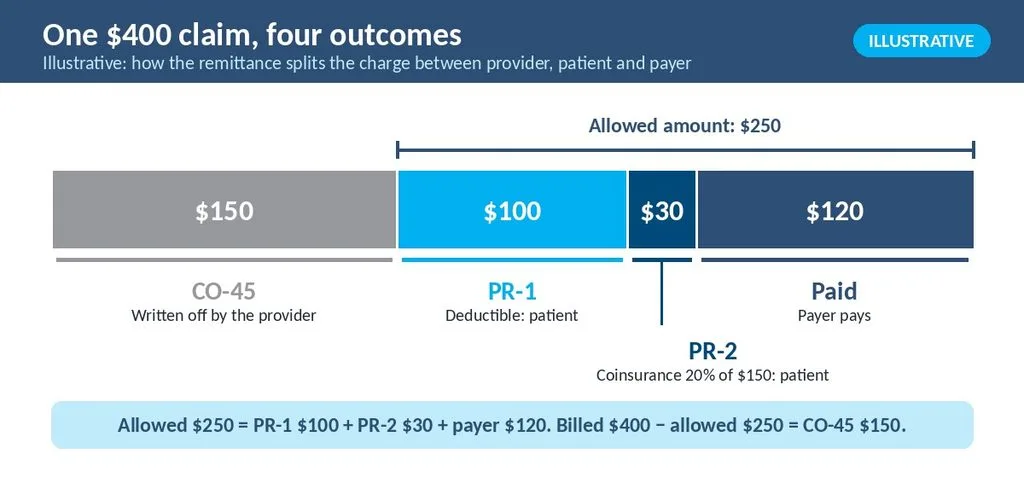
Illustrative scenario (not an actual client record): a practice bills $400 for a visit. The plan’s allowed amount is $250, so $150 posts as a CO-45 write-off. The patient still has $100 of deductible left, which posts as PR-1. Coinsurance is 20% of the remaining $150, or $30, which posts as PR-2. The payer pays $120. Check: $250 − $100 − $30 = $120.
Do the Rules Change for Medicare, Medicare Advantage, Medicaid and Commercial Plans?
Yes. The same three codes carry different billing rules by payer: Medicare and commercial plans generally let you bill PR amounts to the patient, Medicare Advantage adds a plan-specific cap, and Medicaid and Qualified Medicare Beneficiary (QMB) coverage can block patient billing altogether.
How PR-1, PR-2 and PR-3 behave by payer type?
| Payer type | What the PR lines look like | Billing watch-outs | Where to check |
| Original Medicare (Part B) | PR-1 until the $283 deductible (2026) is met, then PR-2 at 20% of the approved amount for most services | A secondary payer or Medigap plan may owe the balance; QMB patients cannot be billed | Medicare remittance and eligibility response |
| Medicare Advantage | PR-3 and PR-2 vary by plan and service; deductibles are plan-defined | In-network cost sharing is capped at the plan’s out-of-pocket limit, up to $9,250 in 2026 | Plan benefit summary and eligibility check |
| Medicaid and CHIP | Nominal copays, where a state allows them | Providers generally accept the Medicaid payment as payment in full beyond permitted cost sharing | State Medicaid provider manual |
| Commercial and employer plans | Deductibles, copays and coinsurance by plan design; high-deductible plans shift more dollars to PR-1 | Self-funded plans follow their plan documents; out-of-network balances follow the contract and federal rules | Payer portal and the benefit summary |
Rows are summaries for orientation. Plan designs, state Medicaid rules and the date a deductible resets differ by payer, so verify each patient’s benefits for the date of service.
QMB patients: the group you must not bill
The most expensive PR mistake in Medicare billing is sending a statement to a patient who is a Qualified Medicare Beneficiary. CMS guidance on QMB billing prohibitions says providers must not bill QMB patients for Part A or Part B deductibles, coinsurance or copayments, whether or not the provider accepts Medicaid. The same guidance tells practices to review the Medicare remittance to spot QMB status and to bill the state’s crossover process instead. For the wider Medicare picture, see our definitive guide to Medicare billing.
Medicare Advantage and out-of-pocket limits
A Medicare Advantage plan sets its own deductible, copay and coinsurance, subject to a yearly maximum. For 2026 that maximum is $9,250 in network and $13,900 for in-network and out-of-network care combined, and many plans set lower limits. When a patient has already reached the plan’s limit, a new PR-2 line deserves a benefit check before anyone bills it.
Commercial plans and high deductibles
KFF’s 2025 Employer Health Benefits Survey found that 88% of covered workers with single coverage have a general annual deductible, averaging $1,886, with smaller firms averaging $2,631. For practices, that means PR-1 balances arrive early in the plan year and can be sizable. Plan years that do not follow the calendar year make January an unreliable guide, so check the reset date for each plan.
Out-of-network care
Out-of-network claims often generate larger PR lines and more disputes. When a patient is out of network for emergency or certain facility-based services, the No Surprises Act generally limits what the patient can owe to in-network cost sharing. The out-of-network claim billing guide covers the contract side; always confirm which rules apply before you bill the difference.
Which PR-1, PR-2 and PR-3 Balances Are Wrong?
A PR balance is wrong when the payer applied the wrong benefit, the wrong plan year or the wrong patient status, so the first job is verifying the amount, not collecting it. Table 4 lists the most common causes billers find in remittance reviews.
Common reasons a PR balance is incorrect
| Root cause | What you usually find | Fix | Stop it at |
| Preventive service processed as diagnostic | Deductible or coinsurance applied to a screening that should carry no patient cost sharing | Corrected claim or appeal with the right diagnosis and modifier | Charge entry |
| Wrong plan year or reset date | Deductible applied after the plan already reset or before it did | Request reprocessing with proof of accumulators | Eligibility check |
| Coordination of benefits (COB) error | Secondary payer was never billed, or primary paid second | Update coverage order and rebill | Registration |
| QMB or Medicaid patient | PR amount posted to a patient who cannot be billed | Bill state crossover; write off the patient balance | Remittance review |
| Copay collected, copay posted again | Patient paid at check-in, then received a statement for the same PR-3 | Match the payment to the claim; refund overpayment | Posting |
Source: common billing practice; frequency of each cause varies by practice and payer mix.
In billing audits, a common pattern is a screening service that rolls into PR-1 because a diagnosis code or modifier made it look diagnostic. When a plan covers a preventive service at no cost to the patient, an incorrect deductible line is a coding fix, not a collections task. The AMA’s preventive services coding guidance explains how modifier 33 signals an ACA preventive service on commercial claims.
Another pattern our team sees: front-desk staff collect a copay at check-in, but the payment is posted to the account rather than matched to the claim. Months later the PR-3 line posts to a patient statement, and a patient who already paid receives a bill. Match same-day payments to the encounter before the remittance posts, and the duplicate-statement problem largely disappears.
When not to waive the balance?
It is tempting to write off small PR amounts or to waive copays for convenience, but routine waivers carry risk. The HHS Office of Inspector General has described routine waiver of Medicare copayments as a longstanding concern that can implicate the federal anti-kickback statute and the False Claims Act, as the OIG statement to the Practicing Physicians Advisory Council explains. Do not adopt a blanket waiver policy; make hardship decisions case by case and document them.
How Do You Work a PR Line From Remittance to Statement?
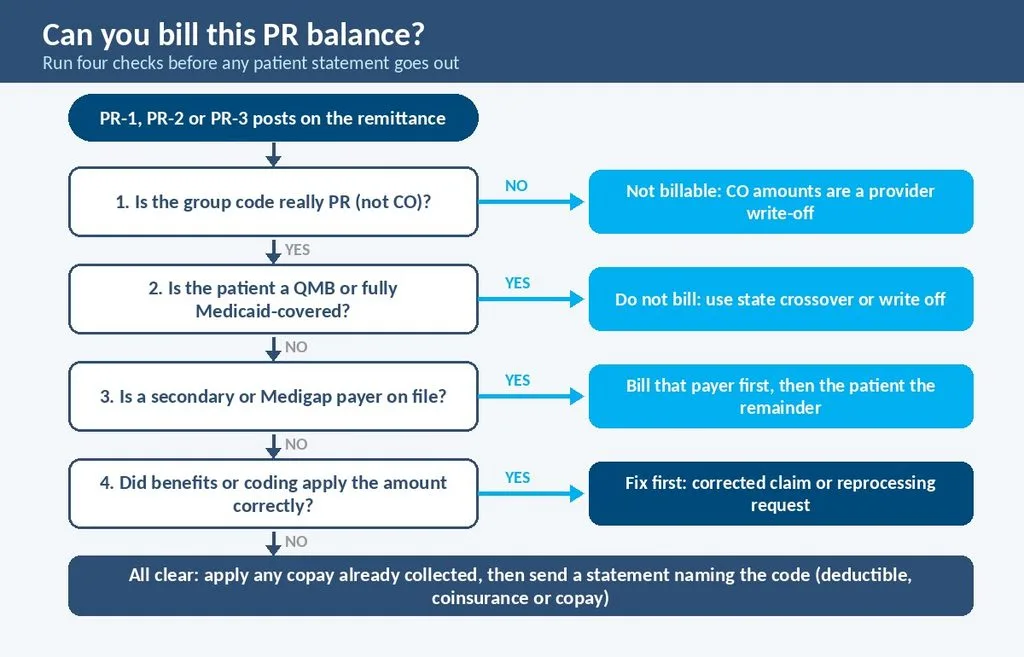
Work every PR line through the same seven steps: confirm the code, check the group, verify benefits, bill any secondary payer, apply patient payments, send the statement and track the balance. The order matters, because billing the patient before the secondary payer is the most common way to create an incorrect statement.
- Read the line: group code PR, CARC 1, 2 or 3, the dollar amount and any remark codes.
- Confirm the patient’s coverage for the date of service, including plan year, deductible accumulators and any QMB status.
- Compare the amount with the estimate given at the visit; investigate a variance larger than a few dollars.
- Send the PR amount to the secondary payer first when one is on file.
- Apply any copay or prepayment collected at the time of service to the matching claim.
- Send a clear patient statement that states the PR code in plain language: deductible, coinsurance or copay.
- Track the balance by age and by code type, and follow up before 90 days.
Teams that handle front-end work in one place can build the estimate step into registration. The front-end RCM workflow from check-in to claim submission and modern eligibility verification tools show how benefit data reach the front desk before the visit, and our front-desk patient responsibility strategies cover how to ask for payment.
Which Patient Responsibility Metrics Show Where Money Is Slipping?
Three metrics show where patient-responsibility revenue slips: collection rate by balance type, estimate variance and PR yield within 90 days. Each needs only the payment ledger and the remittance file, and each should be tracked by balance type rather than as one blended figure.
Collection rate at the time of service, by balance type
Formula: Time-of-service collection rate = PR amounts collected at or before the visit ÷ PR amounts estimated due at the visit × 100, calculated separately for copays and for deductible and coinsurance.
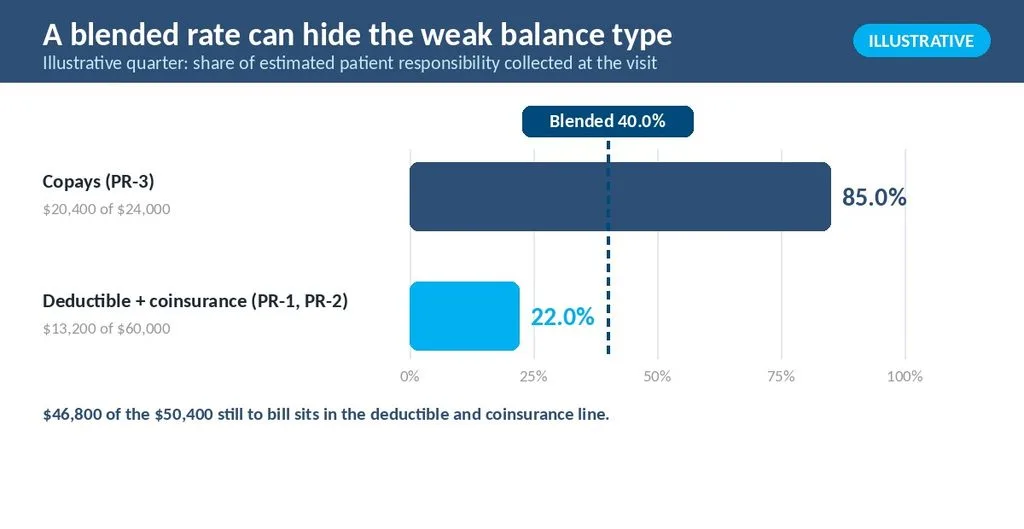
Illustrative scenario (not an actual client record): a practice estimates $24,000 of copays and $60,000 of deductible and coinsurance across a quarter’s visits, and collects $20,400 and $13,200 at the visit. Table 5 shows the result.
Table 5. Illustrative time-of-service collections by balance type (one quarter)
| Balance type | Estimated due | Collected at visit | Rate | Left to bill later |
| Copays (PR-3) | $24,000 | $20,400 | 85.0% | $3,600 |
| Deductible and coinsurance (PR-1, PR-2) | $60,000 | $13,200 | 22.0% | $46,800 |
| Total / blended | $84,000 | $33,600 | 40.0% | $50,400 |
Illustrative: figures are invented to show the method. Actual rates vary by specialty, payer mix and patient population.
The blended rate is $33,600 ÷ $84,000 × 100 = 40.0%, which could pass for an average result. Yet copays are collected at 85%, and the deductible and coinsurance line is only 22%, leaving $46,800 of the $50,400 still to be billed. A practice-wide reminder would miss the problem; the fix is a firmer process for estimating and requesting deductible and coinsurance dollars.
Estimate variance
Formula: Estimate variance = (Actual PR on the remittance − Estimate given to the patient) ÷ Estimate × 100.
Illustrative scenario (not an actual client record): a patient is quoted $180, but the remittance posts $240 of PR-1 and PR-2. Variance = ($240 − $180) ÷ $180 × 100 = 33.3%. A large variance usually signals stale benefit data, a missed secondary payer or an unexpected service code rather than a patient problem.
PR yield within 90 days
Formula: PR yield = PR dollars collected within 90 days of the remittance ÷ PR dollars billed after the visit × 100.
In the same illustrative quarter, the practice bills the remaining $50,400 and collects $30,240 within 90 days. PR yield = $30,240 ÷ $50,400 × 100 = 60.0%. Combined with the $33,600 collected at the visit, the practice has recovered $63,840 of $84,000, or 76.0%, within the window. No national body publishes a benchmark for this ratio, so compare it with your own trend.
Tracking all three numbers monthly is easier with a revenue cycle dashboard; our guide to key metrics for a medical practice revenue cycle dashboard lists where each comes from, and our guide to reducing medical accounts receivable covers follow-up cadence.
Reading PR Metrics Without Fooling Yourself
Compare patient-responsibility metrics with the same payer type, balance type and time period, because high-deductible plans and copay-only plans behave very differently. One poor month is a signal to investigate, not a verdict.
- Separate copays from deductible and coinsurance before judging collections.
- Compare commercial plans with commercial plans; Medicare, Medicare Advantage and Medicaid have different patient-billing rules.
- Expect deductible-heavy balances to peak early in the plan year; compare the same months across years.
In billing audits, a common pattern is a January spike in PR-1 balances that staff read as a collections failure, when the real cause is patients meeting new deductibles. Compare the same months across years before changing the process. Kodiak Solutions KPI data, reported by HFMA, put point-of-service collections at 30.1% of patient payments in Q1 2026, so most patient dollars still arrive after the visit.
MGMA’s October 2025 poll found 66% of medical group leaders said patient balance collections were about the same or better than a year earlier, while 29% said worse, so a flat result is not unusual. The MGMA Stat analysis points to tighter front-end processes and clearer estimates as the levers that improve collections.
How Long Does It Take to Improve Patient Balance Collections?
Most practices can improve estimates and statement accuracy within a few weeks, but collection results lag by a full billing cycle or more. These are general planning ranges, not guarantees:
- 2 to 4 weeks: separate PR-1, PR-2 and PR-3 in your reports, and add a QMB and secondary-payer check to the posting routine.
- 30 to 60 days: estimate variance narrows as benefit data reach the front desk before the visit.
- 60 to 120 days: time-of-service collections of deductible and coinsurance rise as staff request payment with a specific estimate.
Actual timing depends on payer mix, how many plans reset in the period and how many patients carry high deductibles.
Mistakes That Turn Correct PR Lines Into Billing Problems
- Treating PR as a denial. Review the amount, not the payer’s decision, unless benefits look wrong.
- Billing the patient before the secondary payer. Send PR amounts to any secondary or Medigap payer first.
- Billing QMB patients. Check QMB status on the Medicare remittance and use state crossover billing.
- Posting prepayments to the account only. Match copays and deposits to the claim they cover.
- Using one balance bucket. Track copays and deductible dollars separately so one cannot hide the other.
- Waiving balances as routine. Decide hardship cases individually and document the reason.
PR-1, PR-2 and PR-3 Quick Summary
- PR is the group code that assigns an amount to the patient; CARC 1, 2 and 3 mean deductible, coinsurance and co-payment.
- PR lines are not true denials. Verify the amount and the patient’s status before billing.
- Medicare’s 2026 Part B deductible is $283 with 20% coinsurance for most services; MA plans cap in-network cost sharing at up to $9,250.
- QMB patients cannot be billed for Medicare cost sharing; bill the state crossover process instead.
- Practical targets: estimate the balance before the visit, collect most estimable dollars at the visit and track copay and deductible collections separately.
Patient Responsibility Readiness Checklist
Answer yes or no for your practice.
- Do you report PR-1, PR-2 and PR-3 separately in your analytics?
- Is a patient estimate created before each visit with a known deductible or coinsurance?
- Do you track time-of-service collection by balance type?
- Is deductible and coinsurance collection monitored apart from copay collection?
- Does posting check QMB status before a statement is sent?
- Is any secondary or Medigap payer billed before the patient?
- Are copays matched to the claim on the day they are collected?
- Do you review estimate variance monthly and investigate large gaps?
- Are PR balances followed up before 90 days?
- Do you handle hardship waivers case by case, with documentation?
Scoring: 9 to 10 yes answers means a well-controlled process; keep the monthly review. 6 to 8 means moderate risk; fix the QMB, secondary and posting gaps first. 5 or fewer means high risk, and a full patient-responsibility workflow review is warranted. For related deductible and copay dynamics, see our guide to how deductibles and co-pays affect the revenue cycle.
When Should a Practice Get Help With Patient Balances?
Outside help makes sense when PR dollars are growing faster than the team’s ability to estimate, post and follow up on them. Watch for these signals:
- Patient statements are corrected or reversed more than a handful of times a month.
- Nobody can say how much of the A/R is deductible or coinsurance versus copay.
- Staff are unsure whether a patient is QMB, Medicaid or has a secondary plan.
- Estimate variance is large and benefit data are checked only at registration.
Look for support that verifies benefits before the visit, separates PR balances by type, handles secondary and crossover billing, and reports collection rates by balance type, not as one blended number.
Aspect Billing Solutions is one example. The team provides end-to-end billing and coding, credentialing, eligibility verification and prior authorization, denial management, A/R follow-up and compliance support, with a dedicated agent assigned to each provider, described on its medical billing services page. For patient balances, the process centers on benefit checks before the visit, secondary-payer billing and age-based follow-up. Results vary by practice, specialty and payer mix. You can review the Aspect Billing Solutions revenue cycle management service before deciding.
Final Thoughts: Verify, Then Collect
PR-1, PR-2 and PR-3 denial codes are about who owes the money, not about who made a mistake. The patient-responsibility meaning of group code PR, the QMB billing prohibition and Medicare’s 2026 deductible and Medicare Advantage out-of-pocket limits are firm published standards. The KFF and MGMA figures are survey and benchmarking results, and the collection targets are practical conventions.
The worked examples and Table 5 are illustrative. The pattern they show is real: a blended collection rate can hide the one balance type that needs attention, and a PR line is only collectible after the amount, the patient’s status and the secondary payer are confirmed.
The natural next question is how much of your open A/R is patient responsibility, and how much of it you could have collected at the visit. If you want a team to measure that and keep improving it, explore the revenue cycle management service from Aspect Billing Solutions.
PR-1, PR-2 and PR-3 FAQs
What do PR-1, PR-2 and PR-3 mean?
PR-1, PR-2 and PR-3 are patient-responsibility adjustments. Group code PR means the patient owes the amount, and CARC 1, 2 and 3 specify a deductible, coinsurance or co-payment. They show how the payer divide the allocate amount; they are not denials unless the benefit was apply incorrectly.
Can you bill the patient for PR-1, PR-2 or PR-3?
Generally yes, after the payer has processed the claim and any secondary payer has been billed. Exceptions matter: Qualified Medicare Beneficiary patients cannot be billed for Medicare cost sharing, and Medicaid rules limit what providers may charge. Verify the patient’s coverage and benefits before sending a statement.
What is the difference between PR-2 and CO-45?
PR-2 assigns coinsurance to the patient, while CO-45 usually assigns the contractual difference between the billed charge and the allowed amount to the provider. A patient can owe PR-2 on the same claim where CO-45 is written off. Never bill a patient for a CO amount.
Should I appeal a PR-1 denial?
Appeal only when the deductible was apply wrongly, such as a preventive service processed as diagnostic, the wrong plan year or incorrect accumulator data. A correct PR-1 is patient responsibility and needs no appeal. Gather the plan’s benefit documents and the claim data before contacting the payer.
What is a good time-of-service collection rate for patient balances?
No national body sets a target. MGMA benchmarking data showed copay collection at the visit falling from about 90% in 2019 to 56% in 2022, so a practical goal is to track copays and deductible dollars separately and aim for steady improvement in each. A single blended rate can hide a weak segment.
What is a good patient balance A/R target?
No published benchmark exists for the share of A/R that is patient responsibility. A practical approach is to follow PR balances by age and aim to work them before 90 days, then compare the trend by payer type. Rising deductible and coinsurance balances usually point to estimate or posting gaps.
Sources and Methodology
(a) Published standards and definitions: X12 claim adjustment reason code list (CARC 1 Deductible Amount, CARC 2 Coinsurance Amount, CARC 3 Co-payment Amount, CARC 45, and group code PR); CMS announcement of 2026 Medicare Part A and B premiums and deductibles (November 14, 2025); CMS 2026 Medicare Advantage out-of-pocket limits, as reported in KFF’s May 2026 analysis; CMS MLN fact sheet MLN7936176, Prohibition on Billing Qualified Medicare Beneficiaries (September 2025); AMA preventive services coding guidance (page updated May 2024); HHS OIG statement to the Practicing Physicians Advisory Council (December 1999).
(b) Named benchmarking data providers: MGMA benchmarking data on time-of-service collections, as reported in MGMA Stat (October 22, 2025); Kodiak Solutions KPI report (May 2026), reported by HFMA, on the share of patient payments collected at the point of service.
(c) Practical or illustrative targets: estimating balances before the visit, collecting most estimable dollars at the visit and following balances within 90 days are practical conventions commonly reported across industry sources; CMS, AMA, AAPC, MGMA and HFMA do not mandate them. Illustrative scenarios and Table 5 were invented for teaching.
(d) Survey and study data: KFF 2025 Employer Health Benefits Survey (October 2025); MGMA Stat poll of medical group leaders on patient balance collections (October 2025, 247 responses).
Results vary by practice, specialty, payer mix and state. Figures reflect information available at the time of research in October 2026; Medicare amounts, plan benefits and payer policies change annually.