
Split/Shared Visit Billing Rules: Who Bills When a Physician and an NPP Share One Visit
Split/shared visit billing rules let a physician and a non-physician practitioner in the same group share one facility E/M visit, billed once by whoever performed the substantive portion: more than half the combined time or the substantive part of medical decision making. Medicare requires modifier FS, a record naming both clinicians and the billing practitioner’s signature.
A nurse practitioner sees a hospitalized patient at 8 a.m., and the attending adds 20 minutes at noon. Who bills the visit, and what goes on the claim? Many practices guess, and the guess changes payment by 15% and the audit risk by far more. This guide gives the Medicare rules, then shows how payers differ and how to document and audit shared visits. A self-assessment checklist near the end scores your own process.
The Rules and Numbers to Keep at Hand
Seven items drive most split/shared billing decisions: five published rules and two practical review targets. Table 1 lists each with its review frequency and source type, so you can separate a CMS requirement from a working convention. Review the two practical targets monthly, and re-check the five rules whenever CMS publishes a new Physician Fee Schedule final rule or transmittal.
Key facts for split/shared visit billing
| Item | Practical target / range | Review frequency | Source type |
| Current substantive portion test | More than half of total time by the physician and/or NPP, or a substantive part of MDM, from January 1, 2024 | Yearly | Published standard (a): CMS MM13592 |
| Critical care | Time only: more than half of total critical care time | Yearly | Published standard (a): CMS MM13592, FCSO |
| Joint time | Time both clinicians spend together is counted once | Each audit | Published standard (a): Medicare manual as summarized by FCSO |
| Modifier FS | Append to the E/M code on every qualifying claim, whichever clinician bills | Each claim | Published standard (a): Noridian, FCSO |
| Record and signature | Identify both clinicians; the billing practitioner signs and dates | Each note | Published standard (a): Noridian, FCSO |
| Payment when the NPP bills | Commonly reported at 85% of the physician fee schedule rate | When contracts change | Practical target (c): compliance sources |
| FS modifier capture rate | Aim for every qualifying encounter; compare each site with its own baseline | Monthly | Practical target (c) |
Source labels: (a) federal rule, CMS instruction or MAC publication; (b) named benchmarking data provider; (c) practical target commonly used across industry sources, not a mandated standard; (d) named survey or study. This guide uses no (b) or (d) sources. Confirm current rules with your MAC and payers.
What Do Split/Shared Visit Billing Rules Cover, and Which Visits Qualify?
A split or shared visit is an E/M visit that a physician and a nonphysician practitioner (NPP) in the same group both perform in a facility setting. Either could have billed it if performed alone. CMS pays the practitioner who performs the substantive portion, per MLN Matters MM13592.
A facility setting is an institutional setting where Medicare prohibits payment for incident-to services, such as a hospital or, for qualifying visits, a skilled nursing facility. Office visits fall under incident-to rules instead. The distinction decides the whole workflow, because incident-to and split/shared visits use different modifiers, supervision rules and billing practitioners.
Which visits qualify as split/shared under Medicare
| Setting or visit | Split/shared allowed? | Why | Watch-out |
| Hospital inpatient, observation and outpatient E/M | Yes | Facility setting; same-group physician and NPP | Time or MDM decides the billing practitioner |
| Emergency department E/M | Yes | Facility setting | No prolonged services with ED visits on key-component rules; see Table 5 |
| Critical care | Yes, on time only | Combined critical care time on one date | Modifier FS on 99291 and 99292 |
| Skilled nursing facility E/M | Yes, where a physician is not required to perform the visit | Some SNF visits must be performed by a physician | Check the visit type before sharing |
| Office visit (POS 11) | No | Incident-to rules apply | Do not use FS in the office |
| Nursing facility visit | No, per CMS MM13592 | Not billable as split or shared | Confirm with your MAC |
Table follows CMS MM13592 and the FCSO summary of Medicare Claims Processing Manual Chapter 12, section 30.6.18. Details for SNF and nursing facility visits differ by visit type; verify with your MAC.
A common pattern in billing audits is a clinic that uses the same shared-visit workflow in the office and the hospital. The office needs incident-to rules, while the hospital needs FS. Build separate workflows by setting. Our Medicare billing guide covers incident-to basics, and our 2025 Medicare updates summarize recent policy shifts.
Who Bills the Visit? How the Substantive Portion Is Decided?
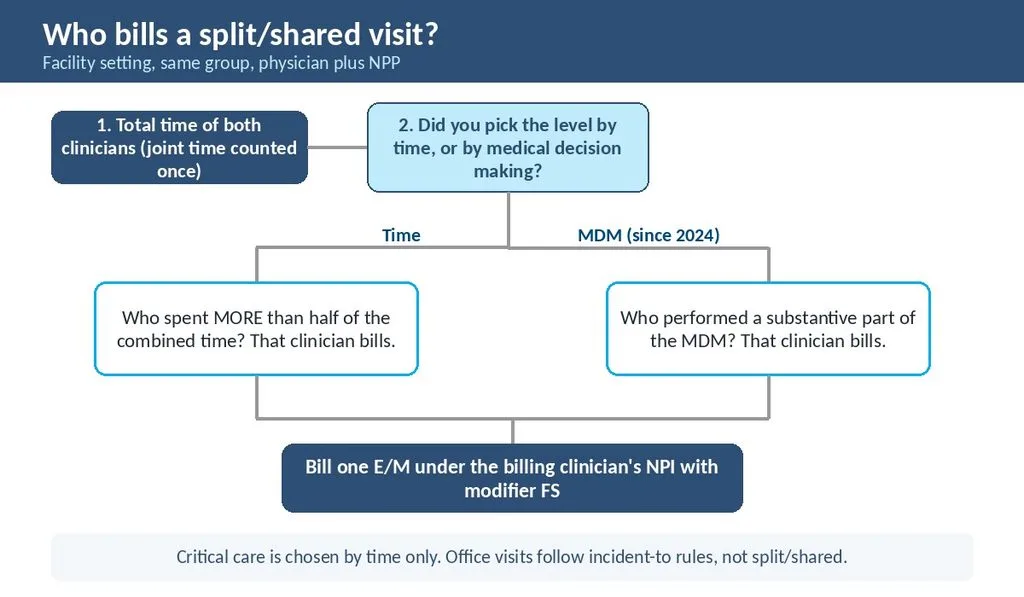
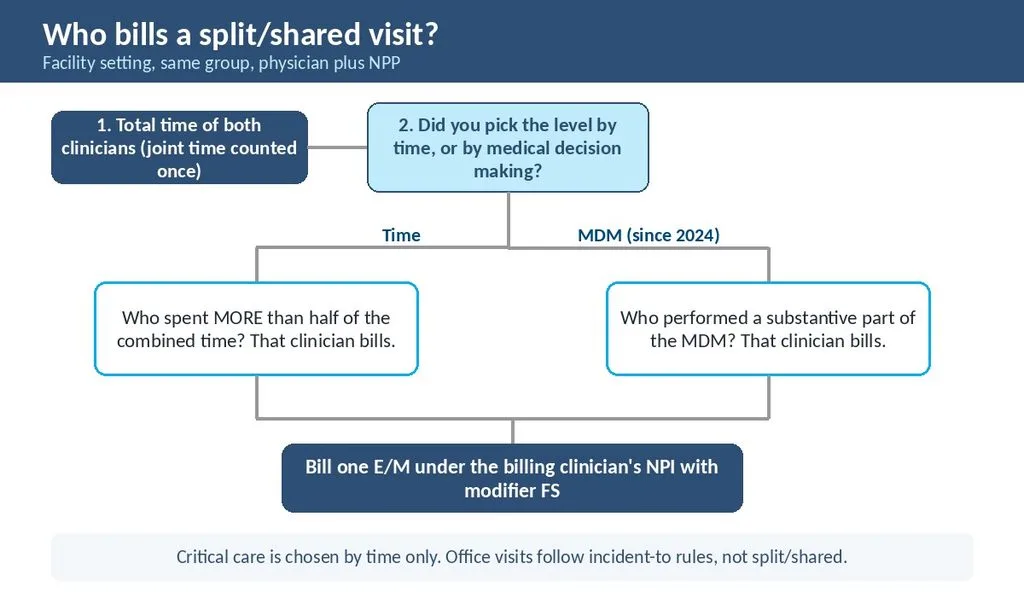
The practitioner who performs the substantive portion bills the visit, under that practitioner’s own name and NPI. Since January 1, 2024, Medicare defines the substantive portion as more than half of the total time spent by the physician and NPP together, or a substantive part of medical decision making (MDM).
The time route is arithmetic. Add physician solo time, NPP solo time and joint time, counting joint time once, then see who has more than half. The MDM route is a judgment: the billing practitioner makes or approves the management plan and takes responsibility for it, as the ACS guidance describes. Reviewing a note or countersigning is not enough.
What time counts?
Countable time includes preparing to see the patient, reviewing history, examining, counseling, ordering, communicating with other professionals, documenting and care coordination when not separately reported. Travel, separately reported services and general teaching do not count. The FCSO manual summary adds that only one clinician’s time counts during a joint discussion.
Does the billing practitioner need face-to-face contact?
One of the two must have in-person contact with the patient, but it does not need to be the billing practitioner. The substantive portion itself can occur without direct patient contact, for example chart review or plan development, if the time or MDM supports it and the record shows it.
What Must the Medical Record and Claim Show?
The record must identify both the physician and the NPP, and the practitioner who performed the substantive portion and bills the visit must sign and date it. The claim must carry modifier FS on the E/M code, whichever clinician bills. Missing any element leaves the claim open to denial or recoupment.
- Both clinicians named: the note shows who did what, with time or MDM for each.
- Substantive portion stated: the note says which clinician performed it and on what basis.
- Billing signature: the billing practitioner signs and dates the record.
- Modifier FS: append it to the E/M code, and to 99291 and 99292 for critical care.
A physician’s signature on its own is likely not enough to support billing at the physician’s rate, as legal commentary on the 2024 rule notes. Brief statements such as “agree with assessment and plan” do not show substantive MDM. The note must show what the physician decided or performed.
Modifier 52 cannot report a partial E/M visit, including a split or shared one, because Medicare does not pay partial E/M visits. If the visit was not completed, review the documentation and code what was done. Review how modifiers work together in our internal medicine modifier guide.
What Must the Medical Record and Claim Show?
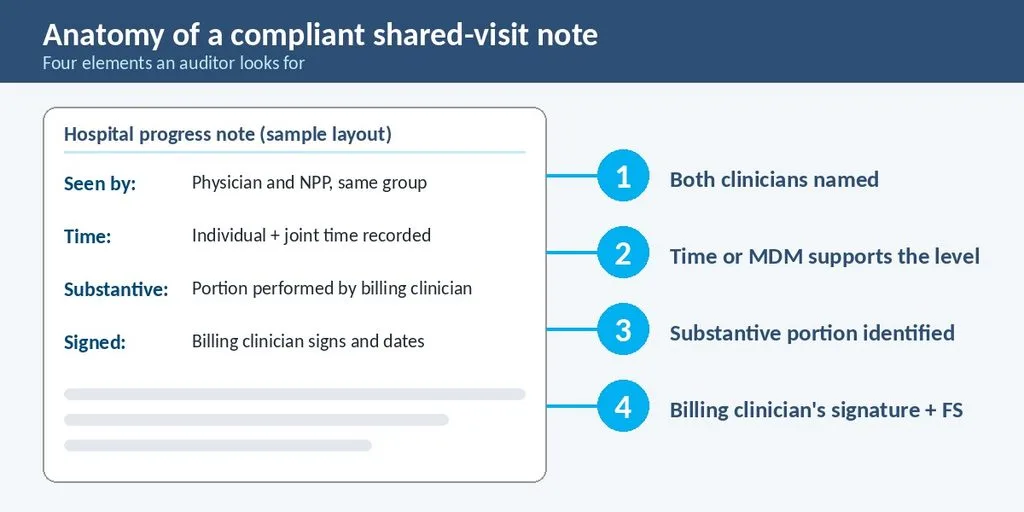
The record must identify both the physician and the NPP, and the practitioner who performed the substantive portion and bills the visit must sign and date it. The claim must carry modifier FS on the E/M code, whichever clinician bills. Missing any element leaves the claim open to denial or recoupment.
- Both clinicians named: the note shows who did what, with time or MDM for each.
- Substantive portion stated: the note says which clinician performed it and on what basis.
- Billing signature: the billing practitioner signs and dates the record.
- Modifier FS: append it to the E/M code, and to 99291 and 99292 for critical care.
A physician’s signature on its own is likely not enough to support billing at the physician’s rate, as legal commentary on the 2024 rule notes. Brief statements such as “agree with assessment and plan” do not show substantive MDM. The note must show what the physician decided or performed.
Modifier 52 cannot report a partial E/M visit, including a split or shared one, because Medicare does not pay partial E/M visits. If the visit was not completed, review the documentation and code what was done. Review how modifiers work together in our internal medicine modifier guide.
Do Critical Care and Prolonged Services Change the Rules?
Yes: critical care uses time only, and prolonged services follow the combined-time rule. Medicare sums total critical care time on one calendar date, and the clinician with more than half bills 99291 and any 99292 add-ons with FS. Prolonged services are billed only when time is used to select the visit level.
- Critical care: do not use MDM as the basis; total critical care time decides.
- Prolonged services: the practitioner with more than half the combined time, including prolonged time, reports the primary and add-on codes.
- Separate E/M on the same day: modifier 25 may apply only if the E/M occurred before critical care was needed, was medically necessary and did not duplicate it.
Because these rules are narrow, check with your MAC for global-surgery cases or unusual same-day combinations before billing, because those cases fall outside the standard shared-visit logic. In billing audits, a common pattern is that unusual combinations are billed on habit rather than checked. When a claim is denied despite correct FS use, follow the path in our guide to appealing a Medicare denial.
How Do Medicare Advantage, Medicaid and Commercial Plans Treat Shared Visits?
Other payers differ, and some mirror Medicare while others restrict or ignore the concept. Medicare Advantage plans often follow CMS but may add their own rules, Medicaid is state-specific, and commercial plans publish their own reimbursement policies. Treat Medicare’s rule as a starting point and confirm each payer in writing.
Split/shared visit rules by payer type
| Payer type | Typical expectation | Watch-outs | Where to check |
| Original Medicare | FS modifier; substantive portion by time or MDM; facility settings only | Office visits use incident-to rules | CMS MM13592; your MAC |
| Medicare Advantage | Often follows CMS, but plan policy governs | Some plans add documentation or authorization steps | Plan provider manual |
| Medicaid and CHIP | State-defined; some states follow Medicare, others restrict NPP billing | Rules and rates differ by state | State Medicaid manual |
| Commercial | Several publish split/shared policies requiring FS; others differ | Policies are reviewed on their own schedule | Payer reimbursement policy |
Illustrative summary; policies vary by payer and plan and change often. Examples reviewed: UnitedHealthcare commercial reimbursement policy (reviewed March 1, 2026) and Priority Health provider manual (updated June 17, 2025), both of which require modifier FS.
Teaching physician rules apply when residents are involved, so check those separately before sharing a visit with a trainee. For all payers, keep the written policy and its review date in your payer file, and ask the payer in writing when the language is unclear.
How Do You Bill a Shared Visit in Six Steps?
Bill a shared visit in six steps: confirm the setting, confirm the group, total the time or identify the MDM, pick the billing practitioner, document, then report with FS. Each step has a condition so staff do not default to the physician’s NPI.
- Confirm the setting. When the visit is in a facility setting, continue. When it is in the office, use incident-to rules instead.
- Confirm the group. When the physician and NPP are in the same group, continue. When they are in different groups, each bills only what that clinician fully performed.
- Total the time or identify the MDM. For time, add solo and joint time, counting joint time once. For MDM, identify who made or approved the plan.
- Pick the billing practitioner. When one clinician has more than half the time or the substantive MDM, that clinician bills. When both have equal time, document the choice.
- Document. Name both clinicians, state the substantive portion and its basis, and have the billing practitioner sign and date.
- Report with FS. Append FS to the E/M code, and submit the claim under the billing practitioner’s NPI.
An EHR integration that prompts for both clinicians’ time at charge entry removes much of the guesswork and keeps the time calculation out of the biller’s hands. Our team supports this kind of workflow design for groups that bill shared visits across several sites. Without one, add a short attestation template that captures the four documentation elements above.
Can You Test a Shared Visit? Worked Examples
Yes: three short examples cover the time test, the payment effect and the FS capture rate. Each gives the formula first, then a numeric walkthrough, so your team can repeat the math on its own encounters. All figures are illustrative and use no real client data or payer contract rates.
Example 1: who bills on time
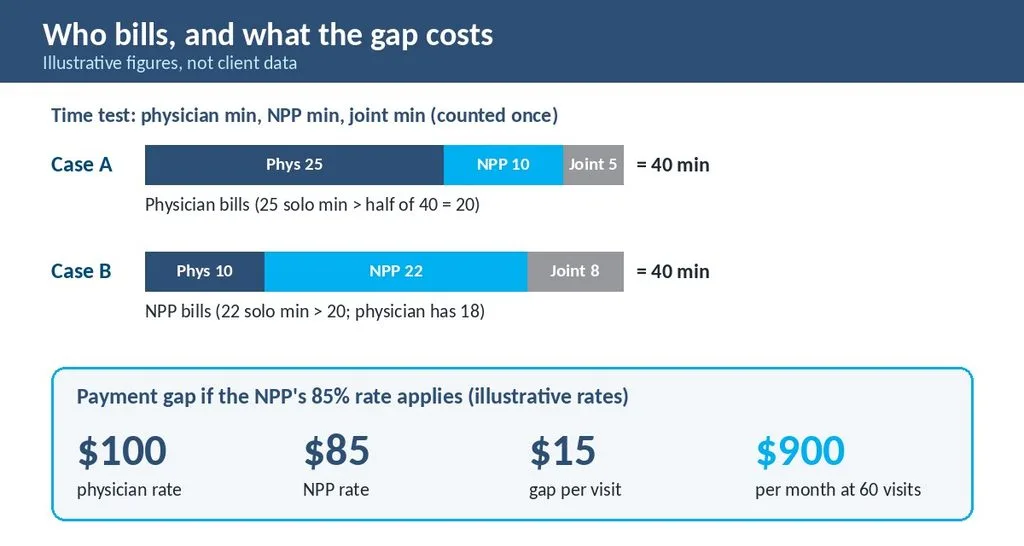
Formula: total time = physician solo + NPP solo + joint time counted once; the billing practitioner has more than 50% of total. Illustrative scenario (not an actual client record): physician 25 minutes solo, NPP 10 minutes solo, 5 minutes together. Total is 40 minutes and half is 20, so the physician bills with 25 minutes, even if the joint time is credited to the NPP.
Second case: physician 10 minutes, NPP 22 minutes, 8 minutes together. Total is 40 minutes again. The NPP has 22, more than 20, while the physician has 18 even with the joint time. The NPP bills. Level selection by total time: CPT’s 99232 requires at least 35 minutes and 99233 requires 50, so both cases support 99232, not 99233.
Example 2: the payment effect
Formula: monthly gap = (physician rate − NPP rate) × visits billed under the wrong NPI. Illustrative scenario (not an actual client record): suppose a visit allows $100 under the physician’s NPI and $85 under the NPP’s NPI, using illustrative rates, not actual fee schedule values. If 60 visits a month that belong under the NPP are billed under the physician, the gap is $15 × 60 = $900.
The dollar figure is small beside the compliance exposure. Billing under the wrong NPI is an overpayment issue that audits examine, and the exposure grows with every repeated encounter. Size it with a sample first, then fix the rule at charge entry so the error stops recurring.
Example 3: FS capture rate by site
Formula: FS capture rate = qualifying encounters billed with FS ÷ qualifying encounters × 100. Illustrative scenario (not an actual client record): a group audits 150 shared encounters. Hospital A has 78 of 80 with FS (97.5%), Hospital B 49 of 50 (98.0%) and the SNF 8 of 20 (40.0%). The blend is 135 of 150, or 90.0%.
A 90.0% blend looks acceptable, yet the SNF is not. A site-level view hides the weak spot inside the average. Comparing each site with its own baseline shows where charge-entry rules or templates are missing. One weak month is a signal to investigate, not a verdict on the team.
How Should You Use These Numbers Correctly?
Use the numbers to find the next question, not to grade a clinician. Compare hospital sites with hospital sites and SNFs with SNFs, because visit types and staffing differ, and read results by billing practitioner, not only by site. Do this when a group has several NPPs, since one clinician’s habits can pull a whole site down.
- Compare each site and each payer with its own history.
- When the NPP share of shared visits rises sharply, check for a template or workflow change before assuming a documentation problem.
- Review again each January, since CMS can change split/shared policy in the annual fee schedule rule.
Dashboards that show billing practitioner, modifier use and payer in one view make this routine; see our guide to revenue cycle metrics dashboards. Build the view monthly, and add it to the same meeting that reviews denials, so shared-visit results get regular attention.
How Long Until Shared-Visit Compliance Improves?
Timing depends on volume, staffing and how many sites bill shared visits. Most groups can fix templates and write a one-page rule within a few weeks, while audit results take a couple of review cycles to show. These are general planning ranges, not guarantees, and results vary by site and staffing.
- 2 to 4 weeks: add both-clinician and time fields to the note template and the FS prompt to charge entry.
- 30 to 90 days: FS capture rises and wrong-NPI corrections fall as staff use the rule.
- 3 to 6 months: monthly audits show whether results hold across sites and new hires.
Where Do Practices Misread the Rules?
Practices misread the rules when they rely on pre-2024 habits or on office workflows. Six mistakes recur in audits, and each has a short correction. Review them against your own charge-entry rules, and fix the ones that match your workflow first, since they carry the most repayment risk.
- Using the office incident-to workflow in a facility. Use FS in facilities only.
- Billing under the physician by default. Bill under whoever performed the substantive portion.
- Relying on a signature. Show the physician’s own work, not only a countersignature.
- Counting joint time twice. Count it once.
- Using stale 2022 and 2023 rules. Apply the 2024 rule: time or substantive MDM, with time only for critical care.
- Omitting FS. Append it to every qualifying E/M and critical care claim.
Split/Shared Visit Billing Quick Summary
- A split/shared visit is a facility E/M shared by a physician and an NPP in the same group.
- The practitioner who performs the substantive portion bills: more than half the time or substantive MDM.
- Critical care uses time only; joint time counts once.
- Append modifier FS; name both clinicians; the billing practitioner signs and dates.
- Office visits use incident-to rules, not FS.
- Practical targets in this guide are working conventions, not mandates from CMS or the AMA.
Self-Assessment: Is Your Shared-Visit Billing Audit-Ready?
Answer yes or no for your practice.
- Do you use FS only in facility settings and incident-to rules in the office?
- Does the note name both clinicians?
- Does the note state who performed the substantive portion and on what basis?
- Does the billing practitioner sign and date every shared visit note?
- Is joint time counted once?
- Is critical care shared on time only?
- Do you track FS capture by site?
- Do you track billing practitioner by NPI against actual time or MDM?
- Do you keep each payer’s written shared-visit policy on file?
Scoring guide: 8 to 9 yes answers suggest a mature process; keep reviewing quarterly. 5 to 7 yes answers suggest gaps worth closing in the next 60 days. 4 or fewer suggest shared visits carry audit risk and deserve priority attention.
When Is It Time to Bring in Outside Billing Help?
Outside help makes sense when shared-visit volume grows faster than your documentation and audit capacity. Outside support is a staffing and process decision, not a verdict on your team, and it fits best when the limits are visible in your own data. Watch for these signals:
- Most shared visits are billed under the physician without a documented basis.
- Nobody tracks FS capture or billing practitioner by site.
- Notes rarely show both clinicians’ time or MDM.
- SNF and hospital workflows use different rules with no written guide.
- Payers recoup or deny shared visits, and the cause is unclear.
Look for support that audits notes against the rule, reports by site and billing practitioner, tracks payer policies and trains clinicians on documentation. Ask how the vendor handles the annual CMS update and whether you receive audit findings, not only collections totals.
Aspect Billing Solutions is one example. The team provides end-to-end billing and coding, credentialing, eligibility verification and prior authorization, denial management, A/R follow-up and compliance support, with a dedicated agent assigned to each provider. Its medical billing audit services review documentation and coding against payer rules, and the full range appears on its services page. Results vary by practice. A self-check can start with our internal billing audit guide. For SNF-specific workflows, see our SNF billing page. Explore the revenue cycle management service.
Final Thoughts: Document the Substantive Portion, Then Bill It
Split/shared visit billing rules reduce to one question: who performed the substantive portion, and does the record show it? The January 1, 2024 substantive-portion definition, the time-only rule for critical care, the FS modifier and the signature requirement are published CMS rules. The capture-rate and audit routines are practical conventions.
The worked examples are illustrative. They show a real pattern: a blended capture rate can look fine while one site, one template or one default NPI quietly creates risk. Auditing by site and billing practitioner keeps it visible, and a common error to avoid is repeating a pre-2024 habit. Our guide on common billing errors covers the related patterns.
Your natural next question is how many of your shared visits would pass an audit today. A sample of 20 notes answers it. If you want a team to run that review and fix the workflow, see the revenue cycle management service from Aspect Billing Solutions.
Split/Shared Visit FAQs
What is a split/shared visit?
A split or shared visit is an E/M visit that a physician and a nonphysician practitioner in the same group both perform in a facility setting. It is billed once, by the practitioner who performed the substantive portion, with modifier FS. Office visits do not qualify and use incident-to rules instead.
How is the substantive portion defined?
Since January 1, 2024, the substantive portion is more than half of the total time spent by the physician and NPP together, or a substantive part of medical decision making. Critical care uses time only. Joint time counts once, and the billing practitioner must perform the substantive MDM.
Which modifier do you use for a split/shared visit?
Medicare requires modifier FS on the E/M code for split or shared visits, whichever clinician bills. For critical care, append FS to 99291 and any 99292 add-on codes. Modifier 52 cannot be used for partial split or shared E/M visits.
Can you bill a split/shared visit in the office?
No. Split or shared billing applies only in facility settings. Office visits with an NPP follow incident-to rules, which require specific supervision and a different billing practitioner. Using FS for an office visit signals the wrong workflow and may cause a denial or audit finding.
What is a good FS modifier capture rate?
No national body sets a target. A practical approach is to aim for every qualifying shared encounter, calculate capture by site and billing practitioner, and compare each with its own history. A high blended rate can hide one site or template that omits FS.
What is a good documentation audit pass rate for shared visits?
No published standard sets one. A practical approach is to audit a sample of shared visit notes each month for both clinicians named, the substantive portion stated, the billing signature and FS. Track the pass rate by site and investigate any site well below its usual level.
Sources and Methodology
(a) Published standards and definitions: CMS MLN Matters MM13592, Updates for Split or Shared Evaluation and Management Visits (released May 3, 2024; effective January 1, 2024; implementation August 1, 2024); Medicare Claims Processing Manual, Pub. 100-04, Chapter 12, section 30.6.18, as summarized by First Coast Service Options (FCSO); Noridian Medicare JE Part B Split or Shared Services page (updated July 21, 2025); American College of Surgeons guidance on reporting split/shared visits (effective January 1, 2024); CY 2024 Physician Fee Schedule final rule (88 FR 78818, November 16, 2023), as reported by Foulston Siefkin; CPT time thresholds for 99231 to 99233 as listed by Coding Ahead.
(b) Named benchmarking data providers: none cited in this guide.
(c) Practical or illustrative targets: the capture-rate and audit routines, planning ranges and all worked examples are working conventions or illustrations commonly used across industry sources. CMS, AMA, AAPC, MGMA, HFMA and X12 do not mandate them. The 85% payment rate for NPP billing is commonly reported in compliance sources; confirm it against the current fee schedule. I found no change to the split/shared definition in the CY 2026 physician fee schedule final rule summaries reviewed (AMA and HFMA); confirm with CMS before relying on this. Payer examples come from the UnitedHealthcare commercial reimbursement policy and the Priority Health provider manual.
(d) Survey and study data: none cited in this guide.
Results vary by practice, specialty, payer mix and state. Figures and rules reflect information available at the time of research in October 2026; CMS instructions and payer policies change on a regular cycle, so confirm current requirements with your MAC or payer before changing a workflow.