
CO-50 Denial Code (Medical Necessity): Causes & Fixes
CO-50 means the payer considers a service non-covered because it was not deemed medically necessary. The CO group code makes the provider liable unless a valid ABN shifts liability to the patient. Keeping CO-50 under 10% of all denials is an illustrative practical target, not a mandate.
Medical necessity denials rank among the most expensive denials to leave unworked because providers have already delivered the care. The CO-50 denial code (medical necessity) can come from a diagnosis mismatch, thin documentation, or a service that truly falls outside coverage. This guide explains how coverage determinations, the Advance Beneficiary Notice, and your notes decide the outcome. It includes worked examples and a self-assessment checklist near the end.
Medical Necessity Figures at a Glance
| Metric | Practical Target/Range | Review Frequency | Primary Source |
| Medicare redetermination deadline | 120 days from receipt of notice | Per claim | CMS published rule |
| ABN before expected-denial services | 100% of cases | Weekly | CMS rule; practical target |
| Diagnosis checked against LCD pre-bill | 100% of LCD-covered services | Daily | Practical target |
| Clean claim rate | 95% or higher | Monthly | Commonly reported range |
| Overall denial rate | 5% or lower | Monthly | Commonly reported range |
| CO-50 share of all denials | Under 10% | Monthly | Illustrative target |
| CO-50 appeal filed within | 30 days of denial | Weekly | Practical target |
Table 1. “CMS published rule” is Medicare policy. The ABN requirement is a CMS rule; the 100% figure is a practical target. “Commonly reported range” is widely cited, not mandated. “Illustrative” targets are working goals.
Why Payers Deny for Medical Necessity?
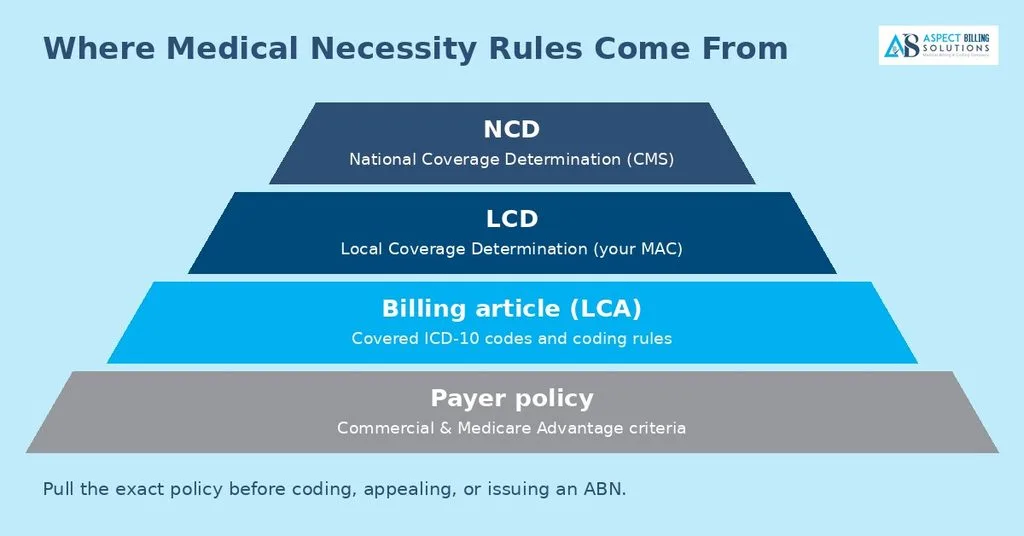
CARC 50 indicates that the payer considers the service non-covered because it does not deem the service medically necessary.. Unlike CO-45 contractual adjustments, this is a coverage decision about the care itself. For Medicare, the rules come from National Coverage Determinations (NCDs) and Local Coverage Determinations (LCDs), plus billing articles that list covered diagnosis codes. Commercial and Medicare Advantage plans use their own medical policies. Remark code N115 often points to the specific LCD involved.
The Four Most Common Triggers
Most CO-50 denials trace to one of four gaps. The diagnosis code does not appear on the policy’s covered list or lacks sufficient specificity. The note does not document the criteria, such as failed conservative treatment before an MRI. The frequency limit was exceeded. Or the service is truly outside coverage. Accurate, specific diagnosis coding closes the first gap; our ICD-10 coding errors guide covers common mistakes.
CO-50 Versus PR-50: The ABN Decides
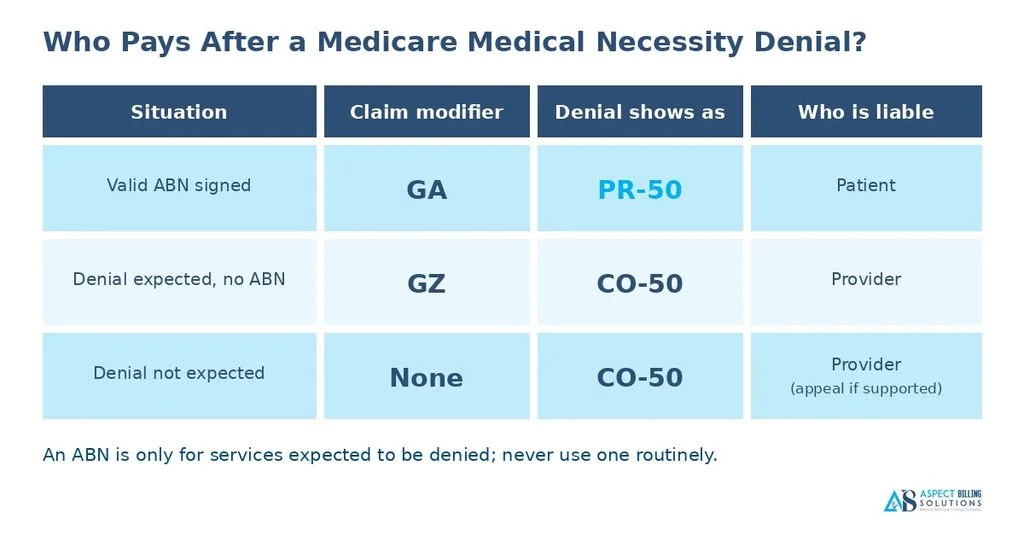
For Original Medicare, liability hinges on the ABN. The CMS ABN booklet (MLN006266) explains that you issue an ABN before a service you expect Medicare to deny, and report modifier GA. The denial then posts as PR-50, and the patient may be billed. Without an ABN, you report GZ. CMS transmittal R2148CP directs contractors to deny GZ lines with group code CO and CARC 50, leaving the provider liable. Providers should never use an ABN routinely for services they expect Medicare to cover.
Worked example — revenue shifted by valid ABNs. Formula: expected-denial services × allowed amount. Illustrative scenario (not an actual client record): a practice performs 25 expected-denial screening services a month at $120 each. With valid ABNs and GA, $3,000 becomes patient responsibility. Without ABNs, the full $3,000 is written off as CO-50.
Commercial and Medicare Advantage Plans
ABNs apply to Original Medicare only. Commercial and Medicare Advantage plans handle medical necessity through prior authorization and their own notice rules. For high-cost imaging or procedures, authorization is the stronger safeguard; see our guide to pre-authorization for high-value procedures.
Appealing a CO-50 That Should Be Paid
When the service met the policy criteria, appeal. First, pull the exact LCD or medical policy cited. Next, confirm that the coding team assigned the most specific diagnosis code the medical record supports. Then build a packet with the note, test results, prior treatments, and a letter of medical necessity. You must file Medicare redeterminations within 120 days of receiving the initial determination. Our Medicare appeals guide walks through each level.
Worked example — appeal deadline. Formula: date the notice was received + 120 days. A denial received on March 16 must be appealed by July 14. Filing within 30 days, a practical target, leaves time to request missing records.
Worked example — overturn rate. Formula: overturned CO-50 appeals ÷ CO-50 appeals filed × 100. With 18 of 30 overturned, the rate is 60%. A low rate may indicate that providers file appeals for services that fall outside coverage. For a growing backlog, our denial management and appeals service can take on appeal work.
Finding Where CO-50 Comes From?
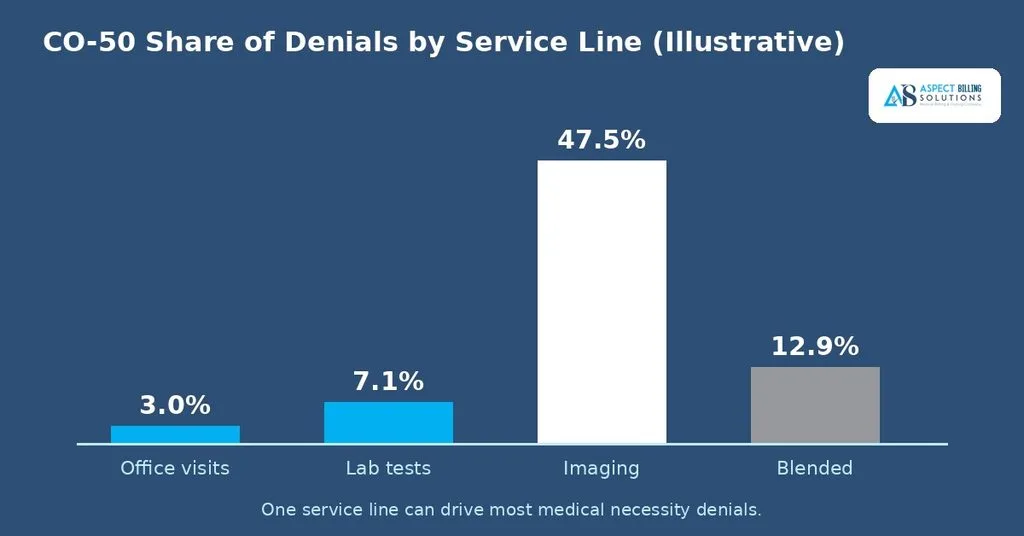
CO-50 share of denials equals CO-50 denials ÷ all denials × 100. With 54 of 420 denials coded CO-50, the share is 12.9%, above an illustrative 10% target.
| Service line | All denials | CO-50 denials | CO-50 share |
| Office visits | 200 | 6 | 3.0% |
| Lab tests | 140 | 10 | 7.1% |
| Imaging | 80 | 38 | 47.5% |
| Blended | 420 | 54 | 12.9% |
Table 2. Illustrative figures, not from a named source. Actual rates vary; verify against your own data.
The blended 12.9% looks only moderately high. Yet imaging produces 38 of 54 CO-50 denials, about 70%. That usually means orders arrive without qualifying diagnoses or documented conservative care. Fixing the ordering workflow for one service line solves most of the problem. If documentation is the root cause, coding support services can review charts before claims go out.
Comparing CO-50 Rates Fairly
Compare CO-50 rates only against practices with similar specialties, services, and payer mix. A practice ordering heavy imaging will naturally see more medical necessity edits than one focused on office visits. Use the same reporting period. One high month is a signal to investigate, not a verdict.
How Soon Medical Necessity Fixes Work?
| Fix | Early signs | Fuller results |
| Pre-bill diagnosis check against LCDs | Next billing cycle | 60 days |
| ABN workflow for expected denials | 30 days | 60–90 days |
| Ordering-provider documentation training | 30–60 days | 3–6 months |
| Appeal triage and backlog rework | 30 days | 90–120 days |
Table 3. General planning ranges only, not a guarantee for any specific practice.
CO-50 Denial Code (Medical Necessity): Recap
- CO-50 means the payer did not accept the service as medically necessary.
- NCDs, LCDs, and billing articles set Medicare’s rules; plans set their own.
- A valid ABN with GA turns a Medicare CO-50 into PR-50; GZ keeps it CO-50.
- Medicare redeterminations are due within 120 days of receipt.
- 95% clean claims and 5% denials are commonly reported targets, not mandates.
Check Your Medical Necessity Workflow
Answer yes or no, then count your yes answers.
- Are diagnoses checked against the LCD before billing?
- Are ICD-10 codes coded to the highest supported specificity?
- Is an ABN issued before every expected-denial Medicare service?
- Are GA and GZ used only when they match the ABN on file?
- Are prior authorizations obtained for commercial imaging and procedures?
- Are CO-50 appeals filed within 30 days?
- Is CO-50 under 10% of all denials?
- Is your clean claim rate 95% or higher?
- Do you track CO-50 by service line and ordering provider?
Scoring: 8–9 yes = strong workflow. 5–7 = targeted fixes needed. 0–4 = a front-end and documentation review is overdue.
When Outside Denial Support Helps?
Some signs show your handling of the CO-50 denial code (medical necessity) has reached its limits. Imaging or lab denials keep repeating. ABNs are missing, outdated, or used routinely. Appeals are filed late or without policy citations. Nobody tracks which ordering providers drive denials. Good outside support offers LCD-aware coding, ABN workflow checks, appeal packets, and service-line reporting. Aspect Billing Solutions follows that structure. Each provider gets a dedicated agent across end-to-end revenue cycle management: coding, billing, credentialing, denial management, and HIPAA compliance. Results vary by practice.
Final Considerations
Most instances of the CO-50 denial code (medical necessity) are preventable at the front end. Match each diagnosis to the applicable coverage policy, document the required criteria, and issue an ABN when you expect a denial. Appeal quickly when the care met the rules.
CMS publishes the 120-day redetermination deadline and the ABN, GA, and GZ rules as standards. Industry reports commonly cite clean claim rates of 95% and denial rates of 5%. The CO-50 share, pre-bill check, and appeal-timing targets are practical or illustrative goals.
Frequently Asked Questions
What does CO-50 mean?
It means the payer considers the service non-covered because it determined that the service was not medically necessary. The provider is liable under the CO group code.
Can I bill the patient for a CO-50 denial?
Not under CO-50. With a valid Medicare ABN and modifier GA, the denial posts as PR-50, allowing you to bill the patient.
What is the difference between CO-50 and PR-50?
CO-50 leaves the provider liable. PR-50 shifts liability to the patient, usually because the patient signed a valid ABN.
Can I appeal a CO-50 denial?
Yes. Submit the policy criteria, documentation, and a letter of medical necessity within the payer’s deadline.
Does an ABN apply to Medicare Advantage?
No. ABNs are for Original Medicare, and Medicare Advantage plans use their own processes.
What is a good CO-50 rate?
No official figure exists. Keeping CO-50 under 10% of denials is an illustrative target; compare against similar specialties.
What is a good appeal overturn rate for CO-50?
No official benchmark exists. A low rate may mean appeals target services that truly fall outside coverage.
What is a good clean claim rate?
Many practices aim for 95% or higher, a commonly reported range. It is not a regulatory standard.
Sources and Methodology
(a) Published standards: X12 CARC 50 definition; CMS MLN006266 on ABNs; CMS transmittal R2148CP on GA, GY, and GZ; Medicare 120-day redetermination rule.
(c) Practical and illustrative targets: clean claim and denial figures are commonly reported ranges. CO-50 share, pre-bill check, and appeal-timing targets are practical or illustrative, and worked examples use invented numbers.
(b, d) Named benchmarking providers and survey data: none used. Actual results vary by practice; figures reflect information available in September 2026.