
Reliable Neurology Revenue Cycle Management in Illinois
Reliable neurology revenue cycle management in Illinois means a process that keeps performing consistently regardless of staff turnover, a single person being out, or which Illinois Medicaid managed care plan a patient carries — covering everything from eligibility verification through final payment, not just claim submission. The clearest sign of reliability is low month-to-month variance in denial and collection rates, not just a good average. A partner is reliable if the numbers stay steady when something normally would have gone wrong.
Most billing comparisons focus on a single average: this month’s denial rate, this quarter’s clean claim rate. But an average can look perfectly fine while hiding wide swings from month to month — the real signature of an unreliable process. This guide looks at what “reliable” actually means for neurology revenue cycle management in Illinois, walks through the consistency metrics that reveal a fragile process before it breaks, and covers the state-specific factors — Illinois’ prompt pay law, the dual-layer Medicaid enrollment system, and Medicare’s Jurisdiction 6 contractor — that a reliable partner has to track. A self-assessment checklist near the end lets you score your own setup against the same numbers.
The Reliability Baseline for Illinois Neurology Practices
Illinois Neurology RCM Reliability Baseline
| Metric | Practical Range | Review Frequency | Primary Source |
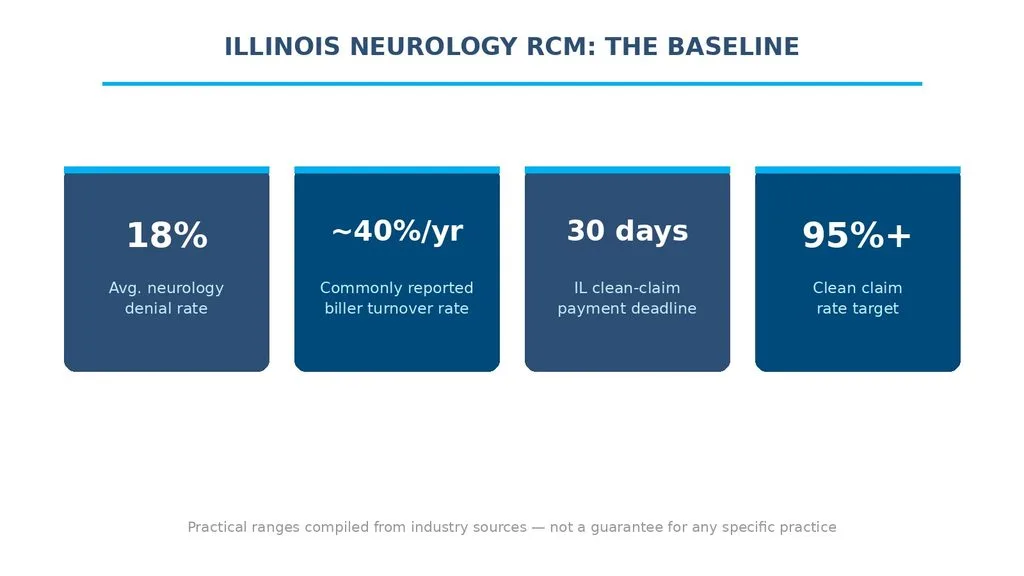
| Neurology-specific denial rate | ~18% average reported, vs. 5%-10% for other specialties | Monthly | Attributed to MGMA benchmarking by industry publications* |
| Clean claim rate | 95%-98% target; 98%+ best-in-class | Monthly | HFMA (MAP Keys) / MGMA DataDive |
| Days in A/R | 30-40 days target; 25 or fewer best-in-class | Monthly | HFMA (MAP Keys) / MGMA DataDive |
| Net collection ratio | 95%-99%; 98%-100% best-in-class | Quarterly | HFMA (MAP Keys) / MGMA DataDive |
| Billing/business-operations staff turnover | 33.3% in 2022 (front-office support staff turnover was higher, at 40%) | Annually | MGMA 2023 DataDive Practice Operations report* |
| Illinois clean-claim payment deadline | Insurer must pay within 30 days of a clean claim; 9% annual interest on late payment (self-funded ERISA plans may not be covered) | Statutory, not a KPI | 215 ILCS 5/368a(c), Illinois Insurance Code |
Source key: “MGMA / HFMA” = a published benchmarking figure directly attributable to that named association. “*Attributed to MGMA by industry publications” = secondary sources (e.g., specialty billing/EHR vendors) name MGMA as the origin, but this guide has not independently located and confirmed the primary MGMA report and table; treat these two rows as reported estimates, not confirmed primary figures. The Illinois deadline is a legal requirement, not a performance target to hit or miss, and may not apply to self-funded employer plans governed by federal ERISA law rather than state insurance law.
What “Reliable” Actually Means in Revenue Cycle Management?
A single good month does not make a billing process reliable. Reliability is about process consistency — whether the same result shows up whether or not a key staff member is out sick, whether or not a payer changes its rules mid-quarter, and whether or not a claim happens to be routed through a Medicaid managed care plan instead of fee-for-service. Two practices can post the same average denial rate over a year while one swings wildly month to month and the other stays steady — only one of those is actually reliable.
The Turnover Problem
MGMA’s 2023 DataDive Practice Operations report found a 33.3% turnover rate among business operations support staff — the category that includes medical billing — in 2022, with front-office support staff turnover running even higher, at 40%. Every departure resets institutional knowledge of payer-specific rules, authorization requirements, and appeal deadlines — exactly the kind of knowledge that does not transfer cleanly through a handoff. A billing process that depends on one specific person remembering how a particular payer behaves is not a reliable process, no matter how good that person is.
The Standardization Problem
An undocumented process is a process that only works when the right person is available to run it. Reliable revenue cycle management means the workflow for eligibility checks, prior authorization logging, and denial follow-up is written down and followed the same way regardless of who is covering that day — not held together by tribal knowledge.
The Two-Layer Illinois Medicaid Problem
Illinois Medicaid enrollment is a two-part process. Providers first enroll with the Illinois Department of Healthcare and Family Services (HFS) through the IMPACT system — this is the state-level foundation. Separately, providers must also contract and credential with each individual HealthChoice Illinois (HCI) managed care organization they want to participate with: currently Aetna Better Health, Blue Cross Community Health Plans (BCCHP), Meridian Health Plan, Molina Healthcare, and YouthCare (for youth in care) statewide, plus CountyCare Health Plan in Cook County only. Being enrolled in IMPACT does not automatically mean a provider is credentialed with any of these plans.
This dual-layer structure is a common point of failure for a billing process that treats “Illinois Medicaid” as one category. A reliable process tracks state enrollment and each individual MCO’s credentialing status separately, because a lapse in either layer stops claims from that plan cold, regardless of how clean the claim itself is. Plan list current as of September 2026 — Illinois periodically adds or retires HealthChoice Illinois plans, so confirm the current roster against HFS’s own page before relying on it.
Medicare Claims Follow a Separate Track: Jurisdiction 6
Neurology practices that also see Medicare patients are dealing with a third system alongside commercial payers and the two-layer Medicaid structure above: National Government Services (NGS) is the Medicare Administrative Contractor for Jurisdiction 6, covering Illinois, Minnesota, and Wisconsin, and processes Medicare Part A and Part B fee-for-service claims for the region under a contract most recently re-awarded in 2020. A reliable process keeps NGS-specific claim edits and appeal timelines separate from commercial and Medicaid workflows rather than treating all payers as interchangeable.
Illinois’ 30-Day Clean Claim Clock
Under 215 ILCS 5/368a(c), Illinois insurers, HMOs, managed care plans, health care plans, preferred provider organizations, and third-party administrators must pay a properly documented (“clean”) health care claim within 30 days of receipt of due written proof of loss. If a payor fails to pay within that window, the payee is entitled to 9% annual interest starting from the 30th day. A payor must also notify a provider within 30 days if a claim is missing documentation.
That deadline is only useful to a practice that consistently submits clean claims — a payer with nothing to pay on time cannot violate a prompt pay law. One important limit: 215 ILCS 5/368a governs state-regulated insurance products. Self-funded employer health plans, which are common with larger employers, are generally governed instead by the federal ERISA statute and are not automatically subject to this state-law deadline — a distinction worth confirming payer by payer rather than assuming statewide coverage.
The Metrics That Reveal (Un)Reliability
The formulas below show what to calculate and how to check whether the result is stable month over month, not just what it averages to.
Denial Rate — and Its Monthly Spread
Formula: Denial Rate = (Denied Claims ÷ Total Claims Submitted) × 100, calculated separately for each month rather than averaged across a quarter.
Worked example: a practice’s denial rate over six months reads 9%, 21%, 11%, 19%, 10%, 20% — averaging 15%, which looks roughly in line with the commonly reported neurology range. But that average hides a swing of 12 percentage points month to month, which points to an inconsistent process — possibly tied to staff turnover or a payer whose rules keep tripping up whoever happens to be handling that claim type that month.
Days in A/R — Trend, Not Snapshot
Formula: Days in A/R = Total Accounts Receivable ÷ (Total Charges ÷ Number of Days in the Period), tracked as a monthly trend line rather than a single point-in-time number.
Worked example: a practice’s days in A/R reads 32, 34, 33 for three consecutive months — inside the 30-40 day benchmark range and, just as importantly, stable. A practice bouncing between 28 and 52 days over the same period is operating inside the same average but with a far less predictable cash flow.
Why a Steady Average Can Hide an Unreliable Process?
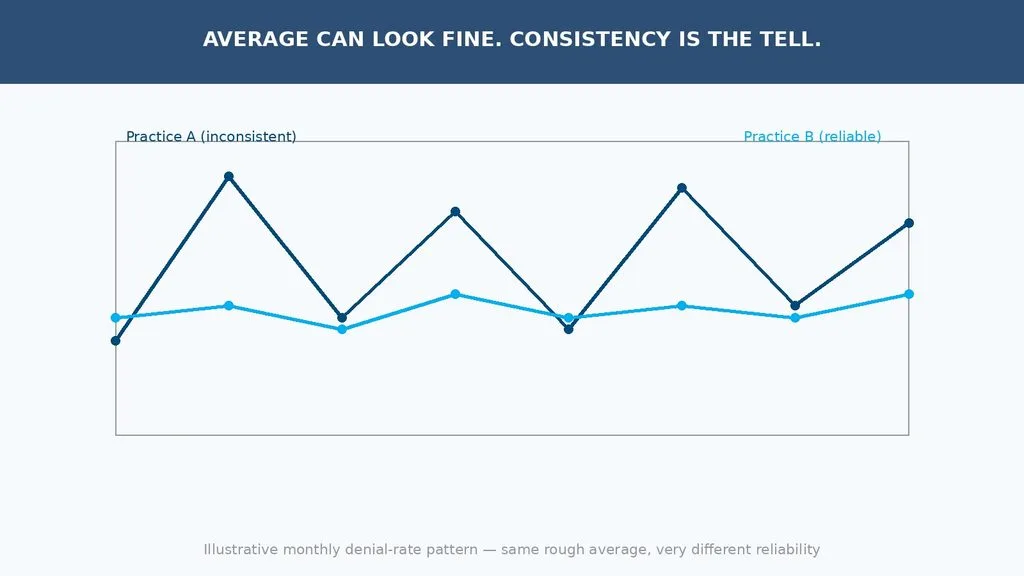
The illustration below shows how two practices can report similar-looking averages while one is far more predictable than the other.
Average vs. Consistency — an Illustrative Comparison
| Practice | 6-Month Avg. Denial Rate | Monthly Range | Reliability Signal |
| Practice A | ~15% | 9%-21% | Wide swing — inconsistent process |
| Practice B | ~10.5% | 9%-12% | Narrow swing — consistent process |
Illustrative — not pulled from a single named data source or a specific practice. Actual figures vary; track your own monthly range to see where you fall.
Practice A’s average denial rate is worse than Practice B’s, but the gap in month-to-month predictability is the bigger operational problem: a practice cannot budget, staff, or plan around a number that could land anywhere from 9% to 21% in a given month. Tracking the range, not just the average, is what actually reveals reliability.
What to Actually Look for in a Reliable RCM Partner?
Documented, Backup-Covered Workflows
Ask whether the process for eligibility checks, prior authorization, and denial follow-up is written down and whether more than one person can run it. If the answer depends on one specific staff member being available, the process is not reliable yet.
Dual-Track Illinois Medicaid Tracking
A partner working Illinois Medicaid claims should be able to show separate status tracking for IMPACT state enrollment and for each individual HealthChoice Illinois MCO — not a single “Medicaid enrolled” checkbox.
Monthly Variance Reporting, Not Just Averages
A reporting package that only shows a rolling quarterly or annual average hides exactly the kind of swings that reveal an unreliable process. Ask to see month-by-month, not just the summary line.
For a fuller definition of the moving parts involved, see what revenue cycle management is.
A dashboard-building walkthrough is covered in building a revenue cycle metrics dashboard, and common failure points in common RCM mistakes costing practices thousands.
Credentialing delays specifically are covered in credentialing mistakes that delay payments.
For neurology-specific coding detail, see neurology billing CPT codes.
How Aspect Billing Solutions Builds In Reliability?
The criteria above only matter if a billing partner actually operates that way. Aspect Billing Solutions’ process is built around a few specific commitments:
- A dedicated agent per provider, so payer-specific knowledge does not walk out the door with staff turnover.
- Denials tracked by payer segment on a monthly cadence, so a spike gets caught before it becomes a pattern.
- IMPACT state enrollment and each HealthChoice Illinois MCO’s credentialing tracked separately, not as one blended “Medicaid enrolled” status.
- Quarterly credentialing reviews, rather than discovering a lapse only after a claim bounces.
This describes process and structure, not a performance guarantee — actual results depend on a practice’s starting point, payer mix, and claim volume. A free consultation starts with a look at your own numbers rather than a general promise.
Reading Consistency, Not Just Averages
A benchmark is only useful compared like-for-like: same specialty mix, a similar payer blend, and the same reporting period. For reliability specifically, the more useful comparison is a practice against its own history rather than an industry average — track whether this month sits close to last month, not just whether the yearly number looks acceptable.
How Long Reliability Takes to Show Up?
Reliability Timeline
| Milestone | What to Expect | General Timeframe |
| Process documentation | Workflows written down and cross-trained across staff | 30-45 days |
| Dual Medicaid tracking in place | IMPACT and each HCI MCO’s status tracked separately | 30-60 days |
| Variance narrows | Month-to-month denial and collection rates stabilize | 90-150 days |
| Full reliability picture | Enough monthly data to confirm consistency, not just a good average | 120-180 days |
These are general planning ranges based on commonly reported RCM transition patterns, not a guarantee for any specific practice. Reliability is inherently something that shows up over several reporting periods, not a single month — a practice will not be able to confirm consistency until it has enough monthly data points to see a pattern.
What This Comes Down To for Illinois Neurology Practices?
- A good average does not prove reliability — check the month-to-month range, not just the mean.
- Billing/business-operations staff turnover ran 33.3% in 2022 per MGMA — a real continuity risk for undocumented processes.
- Illinois Medicaid requires tracking two separate layers: state IMPACT enrollment and each HealthChoice Illinois MCO’s credentialing.
- Illinois’ 30-day prompt pay law (215 ILCS 5/368a) only helps once a claim is clean and complete.
- Neurology denial rates are reported near 18%, versus 5%-10% industry-wide, attributed to MGMA by secondary industry sources (not independently confirmed — see Sources & Methodology).
- Expect documentation and dual-tracking within 30-60 days, and a full reliability picture within four to six months.
Does Your Billing Process Actually Hold Up?
Answer yes or no to each question, then check the scoring guide below.
- Is your billing workflow documented, not held in one person’s head?
- Does every billing role have a trained backup for when someone is out?
- Do you track Illinois Medicaid IMPACT enrollment and each HCI MCO’s credentialing separately?
- Is your denial rate reported monthly, showing the range, not just the average?
- Is your clean claim rate at or above 95%?
- Is your days-in-A/R trend stable month to month, not swinging widely?
- Is credentialing status reviewed at least once per quarter for every payer?
- Would your billing process keep running the same way if your current biller left tomorrow?
- Do you know your actual month-to-month denial rate range, not just the yearly average?
- Are prior authorization numbers and expiration dates logged before the date of service?
Scoring: 8-10 “yes” answers suggests a genuinely reliable, well-documented process. 5-7 suggests some real continuity risk exists, often around staff dependency or Medicaid dual-tracking. 0-4 suggests your current setup is more fragile than it looks on a good month, and a fuller review is worth prioritizing.
When Reliability Becomes the Deciding Factor?
A few signals tend to show up together when an in-house or existing billing setup has become unreliable, even if the yearly average still looks acceptable:
- Denial rate swings widely from month to month rather than staying in a predictable range.
- A recent staff departure caused a visible drop in performance that took weeks to recover from.
- Nobody can say with confidence whether every provider is currently credentialed with every HealthChoice Illinois MCO.
- The billing process exists mostly as institutional knowledge rather than a written workflow.
- Reporting shows a single average number rather than a monthly trend.
When those signals appear together, the practice is exposed to disruption risk that a good average is currently hiding — the gap becomes visible the next time a key person is out or a payer changes its rules.
Illustrative scenario (not an actual client record): using the denial-rate variance example from earlier in this guide, a practice moving from a 9-to-21-point monthly swing to something closer to a stable 9-to-12-point range would see its worst months improve the most — potentially converting several thousand dollars a month of the volatility in its worst-performing months into steadier, more predictable revenue. This is hypothetical math to illustrate the scale of a consistency gap, not a projection for any specific practice’s results.
Aspect Billing Solutions provides HIPAA-compliant medical billing and coding for US healthcare providers, including Illinois neurology practices, covering claim and denial management, eligibility verification, prior authorization, accounts receivable follow-up, and credentialing — through a dedicated agent per provider rather than a rotating queue. The company offers a free, no-commitment consultation that looks at your actual monthly variance, not just your yearly average, before any quote is given.
Learn more at aspectbillingsolutions.com.

Final Considerations
Reliable neurology revenue cycle management in Illinois means the process holds up the same way whether or not a key staff member is out, whether a claim routes through IMPACT or one of the HealthChoice Illinois MCOs, and whether a payer changes its rules mid-quarter — not just a good number once.
A few numbers in this guide are firm, published figures: HFMA’s benchmark ranges for clean claim rate and days in A/R, MGMA’s DataDive turnover figures, and Illinois’ 215 ILCS 5/368a(c) 30-day clean-claim payment deadline (with the noted ERISA carve-out). Others, including the neurology-specific denial rate figure and the variance illustration, are attributed to MGMA by secondary industry sources rather than confirmed against a primary named report, or are explicitly illustrative. Keep that distinction in mind when comparing your own numbers against anything in this guide.
Whichever path an Illinois neurology practice takes, tracking the monthly range alongside the average — not the average alone — is the single habit most likely to reveal whether a billing process is actually reliable.
Frequently Asked Questions
Reliable neurology revenue cycle management in Illinois
What does “reliable” mean for neurology revenue cycle management?
It means the process performs consistently month to month, regardless of staff turnover, payer changes, or which specific plan a claim routes through — not just a good average for the year. The clearest sign is low variance in denial and collection rates over time.
What is a good denial rate for a neurology practice?
A denial rate under 10% is a commonly cited practical target, with top-quartile practices reporting under 5%, per MGMA and HFMA benchmarking. Neurology practices often run higher due to EEG, EMG, and imaging authorization requirements, so the trend and its stability matter more than any single month’s figure.
What is a good clean claim rate for an Illinois neurology practice?
A clean claim rate of 95% or higher is the commonly cited target, with best-in-class practices reaching 98% or above. In Illinois specifically, a high clean claim rate is what actually lets a practice benefit from the state’s 30-day prompt pay deadline.
Does Illinois require insurers to pay claims within a set number of days?
Yes. Under 215 ILCS 5/368a, insurers, HMOs, and managed care plans must pay a properly documented claim within 30 days of receipt, with 9% annual interest owed on late payments. That protection only applies once a claim is clean and complete.
How does Illinois Medicaid credentialing work for neurology providers?
Illinois Medicaid enrollment has two separate layers: state-level enrollment through HFS via the IMPACT system, and separate credentialing with each individual HealthChoice Illinois managed care plan a provider wants to join. Completing one does not automatically complete the other.
What is a good days-in-A/R number, and why does its trend matter more than one snapshot?
A days-in-A/R range of 30 to 40 days is the commonly cited target, with best-in-class practices reaching 25 days or fewer, per MGMA benchmarking. A number that stays inside that range consistently reflects a more reliable process than one that occasionally lands there but swings widely month to month.
Who processes Medicare claims for Illinois neurology practices?
National Government Services (NGS) is the Medicare Administrative Contractor for Jurisdiction 6, which covers Illinois, Minnesota, and Wisconsin, and administers Medicare Part A and Part B fee-for-service claims for the region.
How much does staff turnover actually affect billing reliability?
MGMA’s 2023 DataDive Practice Operations report found 33.3% turnover among business operations support staff (including billing) in 2022, and every departure resets institutional knowledge of payer-specific rules unless that knowledge is documented rather than held by one person. A documented, cross-trained process is far less exposed to this risk than one built around a single specialist.
Should a small Illinois neurology practice worry about reliability if its average numbers look fine?
Yes — a good yearly average can hide wide month-to-month swings that only become visible during a staffing gap or a payer policy change. Reviewing the monthly range behind that average, not just the average itself, is the only way to know whether a process is actually stable.
How long does it take to build a genuinely reliable billing process?
Documenting workflows and setting up dual-layer Illinois Medicaid tracking typically takes 30 to 60 days, while confirming actual month-to-month consistency takes longer — generally four to six months of stable reporting before a practice can be confident the reliability is real and not a temporary run of good months.
Sources & Methodology
(a) Published standards and definitions, verified directly against the primary source:
- 215 ILCS 5/368a(c), Illinois Insurance Code — the 30-day clean-claim payment deadline and 9% annual interest penalty. Full statutory text: ilga.gov/legislation/ilcs/documents/021500050K368a.htm
- Illinois Department of Healthcare and Family Services (HFS) — IMPACT enrollment system and current HealthChoice Illinois managed care plan list. hfs.illinois.gov/medicalclients/managedcare.html
- CMS Medicare Administrative Contractor records confirming National Government Services as the Jurisdiction 6 (Illinois, Minnesota, Wisconsin) Part A/B contractor, most recently re-awarded July 2020.
(b) Named benchmarking data providers, cited but not independently re-verified against the primary report:
HFMA’s MAP Keys framework, which defines and publishes target ranges for clean claim rate, days in A/R, and net collection ratio; MGMA DataDive Practice Operations benchmarking, which independently tracks the same three metrics plus denial rate and staffing turnover and is the source for the 2023 DataDive report’s 33.3% 2022 turnover figure for business operations support staff, as reported in third-party industry analyses. The neurology-specific 18% denial rate figure is attributed to MGMA benchmarking by specialty billing and EHR vendor publications; this guide located that attribution in secondary sources but did not independently confirm it against MGMA’s original report and table, so it should be treated as a reported estimate rather than a confirmed primary statistic.
(c) Practical and illustrative content:
The two-practice variance comparison table and the six-month denial-rate worked example are explicitly labeled illustrative — built to demonstrate the average-vs-consistency concept, not drawn from a specific practice’s real data.
(d) Survey data:
No additional named survey data was used beyond the sources listed above.
Legal note: 215 ILCS 5/368a applies to Illinois-regulated insurance products. Self-funded employer plans are generally governed by federal ERISA law instead and may not be covered by this state deadline. This is general information, not legal advice — confirm plan-specific coverage with counsel where it matters to a claim.
Actual results and consistency vary by practice, staffing, payer mix, and claim volume. Figures in this article reflect information available at the time of research (September 2026) and are not a guarantee for any specific practice.