
Best Internal Medicine Denial Management Billing in Kentucky
The best internal medicine denial management billing in Kentucky combines Kentucky-specific payer knowledge, real-time eligibility verification, accurate ICD-10 and CPT coding, and fast payer-specific appeals. Aspect Billing Solutions delivers this through a dedicated billing agent assigned to every internal medicine practice in the Commonwealth, cutting denial-driven revenue loss and shortening the appeals cycle.
Every month, Kentucky internal medicine practices watch thousands of dollars vanish into a stack of rejected claims. A missed prior authorization, an outdated eligibility verification, or a mismatched CPT code can turn a routine office visit into weeks of unpaid work. For solo practitioners and busy clinics alike, chasing denied claims eats into time that should go toward patient care. Rising scrutiny from Kentucky’s Medicaid managed care organizations and commercial payers has only made the problem worse. This guide breaks down why internal medicine claims get denied across Kentucky, what a best-in-class denial management program looks like, and how Aspect Billing Solutions helps local practices recover revenue faster while staying fully HIPAA compliant.
What Makes Internal Medicine Billing in Kentucky Uniquely Challenging?
Internal medicine billing in Kentucky carries challenges that differ from other specialties and other states. The Commonwealth’s Medicaid program relies heavily on managed care organizations (MCOs), each with its own prior authorization list and timely filing deadline. Internists also treat patients with multiple chronic conditions, which means documentation must support several diagnosis codes on a single claim. Add a mix of commercial payers, Medicare Advantage plans, and rural coverage gaps, and the margin for coding or eligibility mistakes shrinks fast. Practices relying on generic revenue cycle management processes, instead of Kentucky-specific payer knowledge, often see claim denials climb well above the national average.
Kentucky Payer Mix and Medicaid MCOs
Kentucky Medicaid operates through several managed care organizations, each with distinct prior authorization rules, claim edit logic, and appeal windows. An internal medicine practice billing across multiple MCOs must track separate requirements for the very same CPT code. Missing a single MCO-specific rule is one of the fastest ways a clean claim turns into a denial, and it is a pattern Aspect Billing Solutions monitors closely for every Kentucky client.
High Patient Volume and Chronic Disease Complexity
Internal medicine physicians often see fifteen to twenty patients a day, many managing diabetes, hypertension, or heart disease. Each visit can include multiple CPT codes for evaluation and management, chronic care management, and ancillary testing. Denials frequently occur when documentation does not clearly connect the diagnosis to the billed service. Without a medical coding accuracy review before submission, small mismatches multiply quickly across a high patient volume, compounding lost revenue month after month.
Common Causes of Internal Medicine Claim Denials in Kentucky
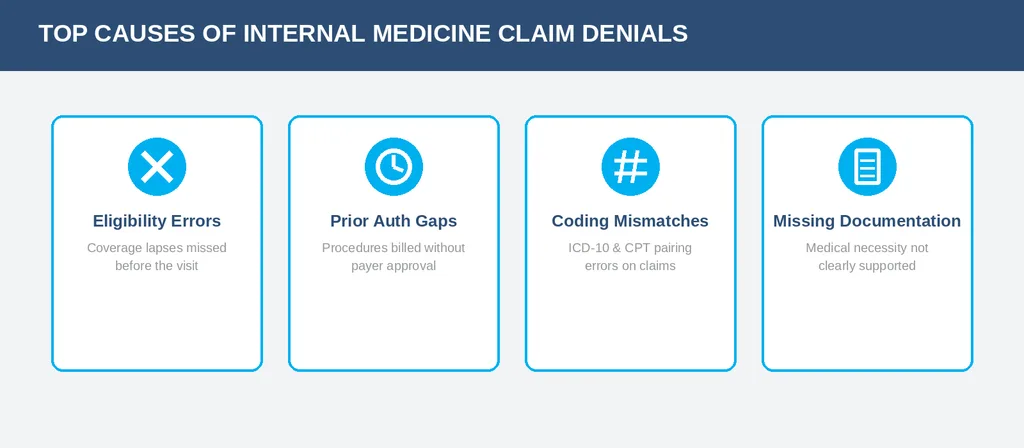
Most internal medicine denials in Kentucky trace back to a handful of preventable errors. Recognizing these patterns is the first step toward reducing lost revenue. The breakdown below covers the most frequent denial triggers reported across Kentucky practices, split into front-end scheduling issues and back-end coding or documentation issues.
Front-End Denial Triggers
Front-end errors happen before a claim is ever submitted, usually during scheduling or check-in. These errors are the easiest to prevent, yet they remain among the most common reasons Kentucky internists lose revenue.
Eligibility Verification Failures
Patient coverage can change between scheduling and the visit date, especially with Kentucky Medicaid MCO plans that reassign members. Without same-day eligibility verification, practices submit claims against inactive policies, and this single error accounts for a large share of avoidable internal medicine denials.
Prior Authorization Oversights
Certain diagnostic tests, injections, and chronic care services require prior authorization before internal medicine providers can bill Kentucky payers. When staff skip this step, or the authorization number does not match the billed CPT code, payers reject the claim outright, often with limited appeal windows.
Back-End Denial Triggers
Even claims with clean front-end data can be denied due to coding or documentation issues discovered during payer review. Internal medicine practices bill a wide range of evaluation and management levels, and any mismatch between documented complexity and the billed code invites scrutiny. Kentucky payers, including several Medicaid MCOs, increasingly flag claims for medical necessity review before payment. Practices without a dedicated coding review step often only catch these errors after the denial arrives, adding weeks to the collection cycle.
Coding and Modifier Errors
Internal medicine claims frequently pair multiple ICD-10 codes with a single evaluation and management visit. Missing modifiers, unbundled procedures, or outdated CPT codes trigger automatic denials from most Kentucky payers, regardless of how medically necessary the service was.
Documentation Gaps
Payers deny claims when chart notes do not clearly support the billed level of service. Internists managing several chronic conditions must document time, complexity, and medical decision-making in enough detail to withstand a payer audit.
What Best-in-Class Denial Management Looks Like?
The best internal medicine denial management billing in Kentucky goes beyond simply resubmitting rejected claims. It combines prevention, fast turnaround, and payer-specific appeal strategies into one coordinated workflow. Practices that treat denial management as a proactive discipline, rather than a reactive cleanup task, see measurably lower days in accounts receivable (AR) and higher first-pass acceptance rates. The table below compares how in-house billing, generic outsourced billing, and Aspect Billing Solutions typically handle Kentucky internal medicine claims.
| Approach | Denial Prevention | Appeal Turnaround | Kentucky Payer Knowledge | Reporting |
| In-House Billing Staff | Limited, reactive | 30–45 days | General | Minimal |
| Generic Outsourced Billing | Moderate | 20–30 days | Limited | Standard monthly |
| Aspect Billing Solutions | Proactive, agent-reviewed | 7–14 days | Kentucky MCO-specific | Transparent, ongoing |
Core Components of a Strong Denial Management Program
A dependable program rests on a handful of repeatable practices rather than one-off fixes:
- Real-time claim scrubbing before every submission
- Denial categorization by root cause using CARC and RARC codes
- Payer-specific appeal templates for Kentucky MCOs and commercial plans
- A disciplined aging accounts receivable follow-up cadence
- Monthly denial trend reporting shared directly with the practice
The Aspect Billing Solutions Denial Management Workflow
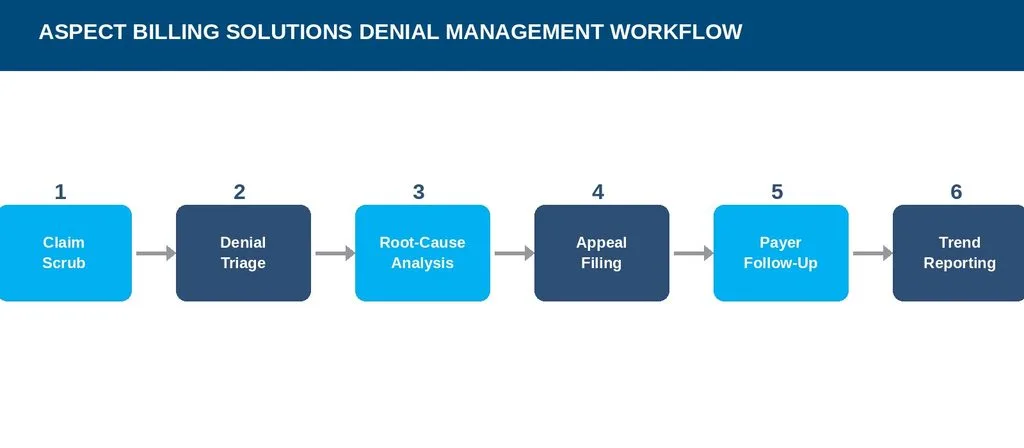
Aspect Billing Solutions applies a six-step workflow to every Kentucky internal medicine claim. Each claim is scrubbed for errors before submission, then any denial is triaged by urgency and dollar value. A dedicated agent performs root-cause analysis to determine whether the issue is coding, eligibility, or documentation. Appeals are filed using payer-specific templates, followed by structured payer follow-up until resolution. Every denial is logged into a trend report so recurring issues are corrected at the source, not just resubmitted month after month.
Kentucky Denial Rate Benchmarks
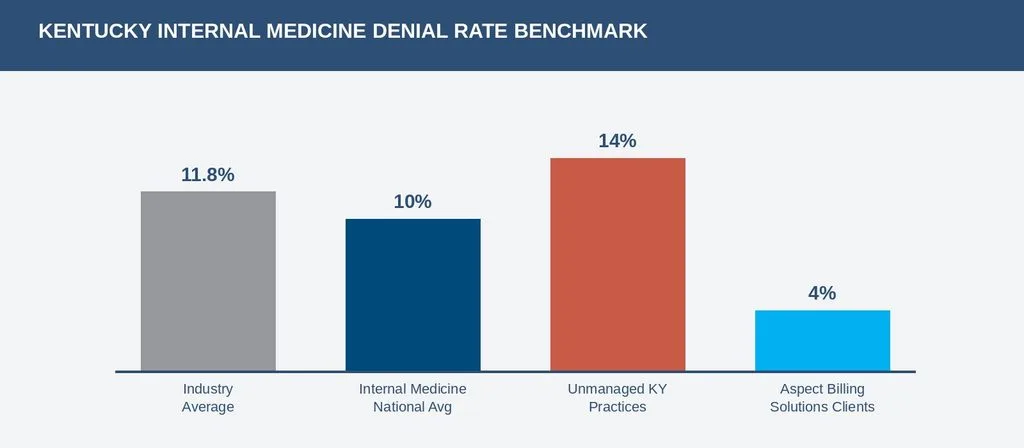
best internal medicine denial management billing in Kentucky-Understanding where your practice stands starts with industry benchmarks. According to MGMA’s most recent Cost and Revenue Report, the average initial claim denial rate across U.S. medical practices reached roughly 11.8 percent, up from about 10.2 percent a few years earlier. Internal medicine and primary care specialties typically run somewhat lower, in the 8 to 12 percent range, while the Healthcare Financial Management Association considers a rate under 5 to 10 percent an acceptable operating band. The chart below illustrates how an unmanaged Kentucky internal medicine practice compares against a practice supported by dedicated denial management.
| Metric | Reported Benchmark | Source |
| All-payer initial denial rate | ~11.8% (2024) | MGMA Cost and Revenue Report |
| Internal medicine specialty range | 8%–12% | Industry practice-management data |
| Providers reporting rates above 10% | ~41% | Experian Health State of Claims survey |
| HFMA acceptable operating band | 5%–10% | Healthcare Financial Management Association |
How to Choose the Best Internal Medicine Billing Partner in Kentucky?
Not every billing company understands the nuances of Kentucky’s payer landscape. Before signing an agreement, practices should evaluate whether a prospective partner can demonstrate real experience with local MCOs, not just generic revenue cycle promises. The right partner should also be transparent about turnaround times, reporting cadence, and how denials are prevented rather than just processed after the fact.
Questions to Ask Before You Sign
- How many Kentucky internal medicine practices do you currently support?
- What is your average first-pass clean claim rate and appeal turnaround time?
- Will our practice have a single dedicated billing agent or a rotating team?
- How do you handle prior authorization tracking for Kentucky Medicaid MCOs?
- Can you provide monthly denial trend reports broken down by root cause?
Why Kentucky Internal Medicine Practices Choose Aspect Billing Solutions?
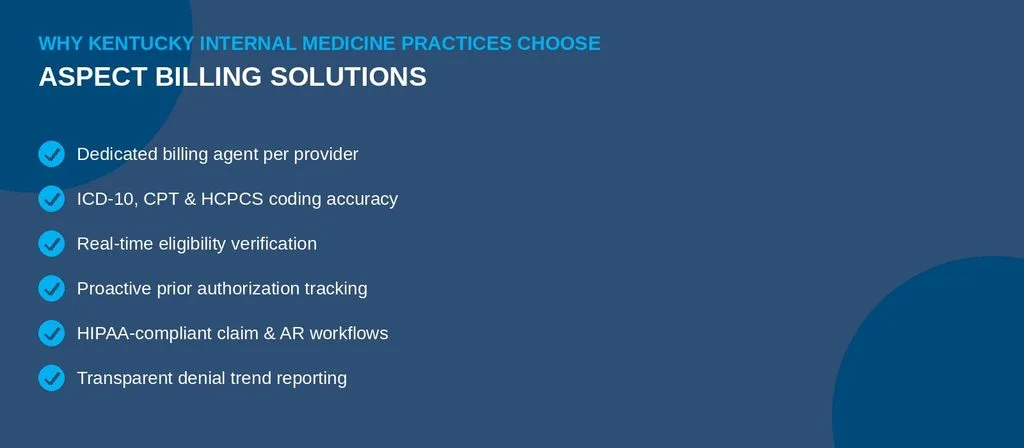
Aspect Billing Solutions pairs every Kentucky internal medicine practice with a dedicated billing agent who understands local Medicaid MCOs, commercial payers, and Medicare Advantage rules. Services span eligibility verification and prior authorization, accurate ICD-10, CPT, and HCPCS coding, and a dedicated
denial management and appeals service built specifically for practices that cannot afford slow payer follow-up. Every engagement is HIPAA-compliant from intake through collections, with transparent reporting so administrators always know where revenue stands.
Quick Summary
- Kentucky’s Medicaid MCO structure creates practice-specific prior authorization and appeal rules.
- Most internal medicine denials trace to eligibility errors, prior authorization gaps, coding mismatches, or thin documentation.
- Best-in-class denial management combines claim scrubbing, root-cause analysis, and fast payer-specific appeals.
- Industry denial rates average roughly 8–12% for internal medicine; HFMA recommends staying under 10%.
- Aspect Billing Solutions assigns a dedicated agent to every Kentucky practice for coding, AR, and denial appeals.
Final Considerations
Denial management is not a one-time fix; it is an ongoing discipline that protects the revenue Kentucky internal medicine practices have already earned. Practices that invest in eligibility verification, accurate coding, and payer-specific appeal strategies consistently outperform those that treat denials as an afterthought. The difference between an 11 percent denial rate and a well-managed single-digit rate can represent tens of thousands of dollars a year for a mid-sized internal medicine clinic.
Choosing the right billing partner matters as much as the workflow itself. A generic, one-size-fits-all vendor rarely understands Kentucky’s Medicaid MCO structure or the documentation standards local payers expect from internists. A dedicated, Kentucky-informed partner shortens appeal cycles and prevents the same denial from recurring month after month.
Aspect Billing Solutions was built around this exact problem: giving Kentucky internal medicine practices a dedicated billing agent who knows the local payer landscape and fights for every dollar owed. The result is fewer denials, faster appeals, and a revenue cycle administrators can actually trust.
Frequently Asked Questions
best internal medicine denial management billing in Kentucky
What is denial management in medical billing?
Denial management is the process of identifying why a claim was rejected, correcting the underlying issue, and resubmitting or appealing it for payment. It also includes tracking denial trends so the same error does not repeat across future claims.
Why do internal medicine practices in Kentucky see high claim denial rates?
Kentucky’s mix of Medicaid managed care organizations, each with different prior authorization and appeal rules, combined with the complexity of chronic-disease documentation, creates more opportunities for errors than in many other specialties.
How quickly can Aspect Billing Solutions resolve a denied claim?
Typical appeal turnaround with a dedicated agent runs seven to fourteen days, compared to twenty to forty-five days with in-house or generic outsourced billing teams, depending on payer response times.
What is considered a healthy denial rate for an internal medicine practice?
Industry benchmarks generally place internal medicine denial rates between 8 and 12 percent, with the Healthcare Financial Management Association recommending practices stay under the 5 to 10 percent range whenever possible.
Does Aspect Billing Solutions handle Kentucky Medicaid MCO claims specifically?
Yes. Aspect Billing Solutions tracks the prior authorization lists, claim edits, and appeal deadlines for Kentucky’s Medicaid managed care organizations, along with commercial and Medicare Advantage payers.
Is outsourcing denial management HIPAA compliant?
When handled correctly, yes. Aspect Billing Solutions follows HIPAA-compliant protocols across eligibility verification, coding, claims submission, and appeals so patient data stays protected throughout the revenue cycle.
Trusted Industry Leader
Aspect Billing Solutions has built its reputation on HIPAA-compliant billing and coding for practices across the country, including internal medicine clinics throughout Kentucky. Every client is assigned a dedicated agent responsible for claims, denials, and accounts receivable, not a rotating call center. If your practice is losing revenue to preventable denials, request a free billing audit and consultation to see exactly where claims are breaking down and how much revenue can be recovered.