
90791 vs 90792: Choosing the Right Evaluation Code
90791 vs 90792 comes down to one question: did you deliver medical services during the psychiatric diagnostic evaluation? Use 90792 when you did and 90791 when you did not. Both codes cover the first assessment of a new episode, and both have the same frequency limits and note requirements. This guide explains the difference, when a repeat evaluation is allowed and what to document. For the wider picture, read our mental health billing guide.
| Key takeaways 90792 includes medical services, and 90791 does not.Medicare contractors cover an evaluation once per episode, with limited repeat exceptions.An evaluation is not reported on the same day as an E/M by the same clinician.The note needs five elements, from history to treatment plan. |
90791 vs 90792: the core difference
Both codes describe a psychiatric diagnostic evaluation. The difference is the added medical services in 90792. The AMA CPT code set defines both codes, and non-physician clinicians may bill when the work falls within their state license, according to a Medicare contractor billing article.
| Feature | 90791 | 90792 |
| Core service | Psychiatric diagnostic evaluation | Psychiatric diagnostic evaluation with medical services |
| Medical services | Not included | Included, within your license |
| Note elements | History, mental status exam, diagnosis, capacity, plan | The same, plus the medical services provided |
| Frequency | Once per day and once per episode | Once per day and once per episode |
| Add-on +90785 | Allowed when a qualifying factor occurs | Allowed when a qualifying factor occurs |
How to choose between the two codes
Start with the episode, then the services, then the add-on. The diagram shows the decision in order.
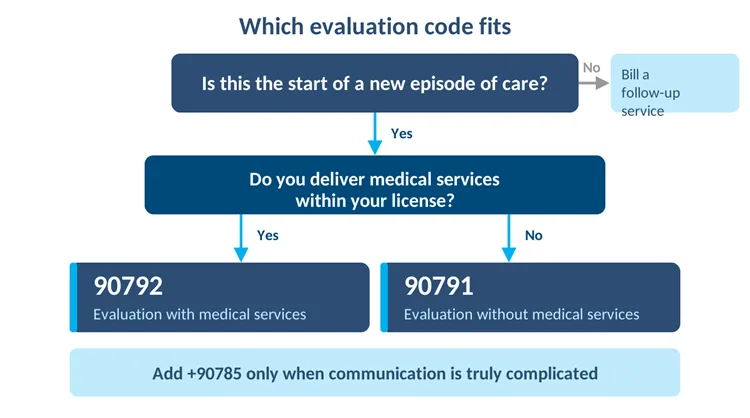
Text summary: for a new episode, bill 90792 if you deliver medical services within your license and 90791 if you do not; otherwise bill a follow-up service, and add +90785 only for truly complicated communication.
Commercial payers may limit which provider types can bill each code, so check the provider manual before you submit.
How often you can bill an evaluation
Medicare contractor guidance treats the evaluation as a one-time service at the onset of an illness or suspected illness. CGS also says it is reported once per day. The WPS article lists limited reasons for a repeat evaluation.
| Situation | Repeat evaluation? |
| Onset of illness or suspected illness | Yes, this is the initial evaluation |
| Extended break in treatment, about 6 months | May qualify |
| Admission to inpatient status for a psychiatric illness | May qualify |
| Significant change in mental status needing more assessment | May qualify |
| Routine follow-up visit | No, bill a follow-up service |
The same guidance says an evaluation is not reported on the same day as an E/M service by the same clinician for the same patient. Crisis psychotherapy codes 90839 and 90840 also cannot be reported with 90791 or 90792.
What your evaluation note must show
Support both codes with the same five elements. If you add medical services for 90792, record them as well.
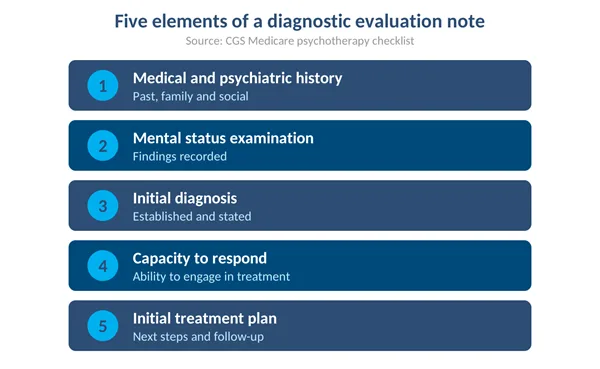
Text summary: document the medical and psychiatric history, mental status examination, initial diagnosis, capacity to respond to treatment, and the initial treatment plan.
If testing follows the evaluation, our guide to neuropsychological testing billing covers those codes.
Common evaluation billing mistakes
Most denials trace back to frequency, same-day services or a thin note.
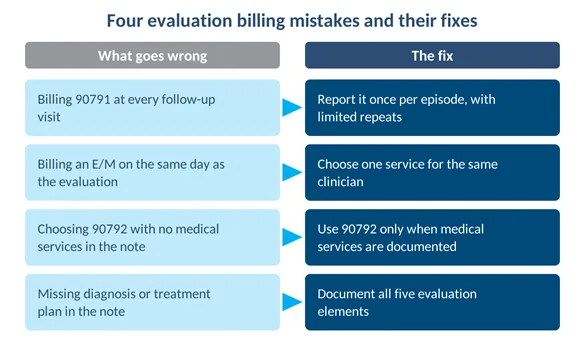
Text summary: bill the evaluation once per episode, avoid same-day E/M services, use 90792 only with documented medical services, and include all five note elements.
If claims still deny, our denial management service reviews root causes. For visits by video, review modifier 95 vs GT first.
Frequently asked questions
What is the difference between 90791 and 90792?
Both codes report a psychiatric diagnostic evaluation. 90792 adds medical services that the clinician delivers within their license, while 90791 does not include them. Choose the code that matches the work you performed, and document the medical services in the note whenever you bill 90792.
How often can I bill 90791?
Medicare contractor guidance treats the evaluation as a service at the onset of an illness or suspected illness, reported once per day. Repeat evaluations may qualify after an extended break of about six months, an inpatient psychiatric admission or a significant mental status change.
Can I bill an evaluation and an E/M on the same day?
Not with the same clinician for the same patient. CGS says the evaluation codes are not reported on the same day as an E/M service. A Medicare contractor article adds that an E/M may substitute for the evaluation when its required elements are met, so bill one or the other.
Can I add interactive complexity to 90791 or 90792?
Yes, when at least one qualifying communication factor occurs and your note supports it. A Medicare contractor article lists interactive complexity among the add-ons for psychiatric procedures. It cannot be used with crisis codes, so keep the documentation specific to the evaluation visit.
Which providers can bill these codes to Medicare?
CGS lists physicians, clinical psychologists, clinical social workers, nurse practitioners, clinical nurse specialists and physician assistants for these services. A Medicare contractor article says non-physicians qualify when the services fall within their state license and training. Commercial plans set their own provider rules.
Final Considerations
90791 vs 90792 is easier once you track two facts: whether medical services were delivered, and whether the episode is new. Keep your notes complete, and review the latest rules in our guide to behavioral health billing directives.
If you want help with evaluation claims, send a message through our contact page. Our team replies within 24 hours.
Sources: AMA CPT code set; CGS Medicare psychotherapy checklist; Wisconsin Physicians Service billing and coding article A57480 (CMS Medicare Coverage Database). This article is general information, not legal or billing advice. Confirm current rules with each payer.