
Associate Therapist Credentialing and Supervised Billing Rules
Associate therapist credentialing is limited because most payers credential only independently licensed clinicians. An associate, intern or pre-licensed therapist can sometimes be paid through a supervisor or a state Medicaid program, but the rules differ for every payer. This guide covers how Medicare, Medicaid and commercial plans treat associates, what supervised billing requires, the compliance risks and what to do the day full licensure arrives.
| Key takeaways Medicare does not enroll pre-licensed clinicians; incident-to billing under a qualifying practitioner is the only route.Clinical social workers, MFTs and mental health counselors cannot bill Medicare incident to their own services.Medicaid rules for associates are set state by state.Commercial plans either pay under a supervisor with the associate listed, or do not pay at all.Never bill an associate’s session as if the supervisor delivered it unless the payer’s written policy allows that format. |
Who Counts as an Associate Therapist?
States use many titles: LPC associate, LMHC associate, LMFT associate, LSW, registered intern or provisional licensee. They share two features: a completed graduate degree and a license that requires ongoing clinical supervision before independent practice. Payers that credential only independently licensed clinicians therefore treat them differently from fully licensed staff. Our insurance credentialing service can map which of your payers accept associate-level work.
How Each Payer Treats Associate Therapists
There is no single national rule. Use this overview, then confirm each payer’s written policy.
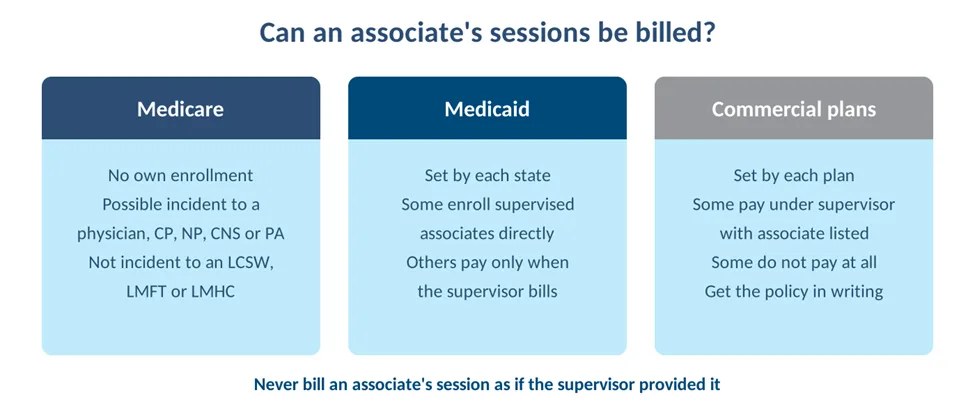
In short, Medicare allows associate work only as incident-to services, Medicaid depends on the state and commercial plans depend on the contract.
Medicare: Incident-To Is the Only Route
Medicare does not enroll associates, so they cannot bill under their own NPI. The CMS Medicare Mental Health booklet (MLN1986542) explains that behavioral health services can be furnished incident to a physician or non-physician practitioner under general supervision, which means the supervisor must be reachable but need not be on site. The billing practitioner must have personally furnished the initial service that the later care supports.
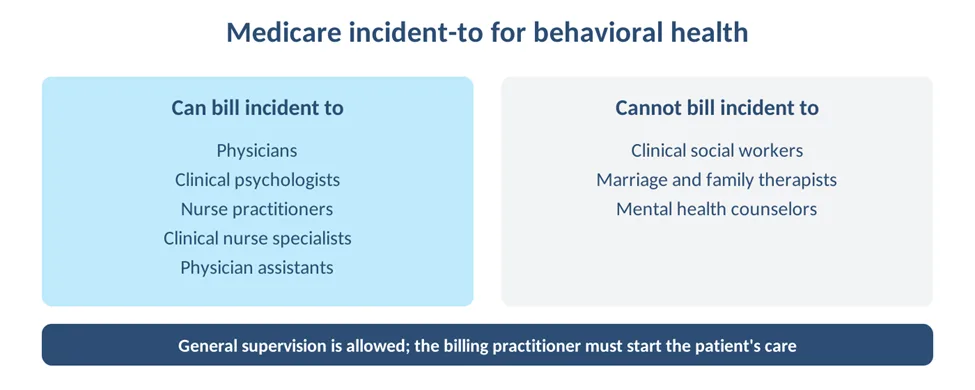
The catch for therapy groups is who can be the billing practitioner. Physicians, clinical psychologists, nurse practitioners, clinical nurse specialists and physician assistants can bill incident-to services. Medicare does not cover services furnished incident to a clinical social worker, marriage and family therapist or mental health counselor, so a group led only by those clinicians cannot bill an associate’s Medicare sessions. State law must also allow the associate to provide the service. Our guide to incident-to billing rules covers the general requirements.
Medicaid and Commercial Plans
Medicaid
Many state Medicaid programs have their own pathway for associates, such as enrolling them as supervised practitioners or paying under the supervising clinician. Requirements, modifiers and eligible license titles vary widely, so read your state’s Medicaid behavioral health manual. Our comparison of Medicare and Medicaid credentialing explains why the two programs diverge.
Commercial plans
Commercial plans fall into two groups. Some pay for associate services only when billed by a qualified supervisor, with the associate still identified on the claim. Kaiser Permanente’s Washington associate-level mental health billing policy, for example, does not credential associates, requires the supervising LMHC, LMFT or LICSW to bill, lists the associate as rendering provider and pays a reduced rate. Other plans do not pay for associate services at all. Get the policy in writing before scheduling.
What Supervised Billing Requires
| Requirement | Why it matters |
| Supervisor credentialed with the payer | The claim is paid under the supervisor’s participation |
| Payer policy allowing associate services | Without it, the service is not covered |
| Associate identified as the payer instructs | Misidentifying the rendering clinician is a compliance risk |
| State supervision agreement on file | Proves the associate practices within the license |
| Notes signed by the associate, co-signed as required | Shows who delivered care and who supervised |
| Client disclosure of supervised status where state law requires | Some states mandate written notice |
Billing an associate’s session under the supervisor’s name and NPI, as if the supervisor delivered it, misrepresents the service unless the payer’s written policy calls for that format. Build regular checks into your internal billing compliance audit, and see our list of credentialing mistakes that delay payments for related errors.
When the Associate Becomes Fully Licensed
Full licensure is the moment to credential the clinician independently with every payer, and delays here leave sessions unbillable.
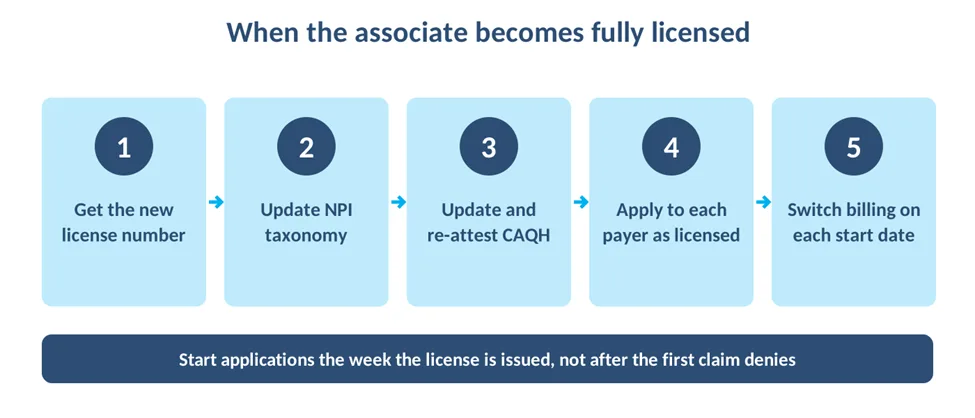
- Record the new license number and effective date the day it is issued.
- Update the NPPES record if the taxonomy code changes with the new license.
- Update the CAQH ProView profile with the new license and re-attest.
- Submit individual or add-provider applications to each payer, including Medicare if the license type is eligible.
- Switch each payer to independent billing only on its confirmed effective date.
For ways to shorten approval times during this switch, see our guide to getting credentialed with insurance panels faster.
Frequently Asked Questions
Can an LPC associate bill insurance?
Sometimes. An LPC associate generally cannot be credentialed independently, but some Medicaid programs and commercial plans pay for associate services billed through a qualified supervisor, often with the associate identified on the claim. Others do not pay at all. Check each payer’s written policy and your state’s supervision rules first.
Can a pre-licensed therapist see Medicare patients?
Only as incident-to services billed by a physician, clinical psychologist, nurse practitioner, clinical nurse specialist or physician assistant who started the patient’s care, and only if state law allows the associate to provide the service. Medicare does not cover services incident to an LCSW, LMFT or mental health counselor.
Can I bill my associate’s sessions under my own NPI?
Only when the payer’s written policy tells you to bill that way. Otherwise, reporting yourself as the clinician who provided a session you did not deliver misrepresents the service and can lead to repayment demands. Where payers allow supervised billing, they usually still require the associate’s details on the claim.
Do associate therapists need a CAQH profile?
Often yes, even if they cannot be credentialed independently yet. Some payers and Medicaid programs use CAQH data for supervised practitioners, and an existing profile speeds independent credentialing once the full license arrives. Keep it current and re-attested every 120 days.
How soon after full licensure can a therapist bill independently?
Only after each payer approves the clinician and confirms an effective date. Approval timelines vary by payer, so submit applications as soon as the license is issued. Until each payer’s date arrives, keep using that payer’s supervised arrangement, if it has one.
Final Considerations
Associate therapist credentialing is less about one application and more about mapping each payer’s rules, keeping supervision records clean and planning the switch to full licensure. Groups that get this right can grow with associates without compliance risk. Our mental health billing guide covers the coding side.
Aspect Billing Solutions is a HIPAA-compliant billing and credentialing company that assigns a dedicated agent to each provider. If you are building an associate program and want help with payer rules and applications, send us a message through our contact page.
Sources: CMS MLN1986542, Medicare Mental Health (March 2026); Kaiser Permanente Washington associate-level mental health billing policy (revised July 2024). This article is general information, not legal advice. Rules differ by payer and state, so confirm requirements in writing.