
How to Add a Provider to a Group Practice in Behavioral Health
To add a provider to a group practice, the new clinician must be credentialed individually with each payer and linked to the group’s NPI and tax ID before claims will pay. For Medicare that means reassigning benefits to the group; for commercial and Medicaid plans it means a separate add-provider request to each one. This guide walks through both tracks, Medicare effective dates, what to collect from the new hire and the mistakes that cost groups money.
| Key takeaways A group contract does not cover a new clinician automatically; each payer must add that person.Medicare reassignment is now reported on the CMS-855I or in PECOS; the separate CMS-855R was retired in 2023.Medicare billing starts on the later of the approved filing date or the first service date, with a limited 30-day look-back.Claims list the clinician’s individual NPI as rendering and the group’s NPI as billing provider.Offboarding matters too: end reassignments and plan links when a clinician leaves. |
Why a New Clinician Needs Separate Credentialing
Payers contract with the group, but they credential people. Each plan needs to check the new therapist’s license, training and history before it pays for that person’s services under the group’s agreement. If you want the whole onboarding handled for you, our insurance credentialing service manages each payer application.
This is different from setting up the group itself, which our credentialing and enrollment guide for physician groups covers. Here the group already exists and is in network; the task is getting one more clinician paid.
Rendering and billing NPIs
Every clinician has one Type 1 (individual) NPI for life, and the group holds a Type 2 (organizational) NPI, as Medicare contractor Noridian explains on its National Provider Identifier enrollment page. On a group claim, the clinician’s individual NPI goes in the rendering provider field and the group’s NPI and tax ID go in the billing provider fields.
How to Add a Provider, Step by Step
Start these steps on the clinician’s first day of onboarding, not after the first insured client is booked.
- Collect the clinician’s license, individual NPI, CAQH ProView ID, malpractice certificate, CV and any supervision agreement.
- Confirm the NPI registry (NPPES) record shows the correct name, taxonomy and practice address.
- Have the clinician update and re-attest their CAQH ProView profile and authorize your group and each plan to view it.
- File the Medicare application with reassignment to the group, either in PECOS or on the CMS-855I.
- Send each commercial and Medicaid plan its add-a-provider request, using the plan’s roster form or portal.
- Track each request until the plan confirms the clinician is linked to your group contract, and record each effective date.
- Load the effective dates into your scheduling system so insured clients are booked only with approved payers.
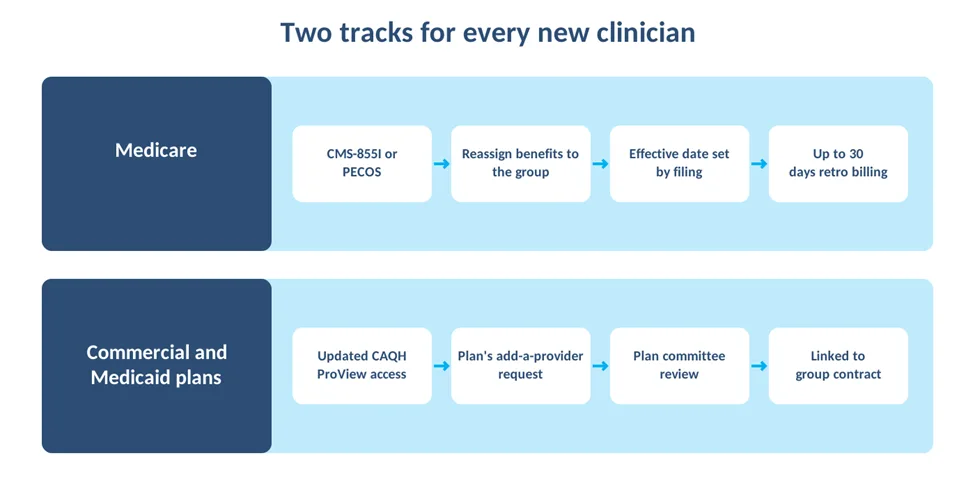
In short, the diagram shows Medicare and private plans moving in parallel, each ending in its own effective date.
Medicare: Reassignment and the Effective Date
Medicare pays the group only when the clinician has reassigned benefits to it. The CMS bulletin on the consolidated CMS-855I enrollment application confirms that reassignment data moved onto the CMS-855I and that the standalone CMS-855R was discontinued after October 2023. Reassignment through PECOS did not change.
Timing is where groups lose money. Under 42 CFR 424.520(d), billing privileges start on the later of the date an approved application was filed or the date the clinician began seeing patients at the location. Under 42 CFR 424.521, the group can bill up to 30 days before that effective date only if circumstances prevented earlier enrollment.
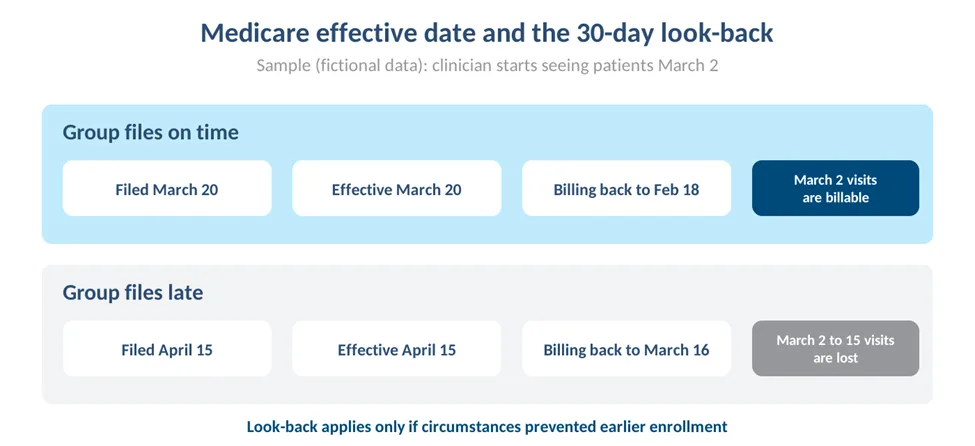
Sample (fictional data). In the example, filing on March 20 protects visits from March 2, while filing on April 15 leaves the first two weeks of visits outside the look-back.
Since January 1, 2024, Medicare also enrolls marriage and family therapists and mental health counselors, so these clinicians follow the same reassignment steps as psychologists and clinical social workers.
Commercial and Medicaid Plans
Private plans each run their own add-provider process, usually through a roster form or provider portal, and many pull data straight from CAQH ProView. Some plans let a group start billing for a new clinician only after the plan’s committee approves them; others assign an effective date tied to the request date. Read each contract’s provider addition terms, and see our guide to in-network credentialing and billing for how participation status affects claims.
Medicaid adds a step: the clinician generally needs state Medicaid enrollment linked to your group before plan credentialing finishes. Our comparison of Medicare and Medicaid credentialing explains the difference. Large groups sometimes negotiate delegated credentialing, where the plan lets the group check its own clinicians under agreed standards.
What to Collect From a New Clinician
Ask for these items in the offer packet so applications are not held up waiting on paperwork.
| Item | Used for |
| State license and license number | Every payer application and the Medicare enrollment |
| Individual NPI and NPPES login status | Rendering provider field and registry updates |
| CAQH ProView ID and current attestation | Most commercial plan applications |
| Malpractice certificate | Proof of coverage at the group’s required limits |
| CV with month and year for each job | Work history checks and gap explanations |
| Degree and training details | Primary source verification |
| Supervision agreement for associate-level clinicians | Payers and states that allow supervised billing |
| Planned start date and locations, including telehealth | Effective dates and directory listings |
Common Mistakes When Adding a Clinician
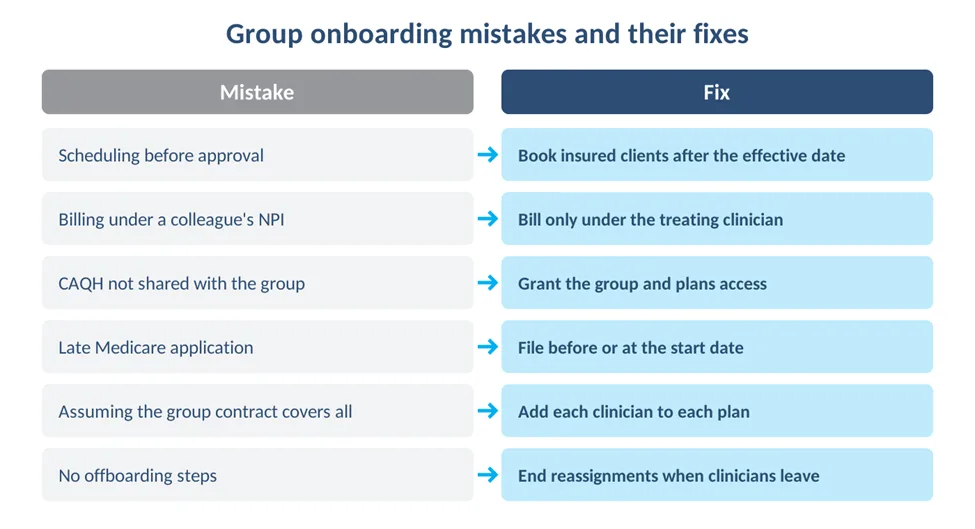
These errors show up again and again in growing therapy groups.
| Mistake | What happens | Prevention |
| Booking insured clients before approval | Claims deny or must be written off | Schedule by payer effective date |
| Billing under another clinician’s NPI | Compliance risk and possible repayment | Bill only under the treating clinician |
| Late Medicare filing | Early visits fall outside the look-back | File at or before the start date |
| Assuming the group contract covers everyone | Out-of-network denials | Send an add-provider request to every plan |
| No offboarding | Reassignments and plan links stay active after departure | Terminate links within payer deadlines |
Our list of credentialing mistakes that delay payments covers more causes of slow approvals.
Frequently Asked Questions
Can a new therapist bill under the group’s NPI right away?
No. The group NPI goes in the billing field, but each payer must first credential the new therapist and link them to the group. Until a plan confirms the effective date, claims for that clinician’s sessions can deny as out of network or unenrolled. Book insured clients by each payer’s confirmed start date.
Can I bill a new clinician’s sessions under the owner’s NPI?
No. Claims must show the clinician who actually provided the service as the rendering provider. Billing one clinician’s sessions under another’s NPI misrepresents who treated the patient and can lead to repayment demands and compliance problems. Wait for approval or see clients privately where your contracts and state rules allow.
Is the CMS-855R still used for Medicare reassignment?
No. CMS merged reassignment into the CMS-855I paper application and stopped accepting the standalone CMS-855R after October 2023. Groups and clinicians report new reassignments, changes and terminations on the CMS-855I or through PECOS, which kept the same reassignment process.
How far back can Medicare pay for a new clinician’s sessions?
Up to 30 days before the effective date, and only if circumstances prevented enrollment in advance. The effective date is the later of the date an approved application was filed and the date the clinician started at the location. Filing promptly is the only reliable way to protect early visits.
What happens when a clinician leaves the group?
End the Medicare reassignment and notify each plan so the clinician is removed from your roster and directory. Leaving old links active can send payments to the wrong place and keep outdated listings online. Payers set their own notice deadlines in contracts, so check each one.
Final Considerations
To add a provider to a group practice without lost revenue, treat onboarding as a payer-by-payer project with dates, not a single form. Once each clinician is approved, consistent billing across the group keeps cash flow steady; our article on medical billing services for group practices and our mental health billing guide cover that side.
Aspect Billing Solutions is a HIPAA-compliant billing and credentialing company that assigns a dedicated agent to each provider. If you are growing a therapy group and want help onboarding clinicians, send us a message through our contact page.
Sources: CMS bulletin on the consolidated CMS-855I; 42 CFR 424.520(d) and 424.521; Noridian Medicare National Provider Identifier page. This article is general information, not legal advice. Payer processes vary, so confirm requirements with each payer.