
Psychologist Credentialing for Medicare and Insurance Panels
Psychologist credentialing is the work of getting a licensed psychologist approved by Medicare, Medicaid and commercial plans so sessions and testing pay in network. For Medicare, the key choice is enrolling as a clinical psychologist, which comes with a physician consultation rule most other therapists do not face. This guide covers the two Medicare designations, the consultation rule, a step-by-step workflow, payer panels and the errors that slow approvals.
Practices that want a team to run every application can use a dedicated provider credentialing service. The steps below show what that work involves either way.
| Key takeaways Doctoral psychologists licensed at the independent practice level enroll in Medicare as clinical psychologists.Clinical psychologists agree to the Medicare physician consultation rule when they sign the enrollment form.Independently practicing psychologists can bill Medicare only for ordered diagnostic testing.Commercial panels rely on CAQH, so complete and attest it before you apply. |
Clinical psychologist vs independently practicing psychologist
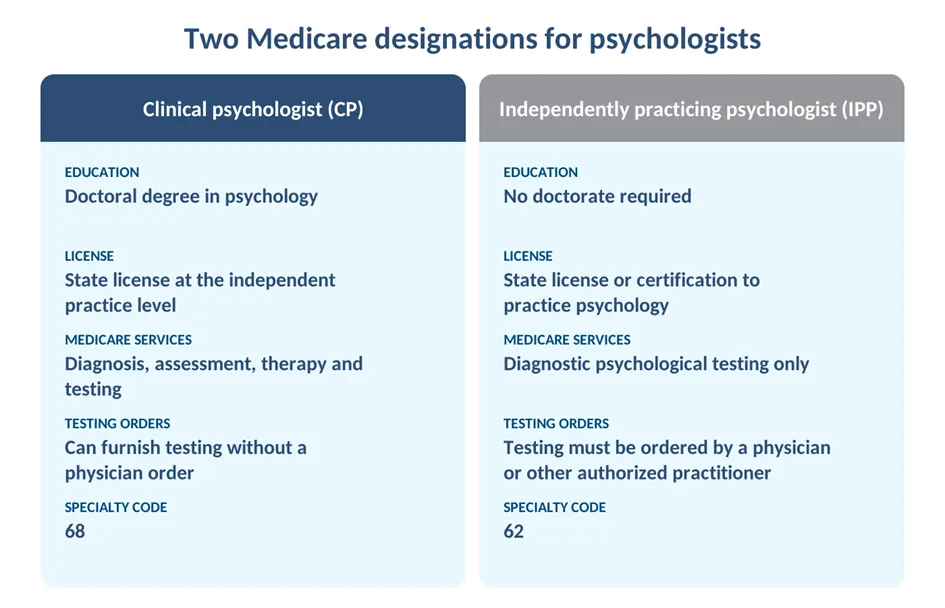
Medicare recognizes two psychologist designations, and the one you choose decides what you can bill. The APA Services Medicare enrollment guide describes the clinical psychologist (CP) as specialty 68 and the independently practicing psychologist (IPP) as specialty 62.
| Feature | Clinical psychologist (CP) | Independently practicing psychologist (IPP) |
| Education | Doctoral degree in psychology | No doctorate required |
| License | State license or certification at the independent practice level | State license or certification to practice psychology |
| What Medicare pays for | Diagnosis, assessment, psychotherapy and testing | Diagnostic psychological testing only |
| Testing orders | Can furnish testing on their own | Testing must be ordered by a physician or another authorized practitioner |
| Specialty code | 68 | 62 |
If testing is a large part of your practice, our guide to neuropsychological testing billing codes explains how those services are coded once you are enrolled.
Medicare requirements for clinical psychologists
Under 42 CFR 410.71, a clinical psychologist holds a doctoral degree in psychology and a state license or certification based on that doctorate, at the independent practice level. The enrollment file itself includes:
- NPI: an individual National Provider Identifier with a psychologist taxonomy, such as 103T00000X or the clinical specialty 103TC0700X.
- Application: CMS-855I or the same application in PECOS, Medicare’s online enrollment system. Stamped signatures are not accepted.
- Payment: the CMS-588 electronic funds transfer (EFT) form, unless you already receive EFT and your bank details are unchanged.
- Participation: the CMS-460 participation agreement when it applies; it is not needed if you reassign benefits to a group.
- License proof: a copy of your license when the contractor cannot verify it online.
The First Coast clinical psychologist enrollment page lists the same documents and signature rules. Medicare charges no application fee for individual psychologists.
The physician consultation rule
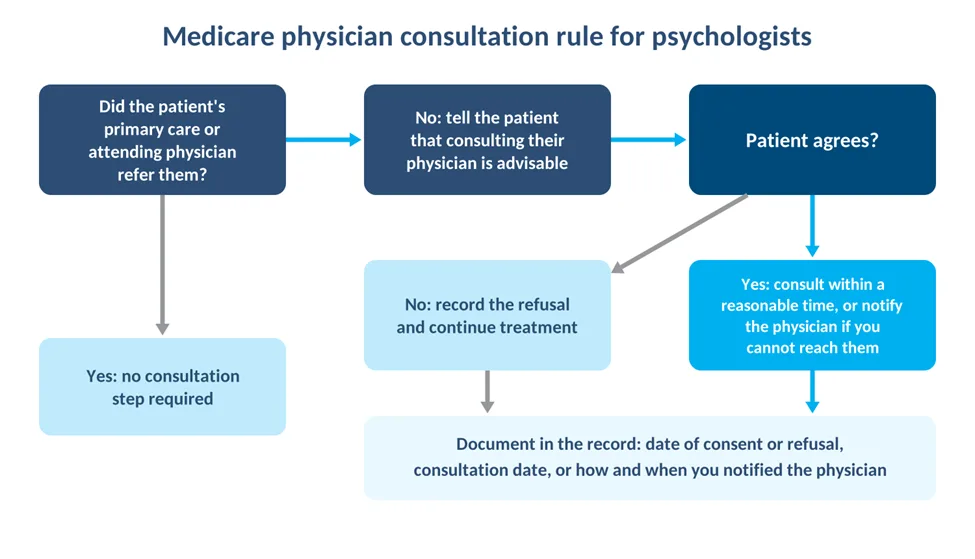
Clinical psychologists agree to a consultation rule when they sign the Medicare enrollment form. Unless the patient’s primary care or attending physician made the referral, you must tell the patient that consulting that physician is advisable. If the patient agrees, try to consult within a reasonable time, or notify the physician that you are treating the patient if you cannot reach them.
Record the date of consent or refusal, the consultation date or the date and method of notice. Neither you nor the physician may bill Medicare or the patient for this consultation.
Psychologist credentialing steps
The diagram lays out the order: confirm eligibility, fix the NPI, build CAQH, enroll in Medicare, apply to panels, track files and keep everything current.
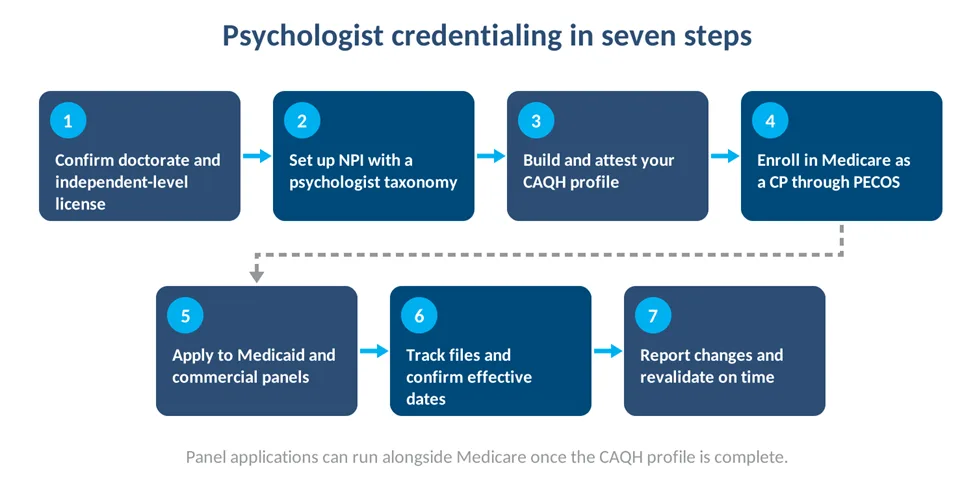
- Confirm eligibility. Make sure your license is at the independent practice level in every state where you will treat patients.
- Set up your NPI. In NPPES, the national NPI registry, choose a psychologist taxonomy that matches your license.
- Build your CAQH profile. Commercial plans pull your data from CAQH ProView, and our overview of how CAQH supports credentialing covers the profile. Upload documents and attest.
- Enroll in Medicare. File in PECOS as a clinical psychologist, add EFT, and add reassignment if a group bills for you.
- Apply to other payers. Submit Medicaid and commercial applications and keep copies of everything.
- Track and confirm. Log reference numbers, follow up on a schedule and get each effective date in writing.
- Stay current. Report changes on time and revalidate when Medicare asks.
Sample (fictional data): Dr. Priya Nair, PsyD, joins a four-clinician group in Phoenix to provide therapy and testing. She enrolls as a clinical psychologist through PECOS with reassignment to the group, applies to three commercial plans through CAQH and holds new patients for each plan until its contract shows an effective date. Swap in your own name, city, group and payers when you use this as a planning template.
Commercial and Medicaid panels for psychologists
Commercial plans run their own credentialing reviews, and many manage behavioral health through a separate network. Ask about panel status in your area first, because some networks close to new psychologists. Our guide to getting on insurance panels faster covers how to prepare a clean application.
Medicaid enrollment is run by each state, and some state programs and managed care plans expect Medicare enrollment first. Postdoctoral fellows and others not yet licensed at the independent level cannot enroll as clinical psychologists, and each commercial plan decides whether it will credential them.
Keeping your enrollment active
Credentialing does not end at approval. Medicare asks you to report a new practice location, an ownership change or a final adverse action within 30 days, and most other changes within 90 days. Medicare also asks you to revalidate about every five years, and missing that request can deactivate billing privileges.
Commercial plans recredential on their own cycles, a process our article on recredentialing versus initial enrollment explains in detail.
Common psychologist credentialing mistakes
| Mistake | How to prevent it |
| Enrolling as an IPP when you need therapy coverage | Enroll as a clinical psychologist if you hold a doctorate and an independent-level license |
| No record of the consultation rule | Add consent, consult and notice dates to your intake template |
| Taxonomy that does not match the license | Check NPPES before any application goes out |
| Seeing plan members before the effective date | Hold appointments until the contract or letter confirms the date |
| Stale CAQH profile | Re-attest on CAQH’s schedule and upload renewed documents |
| Missed revalidation notice | Watch for Medicare mail and calendar every revalidation cycle |
Many of these overlap with the credentialing errors that delay payments seen across specialties.
Frequently asked questions
What is the difference between a clinical psychologist and an IPP in Medicare?
A clinical psychologist has a doctorate and an independent-level license and can bill Medicare for diagnosis, assessment, psychotherapy and testing. An independently practicing psychologist is licensed or certified to practice psychology but can bill Medicare only for diagnostic testing that a physician or other authorized practitioner orders.
Do psychologists need a physician referral to bill Medicare?
No referral is required for a clinical psychologist. Instead, unless a primary care or attending physician referred the patient, you tell the patient that consulting their physician is advisable, consult or notify the physician if they agree, and record the dates in the chart. Independently practicing psychologists do need an order for testing.
What taxonomy code should a psychologist use?
Psychologists use the 103T taxonomy group. The general code is 103T00000X, and specialty codes such as 103TC0700X for clinical psychology describe a focus area. Pick the code that matches your license and practice, and keep it consistent across NPPES, CAQH and each payer application.
Can a postdoctoral psychologist be credentialed?
Not as a Medicare clinical psychologist, because Medicare requires a license at the independent practice level. Commercial plans and Medicaid programs set their own rules, and many credential only fully licensed psychologists. Check each plan’s written policy before a postdoctoral fellow treats its members.
Does credentialing change how psychology services are billed?
Credentialing makes you eligible to bill, but coding rules decide what each service is worth. Psychotherapy, testing and evaluation codes each have their own time and documentation rules, which our complete mental health billing guide walks through.
Final Considerations
Psychologist credentialing goes smoothly when you choose the right Medicare designation, build the consultation rule into intake, keep CAQH current and confirm every effective date in writing. Each of those steps protects the claims that follow.
If you want a dedicated agent to handle your psychologist applications and follow-ups, contact our team and tell us which payers you need.
Sources: 42 CFR 410.71 (eCFR); First Coast Service Options, Clinical Psychologist enrollment; APA Services, Medicare enrollment for psychologists; Wisconsin Physicians Service, Psychological and Neuropsychological Testing billing guidelines (L34646). This article is general information, not legal advice. Confirm current requirements with each payer.