
CO-29 Denial Code (Timely Filing): Deadlines, Proof and Prevention
| The CO-29 denial code is a claim adjustment reason code (CARC 29) that tells a provider the payer received the claim after its filing deadline: “The time limit for filing has expired.” The CO group code puts the loss on the provider, so the balance cannot be shifted to the patient. |
Review note: filing limits in this guide were checked against CMS, eCFR, TRICARE and published payer sources available in October 2026. Payer contracts change, so confirm your own limits at least once a year.
A CO-29 on a remittance is one of the few denials that a coding fix rarely solves. Once a payer’s timely filing limit passes, the money is gone unless you can prove the claim arrived on time or show that a recognized exception applies. This guide covers both routes: how each payer type counts the deadline, which evidence wins a reconsideration, how to measure the leak, and how to stop it. A 10-question self-assessment checklist near the end shows where your practice stands.
Which Timely Filing Numbers Should Every Billing Team Know?
Nine numbers decide most CO-29 outcomes: six filing rules set by regulation, program manuals or contracts, and three internal targets that keep claims far from the edge. Table 1 puts them in one place.
Key timely filing numbers (cheat sheet)
| Metric | Practical target / range | Review frequency | Source type |
| Medicare fee-for-service filing limit | 1 calendar year from the date of service | Yearly | Published standard (a) |
| Medicare exception extension | Through the last day of the 6th month after the notice or recovery month; payer-error extensions end 4 years after the service date | Per case | Published standard (a) |
| Medicaid fee-for-service | No later than 12 months from the date of service; states may set shorter limits (Texas Medicaid: 95 days) | Each state, yearly | Published standard (a); trade publication (d) |
| Medicaid after a Medicare decision (crossover) | Within 6 months of the Medicare disposition notice | Per case | Published standard (a) |
| TRICARE | 1 year from the date of service; 90 days after another insurer’s decision when that insurer caused the delay | Yearly | Published standard (a) |
| Medicare Advantage and commercial plans | Set by contract; 90 days for participating providers appears in several published policies | Each contract renewal | Payer policy (b); trade publication (d) |
| Claim lag (service date to first submission) | 5 business days or fewer | Weekly | Practical target (c) |
| Clearinghouse and payer rejections worked | Within 2 business days | Daily | Practical target (c) |
| CO-29 write-offs | As close to zero as possible; every new CO-29 gets a root cause | Monthly | Practical target (c) |
Source labels: (a) federal regulation or government program manual; (b) a named payer’s published policy, which applies only to that payer; (c) practical target commonly used across industry sources, not a mandated standard; (d) named trade publication. Your own contracts override any figure in this table.
How Should You Read CO-29 on an 835 Remittance?
CO-29 on an electronic remittance advice (ERA/835) combines group code CO, meaning contractual obligation, with CARC 29, meaning the time limit for filing has expired. The group code decides who owns the balance; the claim adjustment reason code explains why the payer did not pay.
Timely filing denials almost always arrive under CO, not PR (patient responsibility), so the balance cannot move to the patient’s statement. The CO-45 denial code assigns liability the same way, although its reason is contract pricing rather than lateness.
Which remark codes travel with CARC 29?
Medicare contractors often pair CARC 29 with the N211 remark code, “Alert: You may not appeal this decision.” Noridian’s Medicare timely filing guidance for JF Part B lists that pairing and states that a claim denied for timely filing is not afforded appeal rights. Commercial payers may add their own remark codes or a free-text EOB message, so read the full claim line, not just the CARC.
How is CO-29 different from look-alike denials?
Several codes feel like lateness problems but need different fixes. Table 2 sorts them.
CO-29 compared with codes billers often confuse it with
| Code | What it means | Usual fix | Recoverable? |
| CO-29 | The time limit for filing has expired | Proof of timely filing, an exception, or a data correction | Only with evidence |
| CO-16 | Claim lacks information or has billing errors | Correct and resubmit | Usually, if resubmitted inside the limit |
| CO-18 | Exact duplicate claim or service | Check the original claim’s status | The original claim decides |
| CO-27 | Expenses incurred after coverage terminated | Find active coverage and bill that payer | Yes, if the new payer’s window is open |
Source: X12 CARC descriptions as published by payers and Medicare contractors; fixes reflect common billing practice.
The CO-16 row matters most. A CO-16 denial for missing information is fixable, but the corrected claim must still land inside the original filing window, so slow rework can turn it into a permanent CO-29.
When Does the Timely Filing Clock Start and Stop?
For most professional claims, the timely filing clock starts on the date of service and stops only when the payer receives a claim it accepts for processing. Medicare measures each line of a CMS-1500 claim from its “From” date, while institutional claims use the “Through” date, according to Palmetto GBA’s published timeliness criteria.
Under 42 CFR 424.44, a Medicare claim for services on or after January 1, 2010 must be filed no later than one calendar year after the date of service. When the last day falls on a weekend or federal nonworkday, the deadline moves to the next workday.
Which events do not stop the clock?
- A claim built in the practice management system but never transmitted.
- A clearinghouse rejection for an invalid member ID or payer ID.
- A claim sent to the wrong payer, unless that payer grants a wrong-payer exception.
- A Medicare claim returned as unprocessable; the corrected claim must still arrive inside one year.
In billing audits, a common pattern is a claim marked “submitted” that never cleared the clearinghouse. The status looks complete, so nobody chases it until a CO-29 posts. Assign one owner to the daily rejection report from your electronic claims clearinghouse when more than a handful of claims reject each week.
How do secondary claims change the clock?
Many plans start the clock for secondary claims at the primary payer’s EOB date; UnitedHealthcare Community Plan of Indiana allowed participating providers 90 days from the primary EOB, per Indiana Medicaid (IHCP) training material. Medicare differs: its one-year limit still runs from the date of service when Medicare pays second. Coordination of benefits gaps make this worse, so run insurance eligibility verification at every visit, including a check for other coverage, when patients change plans often.
How Long Are Timely Filing Limits for Medicare, Medicaid, TRICARE and Commercial Payers?
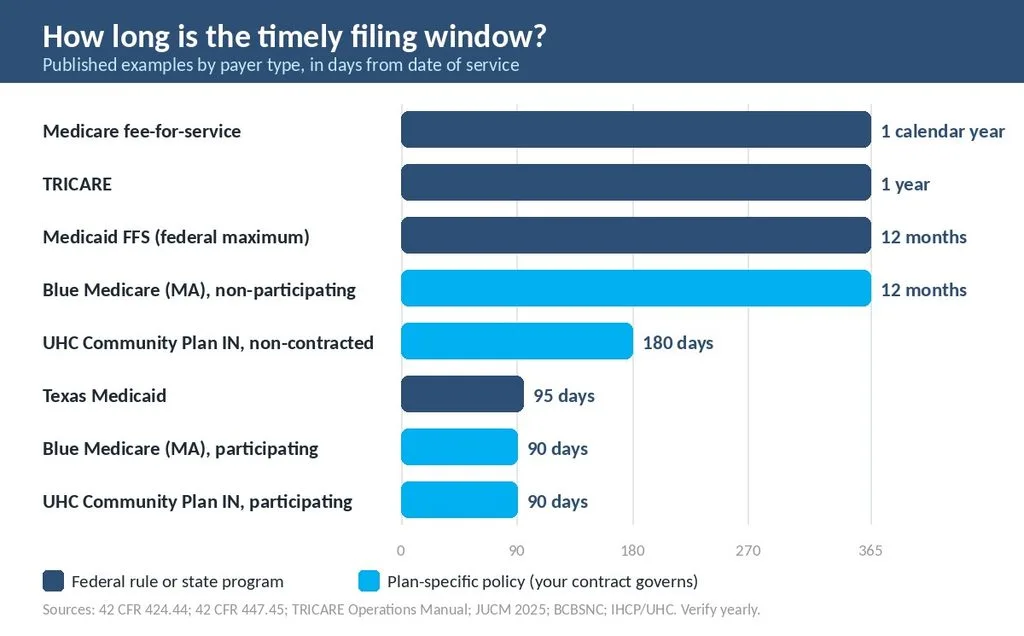
Timely filing limits run from one year for Medicare, TRICARE and the federal Medicaid maximum down to 90 days or less for many commercial and managed care contracts. The shortest limit in your payer mix, not the longest, should set your internal deadline.
Timely filing limits by payer type (published examples)
| Payer type | Filing limit | Clock starts | Key exceptions | Source |
| Medicare fee-for-service | 1 calendar year | Date of service (“From” date per line on professional claims) | Contractor error; retroactive entitlement; Medicaid recoupment; retroactive MA or PACE disenrollment | 42 CFR 424.44; CMS |
| Medicaid fee-for-service | No later than 12 months; states may set shorter limits | Date of service | Crossover claims: 6 months after Medicare’s decision; court or hearing orders | 42 CFR 447.45; state manual |
| Texas Medicaid | 95 days | Date of service | Per state rules | JUCM, 2025 |
| TRICARE | 1 year | Date of service (discharge for inpatient) | 90 days after another insurer’s decision | TRICARE Operations Manual |
| Medicare Advantage (example: BCBSNC Blue Medicare) | 90 days participating; 12 months nonparticipating | Date of service | Per plan policy | BCBSNC policy |
| Commercial (example: UnitedHealthcare) | 90 days for many commercial products | Patient encounter | Per contract | JUCM, 2025 |
Rows naming a specific plan are examples from that plan’s published policy or trade reporting, not industry standards. Limits change; check your contracts and provider manuals each year.
The federal Medicaid rule at 42 CFR 447.45 requires claims within 12 months of the service date, and many states set shorter windows. Managed care plans add their own contract limits, so check the state provider manual and each contract before setting internal rules.
Commercial limits come from the provider agreement. Some states set minimum filing windows for fully insured plans, but self-funded ERISA plans follow their plan documents, so a state minimum may not protect you. Our team often sees practices load one generic commercial rule, such as 180 days, into the billing system; the mismatch stays hidden until a 90-day contract starts producing CO-29s.
Can a CO-29 Denial Be Overturned?
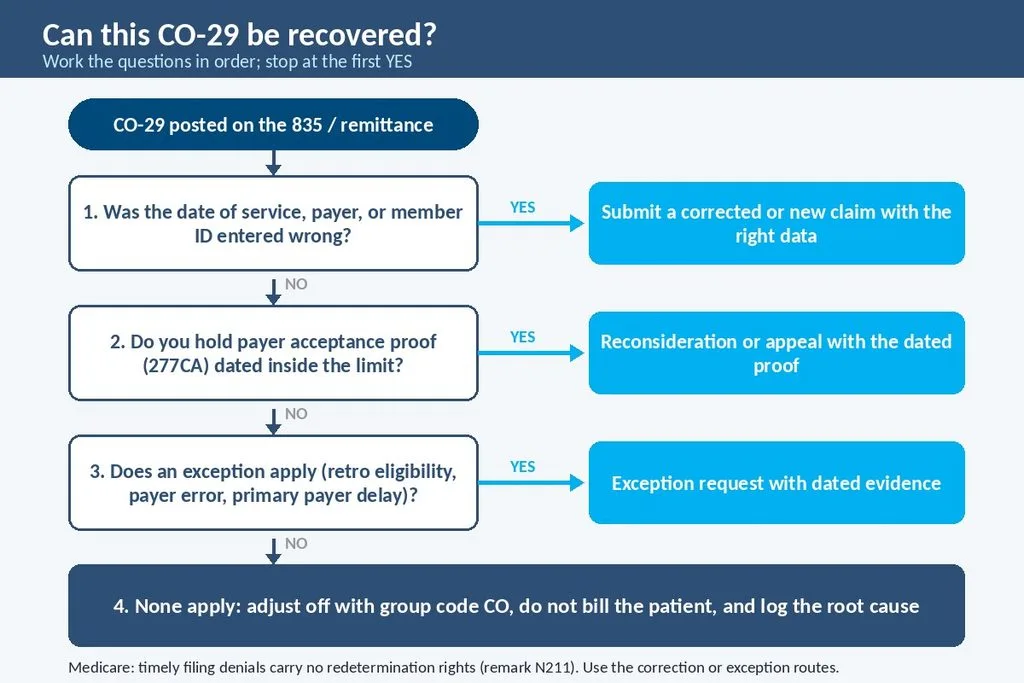
A CO-29 denial can be overturned only when the practice can show one of three things: the claim reached the payer on time, a recognized exception applies, or the denial rests on wrong data such as a mistyped service date. Without one of those, the balance is a provider write-off.
Route 1: Prove the claim was filed on time
Proof of timely filing is dated evidence that the payer, not only your clearinghouse, received the claim. Rank what you hold before you appeal:
- Strongest: a payer claim acknowledgment (277CA) showing acceptance, with the date and payer claim number.
- Strong: an earlier EOB, letter or portal screen from the same payer referencing the original claim.
- Supporting: a clearinghouse report or 999 acknowledgment, which shows transmission rather than payer receipt.
For commercial and Medicaid plans, send the proof through the reconsideration or appeal channel inside the plan’s appeal window, which is separate from the filing limit. A strong claims appeal letter states the original submission date in its first paragraph. For Medicare, the standard Medicare appeal process does not apply, because a timely filing denial is not an initial determination; if the contractor mishandled an earlier claim, that error is itself an exception.
Route 2: Show that an exception applies
CMS recognizes four Medicare timely filing exceptions, listed in the CMS MLN timely filing lesson: an error by Medicare or its contractor, retroactive Medicare entitlement, retroactive entitlement where a state Medicaid agency recoups payment six or more months after the service, and retroactive Medicare Advantage or PACE disenrollment with a similar late recoupment. Each extension runs through the last day of the sixth calendar month after the notice or recovery.
What a Medicare exception request should include
- The claim, with remarks explaining the extension reason (Item 19 or the electronic equivalent on Part B).
- Provider identifiers (PTAN, NPI) and patient details (name, Medicare number, service dates).
- Dated evidence: an SSA entitlement letter, recoupment notice, disenrollment letter or contractor error notice.
Requirements differ slightly by MAC, so follow your contractor’s checklist. Outside Medicare, exceptions live in the provider manual; retroactive eligibility, primary payer delays and plan errors are the common ones.
Route 3: Fix the data behind the denial
Some CO-29s are not late at all. A service date keyed as 2025 instead of 2026 can look late to the payer. Noridian’s guidance is direct: verify the date of service, and when it was wrong, submit a new claim with the corrected date.
A seven-step CO-29 response process
- Confirm group code CO, CARC 29, any remark codes and the service date the payer used.
- Recalculate the deadline and its start event (service date, discharge or primary EOB).
- Pull the submission history: 999 files, 277CA acknowledgments and portal confirmations.
- Check exception triggers: retroactive eligibility, late-found other coverage, payer errors.
- Choose the route: corrected claim, reconsideration with proof, exception request or write-off.
- File inside the payer’s appeal window and calendar a follow-up date.
- Log the root cause so prevention targets the real source.
If you already run a structured denial management workflow, add these steps as a CO-29 branch instead of building a separate process.
How Do You Measure What CO-29 Denials Cost Your Practice?
Three numbers show whether timely filing is a minor annoyance or a steady leak: filing buffer, claim lag by segment, and the CO-29 write-off rate. Each one comes from a standard A/R and remittance report in minutes.
Filing buffer
Formula: Filing buffer (days) = Payer filing limit − Days used before the payer accepts the claim.
Illustrative scenario (not an actual client record): a commercial contract allows 90 days. The claim leaves on day 6, rejects for an invalid member ID and is accepted on day 19. Buffer = 90 − 19 = 71 days, until a coordination of benefits question adds 40 days and leaves 31.
Claim lag, measured by segment
Formula: Average claim lag = Sum of (submission date − service date) ÷ Number of claims, calculated for each segment as well as practice-wide.
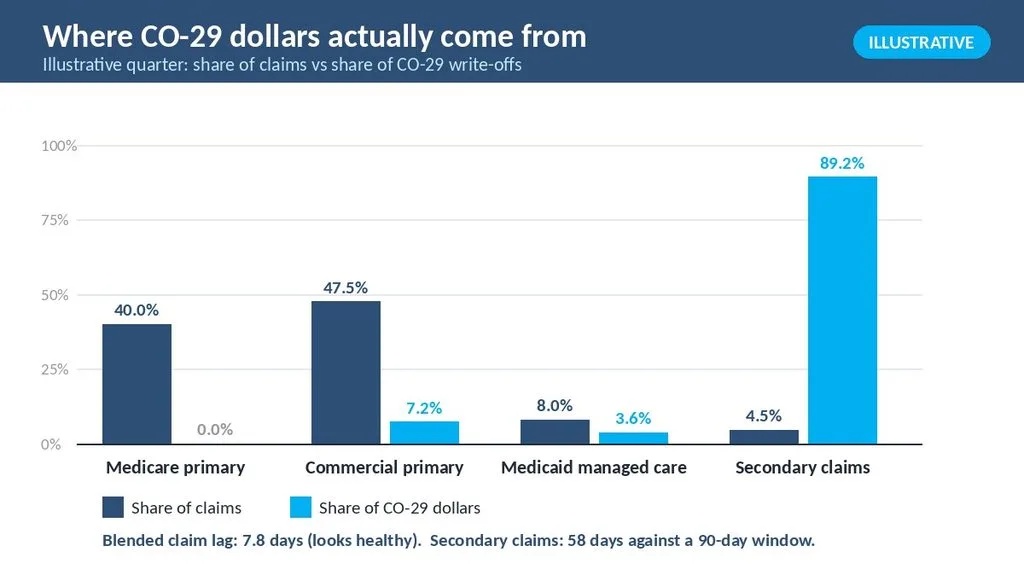
Illustrative scenario (not an actual client record): a practice submits 4,000 claims in one quarter. Table 4 splits them by segment.
Illustrative claim lag and CO-29 dollars by segment (one quarter)
| Segment | Claims | Average lag (days) | Filing limit | CO-29 write-offs |
| Medicare primary | 1,600 | 4 | 1 year | $0 |
| Commercial primary | 1,900 | 6 | 90 days | $1,200 |
| Medicaid managed care | 320 | 9 | 95 days | $600 |
| Secondary claims (all payers) | 180 | 58 (from primary EOB) | 90 days | $14,900 |
| Total / blended | 4,000 | 7.8 | — | $16,700 |
Illustrative: figures are invented to show the calculation. Actual results vary by payer mix, specialty and contracts.
Blended lag = (1,600 × 4 + 1,900 × 6 + 320 × 9 + 180 × 58) ÷ 4,000 = 31,120 ÷ 4,000 = 7.8 days. That average looks close to a five-business-day target. Yet secondary claims, only 4.5% of volume, produce $14,900 of the $16,700 lost, or 89%. The blended number hides the one segment that is failing.
CO-29 write-off rate
Formula: CO-29 write-off rate = CO-29 adjustments ÷ Gross charges for the same period × 100.
Using the same illustrative quarter with $1,240,000 in gross charges: $16,700 ÷ $1,240,000 × 100 = 1.35%. No national body publishes a benchmark for this ratio; the practical target is as close to zero as possible, because almost every timely filing loss is preventable.
Another pattern our team sees: claims held while a new provider waits for payer enrollment. A hold that outlasts a 90-day window becomes a block of CO-29s, so credentialing mistakes that delay payments belong on the timely filing report too.
How Should You Use These Timely Filing Numbers?
Use timely filing numbers to find where a deadline is at risk, comparing each segment with its own limit rather than with the practice average. A 30-day lag is harmless against Medicare’s one-year window and dangerous on a 90-day secondary contract.
- Compare like with like: primary versus secondary, by payer, location and provider.
- Treat one CO-29 as a signal to investigate its queue, not as a verdict on the team.
- Track the buffer at submission; at-risk claims are visible weeks before a CO-29 posts.
How Long Does It Take to Reduce CO-29 Denials?
Most practices can stop creating new CO-29 risk within weeks, but the denial report trails behind, because payers deny late claims after the fact. These are general planning ranges, not guarantees:
- 1 to 2 weeks: build the payer limits table and a report of unbilled and rejected claims sorted by days remaining.
- 30 to 60 days: claim lag and rejection turnaround improve, and fewer new claims approach their windows.
- 60 to 120 days: CO-29 adjustments on remittances fall, since claims that were already late keep denying for a while.
Actual timing depends on payer mix, backlog size and staffing.
What Mistakes Keep CO-29 Denials Coming Back?
- Treating “sent” as “filed.” Reconcile payer acknowledgments daily when rejections exceed a few per week.
- One generic commercial limit. Load each contract’s actual limit whenever you sign or renew it.
- Requesting a Medicare redetermination. Use the correction or exception route; redetermination rights do not exist for CO-29.
- Billing the patient. Write off the balance when the group code is CO.
- Letting rework age. Sort CO-16 and rejection rework by days remaining once the queue exceeds a day’s work.
- Forgetting secondary claims. Use automated claim submission to send the secondary when the primary remittance posts; otherwise run a daily report of paid primaries with no secondary.
Quick Summary
- CO-29 means CARC 29, “the time limit for filing has expired”; the CO group code makes it a provider write-off.
- Medicare: 1 calendar year from the date of service, four exceptions, and no redetermination rights.
- Medicaid: 12 months under federal rules, often shorter by state or plan; crossover claims get 6 months after Medicare’s decision.
- Medicare Advantage and commercial plans: set by contract, often 90 days for participating providers.
- Practical targets: claim lag of 5 business days or fewer, rejections worked within 2 business days, CO-29 write-offs near zero.
- Recover with proof of payer receipt, an exception, or a data correction; otherwise write off and fix the root cause.
Timely Filing Self-Assessment Checklist
Answer yes or no for your practice.
- Does your billing system hold each payer’s actual filing limit and start event?
- Is average claim lag 5 business days or fewer for every segment, not just overall?
- Are clearinghouse and payer rejections worked within 2 business days?
- Do you keep 277CA payer acknowledgments for every claim?
- Does a report show unpaid claims sorted by days left in their filing window?
- Are secondary claims sent automatically, or reviewed daily, once the primary pays?
- Is eligibility, including other coverage, verified before every visit?
- Are claims held for credentialing tracked against their filing deadlines?
- Does every CO-29 get a logged root cause within a week?
- Were CO-29 write-offs near zero last quarter?
Scoring: 9 to 10 yes answers means low risk; keep the annual limits review. 6 to 8 means moderate risk; fix the “no” answers on secondary claims and rejections first. 5 or fewer means high risk, and a full A/R and filing-limit review is warranted.
When Should a Practice Get Outside Help With Timely Filing?
Outside help makes sense when CO-29s come from a capacity or visibility gap the current team cannot close on its own. Common signals:
- CO-29 write-offs appear every month despite longer staff hours.
- Rejection queues regularly hold claims older than a week.
- Nobody can list open claims by days left in their filing window.
- A staff departure, system migration or credentialing backlog has left claims unworked.
Look for a partner that tracks deadlines per payer contract, works rejections daily, keeps acknowledgment proof for every claim and reports CO-29 root causes, not just totals.
Aspect Billing Solutions is one example. The team provides end-to-end billing and coding, credentialing, eligibility verification and prior authorization, denial management and appeals, A/R follow-up and compliance support, with a dedicated agent assigned to each provider. For timely filing, the process centers on daily acknowledgment reconciliation and deadline-sorted A/R follow-up that reduces A/R days. Results vary by practice, payer mix and backlog. You can review how the Aspect Billing Solutions revenue cycle management service is structured before deciding.
Final Thoughts
The CO-29 denial code (timely filing) is less about one late claim than about the gap between when care happens and when a payer accepts the bill. Medicare’s one-year limit and four exceptions, the federal Medicaid maximum, the crossover window and TRICARE’s one-year rule are firm published standards; plan-specific limits bind only that plan.
The claim lag, rejection turnaround and near-zero write-off figures are practical targets, and Table 4 is illustrative. Recovery stays narrow: proof of payer receipt, a documented exception or corrected data. Prevention starts with knowing the shortest limit in your payer mix.
The natural next question is which of your open claims sit closest to their deadline right now. If you want a team to answer that and keep watching it, explore the revenue cycle management service from Aspect Billing Solutions.
Frequently Asked Questions about CO-29 Timely Filing Denials
Can you appeal a CO-29 denial?
It depends on the payer. Medicare timely filing denials carry no redetermination rights, so the options are correcting a wrong service date or requesting one of the four CMS exceptions. Commercial and Medicaid plans usually accept a reconsideration when you show dated payer acceptance, such as a 277CA, or a documented exception.
Can a provider bill the patient for a CO-29 denial?
No, not when the group code is CO. CO means contractual obligation, so the payer has assigned the loss to the provider. Billing the patient for a timely filing denial can breach the provider contract and Medicare billing rules. Write the balance off and record the root cause so it does not repeat.
What is the timely filing limit for Medicare?
Medicare fee-for-service claims for services on or after January 1, 2010 must be filed within one calendar year of the date of service, under 42 CFR 424.44. If the deadline lands on a weekend or federal holiday, the next workday counts. Four CMS exceptions can extend the limit.
What is good proof of timely filing?
Good proof of timely filing shows the payer received the claim before the deadline. A 277CA claim acknowledgment with an acceptance date and payer claim number is the strongest evidence. Clearinghouse reports and 999 acknowledgments support the case but show transmission rather than payer receipt, so some payers treat them as weaker.
What is a good claim lag to avoid CO-29 denials?
A practical target used across industry sources is five business days or fewer from service to first submission, measured separately for each payer and for secondary claims. No national body sets this number. On 90-day contracts, a short lag preserves time for rejections, eligibility problems and coordination of benefits.
What is a good CO-29 write-off rate?
A good CO-29 write-off rate is as close to zero as possible, because nearly every timely filing loss traces back to a preventable process gap. No national benchmark is published. Calculate it monthly as CO-29 adjustments divided by gross charges, and investigate any recurring amount by payer and segment.
Sources and Methodology
(a) Published standards and definitions: 42 CFR 424.44 (Medicare filing limits and exceptions); 42 CFR 447.45 (Medicaid timely claims); CMS MLN training on CMS-1500 timely filing exceptions; CMS Claims Processing Manual, Pub. 100-04, Ch. 1, as summarized by Palmetto GBA; Noridian JF Part B timely filing guidance (updated April 30, 2025); TRICARE Operations Manual, Ch. 8, Sec. 3; X12 CARC 29 description.
(b) Named payer policies: BCBSNC Blue Medicare timely filing policy; UnitedHealthcare Community Plan of Indiana limits in Indiana Medicaid (IHCP) 2022 training material. These apply only to those plans.
(c) Practical or illustrative targets: the claim lag, rejection turnaround and near-zero write-off targets are commonly reported across industry sources; CMS, AMA, AAPC, MGMA and HFMA do not mandate them. Illustrative scenarios and Table 4 were invented for teaching.
(d) Survey, study and trade data: Nikki Benedict, “Timely Filing: What Every Practice Needs to Know,” The Journal of Urgent Care Medicine, September 2025. No survey data were used.
Results vary by practice, payer mix, contract and state. Figures reflect information available at the time of research in October 2026, and payer policies change annually.