
Medical Billing Timely Filing Limits by Payer: 2026 Reference Guide
Medical billing timely filing limits by payer are claim-submission deadlines that each insurer or government program sets, counted from the date of service. Original Medicare allows 12 months, Medicaid programs allow no more than 12 months, TRICARE allows one year, VA Community Care allows 180 days, and commercial contracts commonly allow 90 to 180 days.
A claim filed one day late is usually worth nothing, no matter how clean the coding is. For practice owners and billing managers, the hard part is that every payer runs its own timely filing limit, and each clock starts at the date of service, not when the chart is signed. This guide lays out medical billing timely filing limits by payer for 2026, shows when each clock starts and stops, and walks through the math for setting safe internal deadlines.
You will also find worked examples, a seven-step prevention workflow and a 10-question self-assessment checklist near the end, so you can score your own process against the numbers below.
Key Numbers at a Glance
The source column separates published rules from practical targets your team sets for itself.
| Metric | Practical target/range | Review frequency | Source type |
| Original Medicare filing window | 12 months (1 calendar year) from the date of service | Annually | Published standard |
| Medicaid filing window | No more than 12 months; many states are shorter | Annually, per state | Published standard + state manual |
| Commercial in-network window | Commonly 90 to 180 days; contract controls | At each contract renewal | Payer manual |
| Filing lag (service to payer acceptance) | 2 to 5 business days | Weekly | Practical target |
| Clearinghouse rejection turnaround | 1 to 2 business days | Daily | Practical target |
| Internal file-by date | 50% of the payer’s window | Monthly | Practical target |
| Timely filing write-offs | Zero recurring; review every one | Monthly | Practical target |
Source labels: “Published standard” = a regulation or official program rule (CMS, eCFR, TRICARE, VA). “Payer manual” = a payer’s own provider guide, which your contract can override. “Practical target” = a billing-team planning convention, not a payer or government mandate.
What Are the Medical Billing Timely Filing Limits by Payer in 2026?
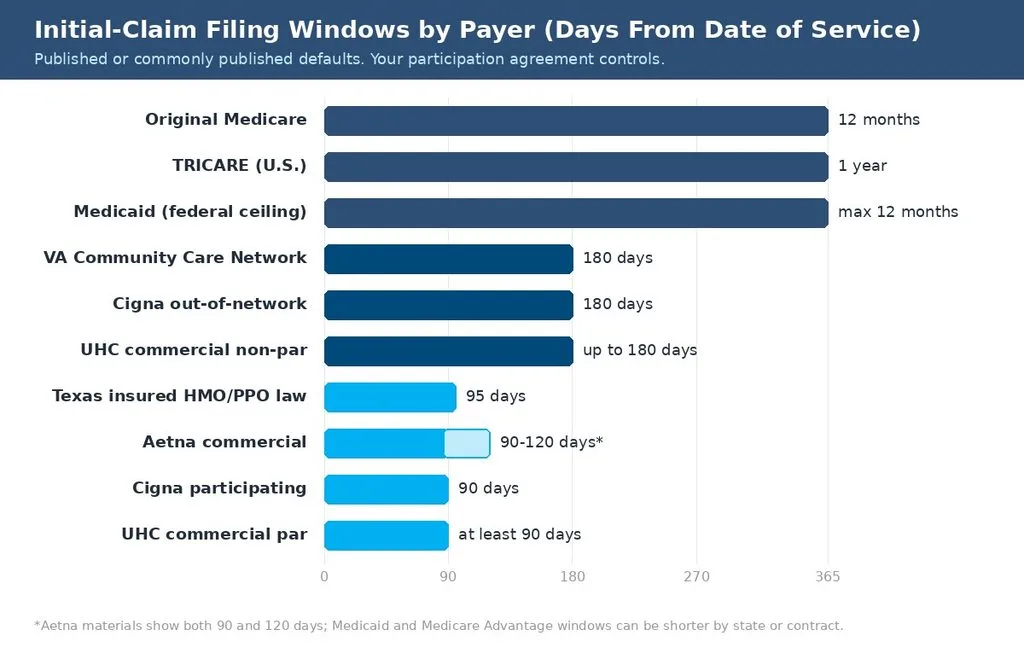
Timely filing limits run from about 90 days for many commercial in-network contracts to 12 months for Original Medicare, with Medicaid, Medicare Advantage and workers’ compensation set by state law or contract. The table below shows the initial-claim window for each major payer type.
| Payer | Initial claim window | Clock starts | Source type |
| Original Medicare (Part A and B) | 12 months (1 calendar year) | Date of service | Published standard: 42 CFR 424.44 |
| Medicare Advantage, contracted | Per your MA agreement | Date of service | Contract |
| Medicare Advantage, non-contracted | 365 days in UHC’s 2026 guidance; confirm per plan | Date of service | Payer manual |
| Medicaid fee-for-service | No more than 12 months; many states shorter | Date of service | Published standard: 42 CFR 447.45 + state manual |
| Medicaid managed care plans | Often shorter than state fee-for-service | Date of service | Plan contract |
| TRICARE (U.S.) | 1 year (3 years overseas) | Date of service or inpatient discharge | Published standard: TRICARE |
| VA Community Care Network | 180 days | Date of service | Published standard: VA |
| CHAMPVA | 1 year | Date of service or discharge | Published standard: 38 CFR 17.276 |
| UnitedHealthcare commercial | At least 90 days participating; up to 180 days non-participating | Date of service | Payer manual |
| Aetna commercial | 90 days commonly published; 120 days in some Aetna materials | Date of service | Payer manual + contract |
| Cigna | 90 days participating; 180 days out-of-network | Date of service | Payer manual |
| Blue Cross Blue Shield plans | Roughly 90 to 365 days, by licensee and product | Date of service | Plan manual |
| Workers’ compensation | Set by state law and carrier | Varies | State rules |
Commercial and Medicare Advantage figures are defaults published in payer manuals or compiled by industry sources at the time of research. Your participation agreement controls when it differs.
Original Medicare: 12 Months and Four Narrow Exceptions
The Medicare timely filing limit is 12 months, or one calendar year, after the date of service for Part A and Part B fee-for-service claims, under 42 CFR 424.44. A claim for a March 10, 2026 visit must reach the Medicare Administrative Contractor (MAC) by March 10, 2027. The CMS Medicare Claims Processing Manual transmittal restates the rule for all fee-for-service claims.
Only four exceptions extend that deadline: administrative error by Medicare or its contractor, retroactive Medicare entitlement, retroactive entitlement where a state Medicaid agency later recoups payment, and retroactive disenrollment from a Medicare Advantage plan or PACE. Each needs supporting documents. Our Medicare billing guide for providers covers enrollment and claim basics around this rule.
Medicare Advantage: The Contract Sets the Clock
Medicare Advantage timely filing follows the plan, not Original Medicare. Contracted providers use the window in their MA agreement, which is often 90 or 180 days. Non-contracted providers generally get longer; UnitedHealthcare’s 2026 guidance, for example, gives non-contracted MA providers 365 days from the date of service.
In billing audits, a common pattern is a practice applying Medicare’s 12-month rule to every patient over 65, then losing contracted MA claims somewhere after day 90. Check the member card at every visit, and when it names a private plan, use the MA contract window.
Medicaid: A Federal Ceiling With State Deadlines Underneath
Medicaid timely filing starts with a federal rule: 42 CFR 447.45 requires each state Medicaid agency to require claims within 12 months of the date of service. States and Medicaid managed care plans can set shorter windows, and Texas Medicaid is commonly reported at 95 days. Check your state Medicaid provider manual and each managed care contract before you bill.
One relief valve exists for dual-eligible patients. When the Medicare claim was filed on time, the state may pay the related Medicaid claim within 6 months after the Medicare disposition notice, even if the standard Medicaid window has passed.
TRICARE, VA Community Care and CHAMPVA
TRICARE requires claims within one year of the date of service or inpatient discharge, or within three years for care overseas. VA Community Care Network claims are due within 180 days of the date of service, and CHAMPVA claims within one year of service or discharge. TRICARE usually pays after other health insurance, and TRICARE West’s timely filing waiver rules accept a claim filed within 90 days of the other insurer’s decision when that EOB arrived inside the filing deadline.
Commercial Payers: Why One Number Is Never Enough
Commercial windows come from the payer’s manual and your participating provider agreement, and the two can differ. UnitedHealthcare’s 2026 Administrative Guide allows participating commercial providers at least 90 days and non-participating providers up to 180 days. Cigna’s claim submission guidance lists 90 days for participating providers and 180 days for out-of-network providers.
Aetna causes the most confusion, because industry references cite both 90 and 120 days for commercial claims; different Aetna products and contracts use different windows. Pull the signed contract before you set a tracker value. Carrier-specific habits are covered in our Aetna billing playbook and our UnitedHealthcare billing guide.
State Prompt-Pay Laws Can Set a Minimum
Some states write filing deadlines for insured plans into statute. Texas, for example, requires physicians to submit claims to HMOs and preferred provider carriers by the 95th day after service, unless the contract extends that period. State insurance rules generally do not reach self-funded employer plans governed by ERISA, so two patients carrying the same insurer’s card can be under different rules.
Workers’ Compensation and Auto Claims
Workers’ compensation deadlines come from state law and the carrier, so give them their own tracker row; our guide to workers’ compensation medical billing explains the claim setup.
When Does the Timely Filing Clock Start and Stop?
The clock usually starts on the date of service, or on the discharge or “through” date for institutional claims, and it stops only when the payer receives a claim it accepts for processing. A claim sitting in your billing system, or bounced back by the clearinghouse, has not been filed.
That second point loses more claims than the deadline itself. A clearinghouse rejection happens before the payer sees the claim, so the clock keeps running while the rejection waits in a queue. Read your electronic claims clearinghouse reports daily, and keep the payer-level acceptance acknowledgment, not the “sent” timestamp, as filing proof. Claims sent to the wrong payer cause the same loss, which is why insurance eligibility verification at every visit protects the filing window as much as the payment.
Secondary Claims Run on Different Clocks
Coordination of benefits (COB, the rules that decide which plan pays first) changes the starting point for secondary claims, and payers disagree on how.
| Situation | When the secondary clock runs | Source type |
| Medicare as secondary payer | Still 12 months from the date of service | Published standard: CMS |
| Cigna as secondary payer | From the processing date on the primary payer’s EOB | Payer manual |
| Texas insured plans as secondary | 95 days after notice of the primary payer’s decision | Published standard: Texas |
| TRICARE after other health insurance | 90 days from the other insurer’s decision, if that EOB came within the 1-year deadline | Published standard: TRICARE West |
| Medicaid after Medicare (crossover) | Within 6 months of the Medicare disposition notice, if Medicare was filed on time | Published standard: 42 CFR 447.45 |
Corrected Claims and Appeals Have Separate Deadlines
A corrected claim replaces a claim the payer already processed. Some payers count it against the original filing window, while others measure from the remittance date, so record both rules in your payer matrix. For Original Medicare, MAC guidance confirms that adjustment claims are also held to the one-calendar-year limit. Appeals carry their own appeal deadline: a Medicare redetermination must be requested within 120 days of receiving the initial determination, and commercial appeal windows are set by each payer’s manual.
How Do You Calculate a Timely Filing Deadline?
Add the payer’s window, in calendar days, to the date of service, then set an internal file-by date at half that window. The four formulas below turn those rules into numbers you can track every week.
Payer Deadline
Formula: Deadline = date of service + payer window (calendar days).
Example: a visit on March 10, 2026, under a 90-day commercial contract. March has 21 days left, April adds 30 and May adds 31, which reaches 82 days; eight more days lands on June 8, 2026. The same visit billed to Original Medicare is due by March 10, 2027. If your contract defines the day count differently, use the contract’s method.
Internal File-By Date
Formula: File-by date = date of service + (payer window x 50%).
For the 90-day example, half the window is 45 days, which gives a file-by date of April 24, 2026. The 50% buffer is a practical target, not a payer rule. It leaves room for one rejection cycle, one eligibility correction and one round of missing documentation.
Window Used by Payer
Formula: Window used (%) = average filing lag / payer window x 100, where filing lag is the days from service to payer acceptance.
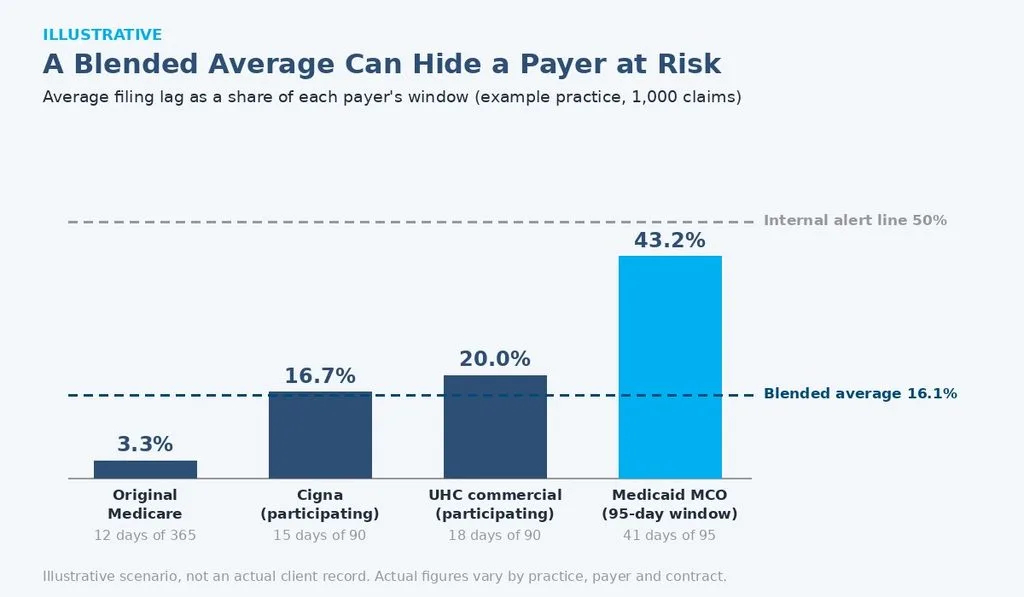
Illustrative scenario (not an actual client record): a practice submits 1,000 claims in a month across four payer groups.
| Payer group | Claims | Avg filing lag | Window | Window used |
| Original Medicare | 400 | 12 days | 365 days | 3.3% |
| Cigna participating | 200 | 15 days | 90 days | 16.7% |
| UHC commercial participating | 250 | 18 days | 90 days | 20.0% |
| Medicaid managed care plan | 150 | 41 days | 95 days | 43.2% |
| Blended (weighted by claims) | 1,000 | 18.5 days | n/a | 16.1% |
The blended lag of 18.5 days looks comfortable. The Medicaid plan tells a different story: an average of 41 days in a 95-day window means many claims are already past the halfway mark, and one bad week of rejections would push some over the line.
Revenue at Risk
Formula: Revenue at risk = unaccepted claims within 30 days of their deadline x average expected allowed amount.
Illustrative scenario (not an actual client record): 38 claims x $142 = $5,396 that becomes a write-off if those claims are not accepted within the month. Run this by payer from your A/R aging report, not as one total. It pairs well with the steps for lowering accounts receivable days.
How Should You Read These Numbers?
Compare each payer against its own window and its own history, never against a different payer. A 30-day filing lag is harmless for Original Medicare and a warning sign for a 90-day commercial contract.
One missed file-by date is a signal to investigate, not a verdict on your team; check eligibility, documentation holds and the rejection backlog first. When the same miss repeats for two weeks or across two payers, treat it as a process problem.
What Is the Best Process to Prevent CO-29 Denials?
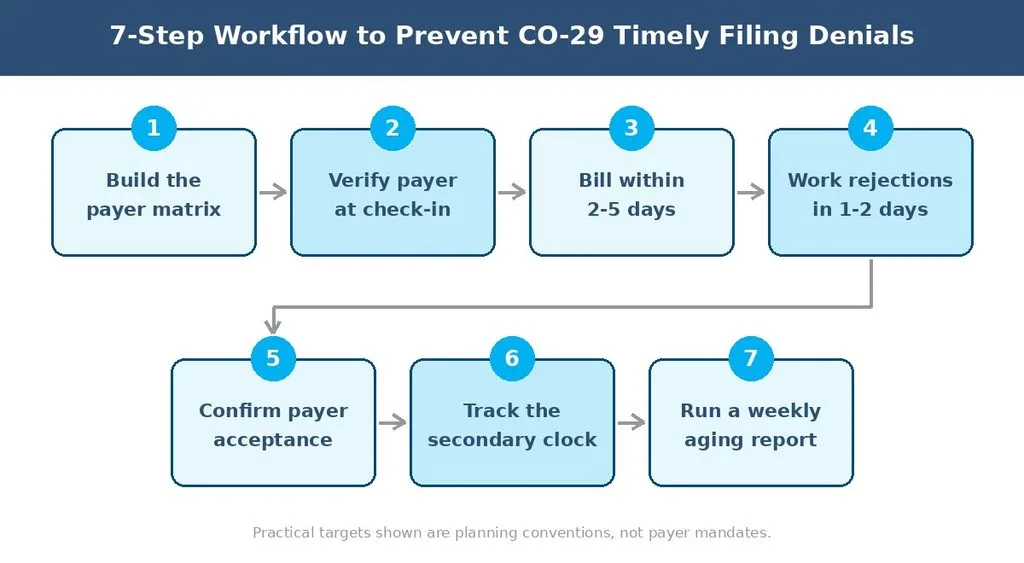
The most reliable prevention is a short, repeatable workflow that files every claim well inside its shortest window and confirms payer acceptance. The CO-29 denial code is the claim adjustment reason code meaning the time limit for filing has expired; the CO group code marks it as a contractual obligation, so in-network providers generally cannot bill the patient. The stakes are rising: Experian Health’s 2025 State of Claims survey found that 41% of providers report denial rates of 10% or higher.
- Build a payer matrix. List every payer and product with its initial, corrected-claim, secondary and appeal windows, taken from the contract, and update it at each renewal.
- Verify the payer at check-in. Confirm primary and secondary coverage at every visit, and re-verify when a patient reports a plan change.
- Bill within 2 to 5 business days. Hold a claim only when documentation is incomplete, and give every hold an expiry date.
- Work rejections within 1 to 2 business days. Assign one owner per day so the queue never ages unnoticed.
- Confirm payer acceptance. Match a payer acknowledgment or claim number to every submission within a week.
- Track the secondary clock. Submit secondary claims within a few days of posting the primary EOB.
- Run a weekly aging report by payer. Sort it by days left in the window, not days since service.
Across billing audits, our team often finds that the oldest unfiled claims are not complex ones. They are claims parked for a missing signature or referral with no hold expiry date. When your weekly report keeps showing claims past their file-by date, our denial management and appeals service can take over the rework queue while you fix the front end.
What Can You Do After a Timely Filing Denial?
You can overturn a timely filing denial only by proving the claim was filed on time or by qualifying for a documented exception; a late claim without proof is generally a write-off. Start by building a proof of timely filing packet before you contact the payer.
- The payer acceptance report or acknowledgment showing the date received.
- The payer claim number from the original submission.
- The original electronic file or paper claim, plus any rejection notice.
- The prior EOB and any payer correspondence about the claim.
For Original Medicare, a timely filing denial is not an initial determination, so it cannot go through the normal appeal levels; the route is an exception request to your MAC with documents that prove one of the four exceptions. Our guide to appealing a Medicare denial covers the appeal levels for other Medicare denials. For commercial payers, send a reconsideration with the packet and a concise claims appeal letter. Do not bill the patient for an in-network CO-29 adjustment; Cigna, for example, states that its contract prohibits balance billing for late-filed claims.
How Long Does It Take to Fix Timely Filing Problems?
Most practices can stop new timely filing losses within roughly 30 to 60 days by building the payer matrix, clearing the rejection backlog and starting a weekly window report. Full results, meaning a stable filing lag and no recurring write-offs, typically take 90 to 180 days, because the new process has to run through full filing windows for your main payers. These are planning ranges, not guarantees, and claims already past their deadline usually stay lost without proof or an exception.
Common Mistakes and How to Avoid Them
- Treating Medicare Advantage like Original Medicare. When the member card names a private plan, use the MA contract window, not 12 months.
- Using one number for a multi-product payer. When Aetna, a Blue plan or a Medicaid plan has several products, record a window per product.
- Counting the send date. When the clearinghouse report shows a rejection, the claim has not been filed; correct and resend within 1 to 2 business days.
- Holding claims during credentialing without a plan. When a new provider is waiting on enrollment, log the service date of every held claim and confirm the effective date early. In billing audits, a common pattern is a provider’s first month of claims expiring before anyone confirms the effective date; our article on credentialing mistakes that delay payments covers prevention.
- Forgetting the secondary clock. When a primary EOB posts, start the secondary claim the same week.
- Billing the patient for CO-29. When the denial carries a CO group code on an in-network claim, write it off or prove timely filing; do not send it to the patient.
Quick Summary
- Original Medicare allows 12 months from the date of service, with four documented exceptions.
- Medicaid allows no more than 12 months federally, and many states and plans allow less.
- Medicare Advantage and commercial windows come from the contract, commonly 90 to 180 days.
- The clock stops only at payer acceptance; clearinghouse rejections do not count as filing.
- Practical targets: bill in 2 to 5 business days, fix rejections in 1 to 2 days, file by 50% of the window.
- Track window used by payer, because blended averages hide the payer at risk.
Self-Assessment Checklist
Answer yes or no to each question, then count your yes answers.
- Do you have a written filing window for every payer and product, taken from the contract?
- Does your payer matrix list separate corrected-claim, secondary and appeal windows?
- Do you bill most claims within 2 to 5 business days of service?
- Are clearinghouse rejections worked within 1 to 2 business days?
- Do you confirm payer acceptance, not just submission, for every claim?
- Is every claim filed by 50% of its payer window?
- Do you verify primary and secondary coverage at every visit?
- Do you run a weekly aging report sorted by days left in the window?
- Did you have zero timely filing write-offs last month?
- Can you produce a proof-of-timely-filing packet for any claim within one business day?
Scoring: 9 to 10 yes answers means strong control; keep quarterly contract reviews. 6 to 8 means a workable but exposed process; fix the “no” items, starting with rejections and acceptance tracking. 0 to 5 means high risk; build the payer matrix and weekly window report this month, and consider outside support.
When Should a Practice Consider Professional Billing Support?
Outside support makes sense when timely filing losses recur even after you set internal deadlines. Watch for these signals:
- Timely filing write-offs appear in two or more consecutive months.
- The clearinghouse rejection queue is regularly older than a few business days.
- No one can say which window applies to each Medicare Advantage or Medicaid managed care contract.
- Staffing gaps or new-provider onboarding have pushed filing lag past half of your shortest window.
- You are adding payers or locations faster than the payer matrix is updated.
In any outside partner, look for contract-level payer tracking, daily rejection work, acceptance confirmation, secondary claim follow-up, payer-level reporting, HIPAA-compliant processes and a named contact.
Aspect Billing Solutions is one example. Our team provides end-to-end billing and coding (ICD-10, CPT and HCPCS), credentialing, eligibility verification and prior authorization, denial management, A/R follow-up and compliance support, with a dedicated agent assigned to each provider. In practice, that agent maintains the payer matrix, works rejections and tracks every claim against its filing window. Results vary by practice, payer mix and starting backlog. See our revenue cycle management services or the full range of medical billing services.When Should a Practice Consider Professional Billing Support?
Outside support makes sense when timely filing losses recur even after you set internal deadlines. Watch for these signals:
- Timely filing write-offs appear in two or more consecutive months.
- The clearinghouse rejection queue is regularly older than a few business days.
- No one can say which window applies to each Medicare Advantage or Medicaid managed care contract.
- Staffing gaps or new-provider onboarding have pushed filing lag past half of your shortest window.
- You are adding payers or locations faster than the payer matrix is updated.
In any outside partner, look for contract-level payer tracking, daily rejection work, acceptance confirmation, secondary claim follow-up, payer-level reporting, HIPAA-compliant processes and a named contact.
Aspect Billing Solutions is one example. Our team provides end-to-end billing and coding (ICD-10, CPT and HCPCS), credentialing, eligibility verification and prior authorization, denial management, A/R follow-up and compliance support, with a dedicated agent assigned to each provider. In practice, that agent maintains the payer matrix, works rejections and tracks every claim against its filing window. Results vary by practice, payer mix and starting backlog. See our revenue cycle management services or the full range of medical billing services.
Final Considerations
Timely filing denials are almost entirely preventable and very hard to reverse. The fix is not memorizing a chart; it is knowing which rule applies to each claim and filing well before it bites.
Some numbers in this guide are firm published standards: Original Medicare’s 12 months, the 12-month federal Medicaid ceiling, TRICARE’s one year, VA Community Care’s 180 days and Texas’s 95-day statute for insured plans. Commercial and Medicare Advantage windows are payer-manual defaults that your contract can change. The 2 to 5 day filing lag, 1 to 2 day rejection turnaround and 50% file-by date are practical targets, and the worked-example figures are illustrative.
Medical billing timely filing limits by payer will keep shifting as contracts renew, so the natural next question is which of your payers is closest to its window right now. If you want a team to answer that every week, explore our revenue cycle management services.
Frequently Asked Questions
What is the timely filing limit for Medicare?
Original Medicare’s timely filing limit is 12 months, or one calendar year, from the date of service for Part A and Part B claims, under 42 CFR 424.44. Exceptions exist only for administrative error, retroactive entitlement, Medicaid recoupment after retroactive entitlement, and retroactive Medicare Advantage or PACE disenrollment, each with documentation.
Does Medicare Advantage follow Medicare’s 12-month rule?
Not automatically. Medicare Advantage plans are run by private insurers, and contracted providers follow the window in their MA agreement, which is often 90 or 180 days. Non-contracted providers usually get longer; UnitedHealthcare’s 2026 guidance allows them 365 days. Always check the plan’s provider manual and your contract.
What is a good filing lag for medical claims?
A good filing lag is 2 to 5 business days from service to payer acceptance. That is a practical target used by billing teams, not a payer rule. It leaves room to fix rejections and eligibility problems long before even a 90-day commercial window closes.
What is a good internal deadline for timely filing?
A good internal deadline is 50% of each payer’s window, such as day 45 for a 90-day contract. This practical target leaves time for one rejection cycle, one eligibility correction and one documentation request. Set it per payer and product, not as one practice-wide number.
Can you appeal a timely filing denial?
For commercial payers, yes, with proof that the payer received the claim on time, such as an acceptance report or payer claim number. Original Medicare treats a late-filing denial as not appealable; you instead request an exception from your MAC with documentation. A late claim without proof or an exception is generally a write-off.
What is a good way to prove timely filing?
A good proof packet includes the payer-level acceptance report showing the receipt date, the payer claim number, the original claim file, any rejection notice and related EOBs. A clearinghouse “sent” report alone may not be enough, because many payers measure filing by their own receipt date.
Sources and Methodology
(a) Published standards and definitions: 42 CFR 424.44 and CMS Pub. 100-04, Chapter 1, Section 70 (Medicare timely filing and exceptions); 42 CFR 447.45 (Medicaid timely claims, including crossover claims); TRICARE claims filing rules (tricare.mil and TRICARE West); VA Community Care claim requirements (va.gov); 38 CFR 17.276 (CHAMPVA); Texas Insurance Code Sections 843.337 and 1301.102 and 28 Tex. Admin. Code Section 21.2806; claim adjustment reason code 29 (X12 code set); Medicare redetermination filing rule (120 days).
(b) Named benchmarking data providers: No named benchmarking-provider data was used for filing-lag or file-by targets in this article.
(c) Practical or illustrative targets from general industry sources: commercial and Medicare Advantage defaults from UnitedHealthcare’s 2026 Administrative Guide (as cited by industry sources), Cigna’s provider website, Aetna materials (90 and 120 days both appear) and Blue plan manuals compiled by industry sources; the 2 to 5 day filing lag, 1 to 2 day rejection turnaround and 50% file-by date are practical targets; all worked-example figures are illustrative.
(d) Survey or study data: Experian Health, State of Claims 2025 (survey of 250 healthcare professionals, June to July 2025): 41% of providers report denial rates of 10% or higher.
Results vary by practice, payer mix, contract and state. All figures reflect information available at the time of research (October 2026); codes, payer manuals and fee schedules change, so confirm current rules before relying on any number here.