
Medicare Advantage Billing Guide: 2026 Rules for Claims, Prior Auth and Appeals
A Medicare Advantage billing guide explains how to bill Part C plans, which are private plans that pay most Medicare-covered services instead of Original Medicare. Claims go to the MA plan, not the MAC, using the plan’s member ID. Since January 1, 2026, MA plans must decide expedited prior authorizations within 72 hours and standard requests within 7 calendar days.
Medicare Advantage now covers more than half of Medicare beneficiaries, so for most practices it is no longer a side payer. It is also where the most friction sits: misrouted claims, authorization denials, underpayments and appeal rules that differ from Original Medicare. This guide covers who to bill, how prior authorization works in 2026, how contracted and non-contracted providers are paid, how to appeal, and how to measure your MA performance with four formulas. A ten-question self-assessment checklist near the end scores your MA billing in a few minutes.
Key Numbers Cheat Sheet
Medicare Advantage numbers at a glance
| Metric | Practical target/range | Review frequency | Source type |
| Prior authorization decision time | 72 hours expedited; 7 calendar days standard (since January 1, 2026) | Per request | [P] CMS-0057-F |
| MA prior authorization denial rate (national) | 7.7% of requests fully or partly denied in 2024 | Annually | [S] KFF analysis of CMS data |
| Share of MA prior authorization denials appealed / overturned | 11.5% appealed; 80.7% of appeals partly or fully overturned (2024) | Annually | [S] KFF analysis of CMS data |
| Non-contracted clean claim payment | 95% paid within 30 days; other claims within 60 days | Monthly | [P] CMS Medicare Managed Care Manual / 42 CFR 422.520 |
| Medicare patients with MA status verified before the visit | 100% | Daily | [I] practical target |
[P] = published rule from CMS. [S] = named study or analysis (KFF). [I] = practical target, not a CMS, AMA, AAPC, MGMA or HFMA mandate. Results vary by plan, contract, specialty and region.
How is Medicare Advantage billing different from Original Medicare?
Medicare Advantage billing differs from Original Medicare in who pays, which rules apply and how disputes are handled. An MA organization, not a Medicare Administrative Contractor (MAC), processes the claim under its own policies, within limits CMS sets, and pays according to a contract or, for out-of-network providers, the Original Medicare amount.
Under Original Medicare, a MAC pays from the Medicare Physician Fee Schedule and applies national and local coverage rules. Under MA, the plan does both jobs and adds its own layer: networks, referrals, prior authorization, claim edits and appeal procedures. Our guide to Medicare billing for providers covers the Original Medicare side.
Original Medicare vs Medicare Advantage for providers
| Topic | Original Medicare | Medicare Advantage |
| Who pays the claim | MAC | MA plan (private insurer under CMS contract) |
| Patient ID on the claim | Medicare Beneficiary Identifier (MBI) | Plan member ID from the MA card |
| Payment rate | Medicare Physician Fee Schedule | Contract rate; Original Medicare amount if non-contracted |
| Coverage rules | NCDs and LCDs | Must follow NCDs and LCDs; plan criteria only where Medicare’s are not fully established |
| Prior authorization | Limited set of services | Common; 72-hour and 7-day decision limits since 2026 |
| Appeals | Redetermination by the MAC | Plan reconsideration, then independent review |
Summarized from CMS regulations and guidance, including the CY 2024 MA final rule (CMS-4201-F) and CMS-0057-F. Plan contracts add their own terms.
The 2024 coverage-criteria rule still matters
Since January 1, 2024, CMS’s MA final rule (CMS-4201-F) has required plans to follow Traditional Medicare’s national and local coverage determinations. Plans may use internal criteria only where Medicare’s are not fully established, and must make those criteria publicly accessible. An approved authorization must remain valid for the course of treatment, and new enrollees get a 90-day transition period for active treatment.
Which payer should you bill for a Medicare Advantage patient?
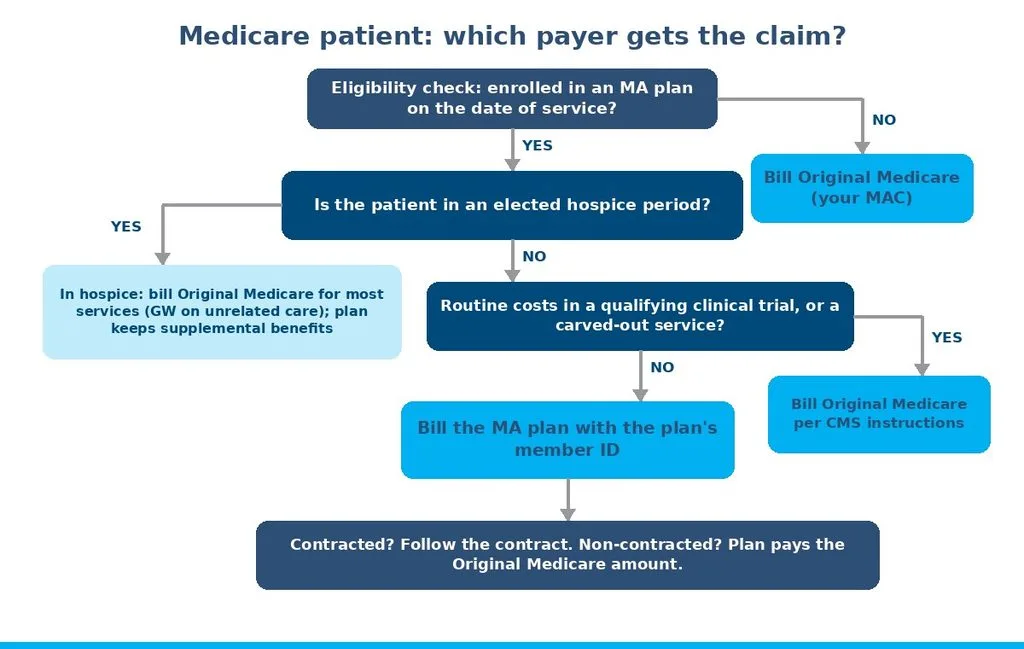
Bill the MA plan for almost all Medicare-covered services when the patient is enrolled in an MA plan on the date of service. A few situations still go to Original Medicare through the MAC, so check enrollment and those exceptions before every claim.
Patients often show only their Medicare card, even when they are in an MA plan. Check enrollment at each visit through an eligibility transaction or portal, and scan the MA card; our insurance eligibility verification guide covers the steps. A claim sent to the MAC for an MA enrollee will reject and has to be rebilled to the plan.
Exceptions billed to Original Medicare
When an MA enrollee elects hospice, Original Medicare becomes responsible for most services, while the plan keeps responsibility for supplemental benefits. CMS ended the VBID hospice benefit component on December 31, 2024, so that carve-out applies again across all plans. Services unrelated to the terminal condition generally carry modifier GW; our hospice modifier GW guide explains its use.
Routine costs for MA enrollees in qualifying clinical trials are also billed to Original Medicare, and CMS can carve out new national coverage determinations it classifies as significant cost until plan payments are adjusted. Follow the CMS Claims Processing Manual instructions for each.
How does prior authorization work for Medicare Advantage in 2026?
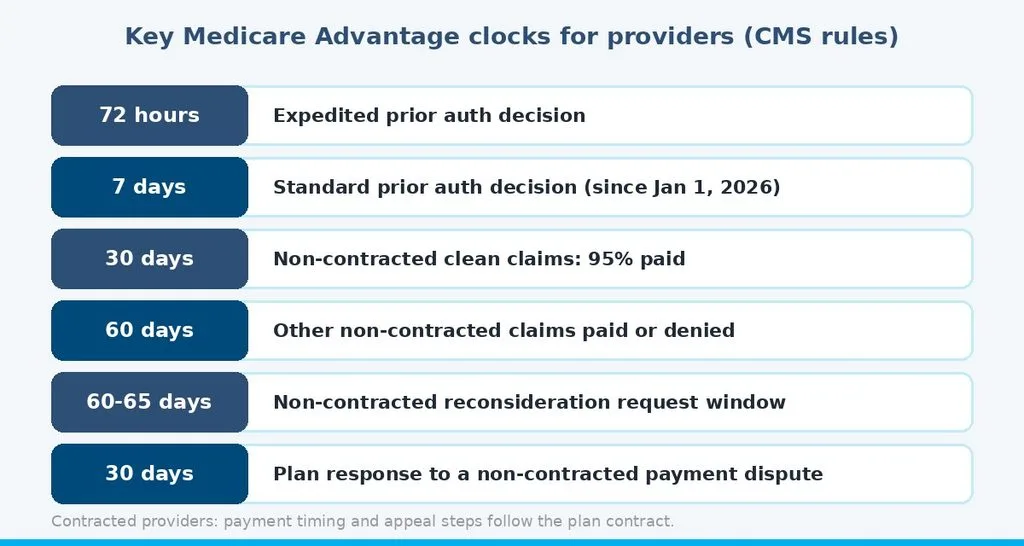
MA plans may require prior authorization, but since January 1, 2026, the CMS Interoperability and Prior Authorization Final Rule (CMS-0057-F) requires decisions within 72 hours for expedited requests and 7 calendar days for standard requests, with a specific reason for every denial. Plans also had to post their first public prior authorization metrics by March 31, 2026.
Prior authorization is far more common in MA than in Original Medicare. KFF’s analysis of CMS data found MA insurers made nearly 53 million prior authorization determinations in 2024, denied 4.1 million (7.7%), and overturned 80.7% of the small share of denials that were appealed.
What the 2026 metrics show
KFF’s review of the first required public reports found MA insurers denied 12% of standard prior authorization requests, and 67% of appealed denials were overturned, with wide variation between insurers. The two KFF figures use different data sources and years, so treat both as context rather than a single benchmark.
Making authorizations stick
Check each plan’s authorization list for every scheduled service, submit with the clinical documentation that matches the plan’s published criteria, and record the authorization number on the claim. Our guide to prior authorization for high-value procedures covers documentation that holds up.
In billing reviews, a common pattern is authorizations approved for one CPT code while the procedure performed, and billed, is a closely related code. MA plans often deny the mismatch even when the service was medically necessary, so update the authorization before the claim goes out.
How are contracted and non-contracted providers paid?
Contracted (in-network) providers are paid what their MA contract says, on the contract’s timeline. Non-contracted providers that are eligible to bill Medicare must be paid at least what Original Medicare would have paid, and CMS requires plans to pay 95% of their clean claims within 30 days.
Contracted providers
The contract sets the fee schedule, timely filing limit, claim editing rules, and appeal steps. Many MA contracts pay a percentage of the Medicare fee schedule, but some use capitation or shared-savings arrangements. Credentialing and contracting decisions shape the rest of MA billing; our guide to in-network credentialing and billing explains the trade-offs.
Non-contracted providers
Under 42 CFR 422.520 and the Medicare Managed Care Manual, MA plans must pay 95% of clean claims from non-contracted providers within 30 days, with interest after that, and must pay or deny other claims within 60 days. The payment should equal the Original Medicare amount for the service, and patient liability is generally limited to plan cost sharing plus anything Original Medicare rules would allow that provider to collect.
Balance billing and dual-eligible patients
Contracted providers may not charge MA enrollees more than plan cost sharing for covered services, and non-contracted providers are held to what Original Medicare rules would allow, so check each plan’s out-of-network payment rules. Patients in the Qualified Medicare Beneficiary (QMB) program cannot be billed for Medicare cost sharing at all. For dual-eligible patients in Dual Eligible Special Needs Plans (D-SNPs), check how the plan coordinates Medicaid secondary payment.
How do you appeal a Medicare Advantage denial or underpayment?
The appeal path depends on whether you are contracted and whether the issue is a denial or an underpayment. Contracted providers follow the plan’s contract process. Non-contracted providers can request a reconsideration of a denial with a signed Waiver of Liability, or file a payment dispute when they believe the plan paid less than Original Medicare would.
Medicare Advantage provider appeal paths
| Situation | Process | Key timing |
| Contracted provider, denial or underpayment | Plan’s contractual dispute and appeal process | Per contract |
| Non-contracted provider, denied claim | Plan reconsideration with a signed Waiver of Liability; then independent review entity | Request within 60 to 65 days of the notice, per CMS guidance and the plan notice |
| Non-contracted provider, paid less than Original Medicare | Plan payment dispute; then CMS payment dispute resolution if unresolved | Plan response within 30 days under CMS guidance |
| Pre-service authorization denial | Reconsideration (expedited when urgent), often with a peer-to-peer review | Follow the denial notice timelines |
Summarized from CMS Parts C and D appeals guidance and the CMS provider payment dispute memo. Plan filing windows may differ; always follow the timeframe on the plan’s notice.
CMS’s Parts C and D appeals guidance states that a non-contracted provider must sign a Waiver of Liability holding the enrollee harmless to request reconsideration, and that the payment dispute process cannot be used for zero-pay denials. Our guide on how to write a claims appeal letter covers the narrative and attachments.
Given that most appealed MA authorization denials are overturned, a practice that rarely appeals is likely leaving payment behind. A tracked denial management workflow makes sure each denial gets a decision: appeal, correct or write off.
How does risk adjustment affect Medicare Advantage billing?
MA plans are paid partly on patient risk scores built from the diagnoses providers document and code. For payment year 2026, CMS completed the three-year phase-in of its 2024 CMS-HCC risk adjustment model (often called V28), so accurate, specific diagnosis coding matters even when a claim’s payment does not change.
Each chronic condition should be assessed and documented at least once a year in a face-to-face or qualifying telehealth encounter, coded to the highest specificity the record supports. Diagnoses copied forward without assessment can fail plan or CMS validation audits. Our ICD-10 coding support guide covers specificity that supports both claims and risk scores.
How do you measure Medicare Advantage billing performance?
Measure MA performance with four checks by plan: prior authorization denial rate, appeal yield, payment variance against the expected rate, and timeliness of payment. A blended MA figure can look normal while one plan accounts for most of the problems.
Worked example 1: prior authorization denial rate by plan
Formula: prior authorization requests denied (fully or partly) ÷ requests submitted. Illustrative scenario (not an actual client record): Plan A denies 10 of 200 requests (5%), Plan B 18 of 120 (15%), and Plan C 4 of 80 (5%). The blended rate is 32 ÷ 400, or 8%, close to KFF’s 7.7% national figure. Plan B, at three times the others, is the real finding.
Worked example 2: appeal yield
Formula: denials appealed ÷ denials, and denials overturned ÷ denials appealed. Illustrative scenario: of 32 denials, the practice appealed 6 (19%), and 4 were overturned. The 26 denials never appealed represent $11,700 at an average of $450 each. Not every denial merits appeal, but each one deserves a documented decision.
Worked example 3: non-contracted payment variance
Formula: (expected Original Medicare amount − amount paid) ÷ expected amount. Illustrative scenario: a non-contracted claim should have been paid $142.00, the Original Medicare amount for the locality, but the plan paid $128.00. The $14.00 shortfall is a 9.9% variance and qualifies for a payment dispute. The CMS Physician Fee Schedule Look-Up Tool shows the expected amount for your locality.
Worked example 4: prompt payment on non-contracted clean claims
Formula: clean claims paid within 30 days ÷ clean claims submitted. Illustrative scenario: 180 of 200 clean non-contracted claims to one plan were paid within 30 days, or 90%, below the 95% CMS requires plans to meet. Document the late claims and check that interest was paid.
How long does it take to improve Medicare Advantage billing?
Eligibility and routing fixes can work within weeks, while denial and payment trends usually take a few months to improve. Treat these as general planning ranges, not guarantees.
Adding MA enrollment checks and plan-specific authorization lists to front-desk workflows is often done within 2 to 4 weeks. Authorization documentation and appeal processes typically show results within 1 to 3 months as cases move through review. Denial rates and payment variances by plan usually stabilize over one to two quarters, especially after escalating patterns with plan representatives.
What are the most common Medicare Advantage billing mistakes?
The most common mistakes are billing the wrong payer, treating MA like Original Medicare, and not appealing. Each has a simple control.
Billing the MAC for an MA enrollee
Verify MA enrollment at every visit; patients switch plans each year, and many carry only their Medicare card.
Billing the MA plan for carved-out services
Hospice-period services and clinical trial routine costs generally go to Original Medicare. Build these exceptions into your eligibility workflow.
Authorizing one code and billing another
Update the authorization when the planned procedure changes, or the claim is likely to deny.
Accepting underpayments as non-contracted
If the plan paid less than the Original Medicare amount, file a payment dispute. Many practices never compare.
Not appealing denials
KFF’s data show few MA denials are appealed, but most appeals succeed. Decide on every denial deliberately. Original Medicare uses a different, five-level appeal process, so do not mix the two.
A pattern that shows up repeatedly in MA reviews is treating every plan the same. Authorization lists, payer IDs, timely filing limits and appeal addresses differ by plan, so a one-page reference per major MA plan prevents most avoidable errors.
Quick Summary
- Bill the MA plan, not the MAC, using the plan member ID, after verifying enrollment on the date of service.
- Hospice-period services and clinical trial routine costs for MA enrollees generally go to Original Medicare.
- Since January 1, 2026, MA plans must decide prior authorizations within 72 hours (expedited) or 7 calendar days (standard) and give specific denial reasons.
- Non-contracted providers should receive at least the Original Medicare amount, with 95% of clean claims paid within 30 days.
- KFF: 7.7% of MA authorization requests were denied in 2024, and 80.7% of appealed denials were overturned.
- Track denial rate, appeal yield, payment variance and timeliness by plan, not just for MA overall.
Self-Assessment Checklist
Answer yes or no for your practice:
- Do you verify MA enrollment for every Medicare patient on the date of service?
- Do you route hospice-period and clinical trial services to Original Medicare when required?
- Do you keep a current prior authorization list for each major MA plan?
- Are authorization numbers recorded and matched to the billed codes before claims go out?
- Do you compare MA payments with contract rates, or Original Medicare amounts if non-contracted?
- Do you track prior authorization denial rates by plan?
- Do you make a documented appeal decision on every MA denial?
- Do non-contracted reconsiderations include a signed Waiver of Liability?
- Are chronic conditions assessed and coded to full specificity at least once a year?
- Do you monitor whether non-contracted clean claims are paid within 30 days?
Scoring: 9 to 10 yes answers means strong MA billing controls; keep quarterly reviews. 6 to 8 yes answers means targeted gaps; fix the “no” items within one quarter. 5 or fewer means meaningful revenue is likely being lost to MA denials, underpayments or misrouting; prioritize a plan-by-plan review.
When should a practice consider professional support?
Consider outside support when MA problems persist after you have added enrollment checks and plan references. These signals usually mean the in-house approach has reached its limits:
- Authorization denials for one or more plans stay well above the national figure for two quarters.
- Denials go unappealed because nobody has time to work them.
- Underpayments are suspected but nobody compares payments with expected rates.
- Contract terms, payer IDs and authorization lists for multiple MA plans are not maintained in one place.
- Risk adjustment coding is inconsistent across providers.
When evaluating help, look for teams that maintain plan-specific rules, handle prior authorization end to end, compare payments with contracts, and run MA appeals and payment disputes within deadlines. A dedicated prior authorization service is one option when authorization volume is the main bottleneck.
Aspect Billing Solutions is one example of this kind of partner. Its medical billing and coding services cover end-to-end billing and coding, credentialing, eligibility verification and prior authorization, denial management, A/R follow-up and compliance support, with a dedicated agent assigned to each provider. Results vary by practice, specialty and payer mix. You can review how the team handles revenue cycle management for medical practices.
Final Considerations
A Medicare Advantage billing guide comes down to four habits: confirm the right payer, secure the right authorization, compare payment with the right rate, and use the right appeal path. Each habit is simple, but each one differs from Original Medicare in ways that cost money when missed.
Some figures here are firm published rules: the 72-hour and 7-day authorization limits under CMS-0057-F, the 30-day and 60-day non-contracted payment rules, the Waiver of Liability requirement, and the 2024 coverage-criteria rule. The 7.7%, 11.5%, 80.7%, 12% and 67% figures are KFF analyses of CMS and insurer data. The 100% verification target and all worked-example figures are practical or illustrative.
The natural next question is how your own MA claims compare. Pull one quarter of MA authorizations, denials and payments, run the four formulas by plan, and score the checklist. If the gaps are larger than your team can close, explore Medicare Advantage billing and revenue cycle support from Aspect Billing Solutions.
Frequently Asked Questions
Do you bill Medicare or the Medicare Advantage plan?
Bill the Medicare Advantage plan for almost all Medicare-covered services when the patient is enrolled in an MA plan on the date of service, using the plan member ID. Exceptions include services during an elected hospice period and routine costs in qualifying clinical trials, which generally go to Original Medicare.
How long does a Medicare Advantage plan have to decide prior authorization?
Since January 1, 2026, under CMS-0057-F, MA plans must decide expedited prior authorization requests within 72 hours and standard requests within 7 calendar days. They must also give a specific reason for every denial and publicly report authorization metrics each year.
What is a good prior authorization denial rate for Medicare Advantage?
There is no official target. For context, KFF found MA insurers denied 7.7% of prior authorization requests in 2024. A practice should compare its own denial rate by plan and service line against that figure and investigate any plan running far higher.
What is a good appeal rate for Medicare Advantage denials?
No standard exists, but KFF found only 11.5% of MA authorization denials were appealed in 2024, while 80.7% of appeals were partly or fully overturned. A practical goal is a documented appeal decision on every denial, appealing those where the record supports medical necessity.
How much does an MA plan pay a non-contracted provider?
An MA plan must pay a non-contracted provider that is eligible to bill Medicare the amount Original Medicare would have paid. CMS requires plans to pay 95% of clean claims from non-contracted providers within 30 days, with interest on late clean claims, and to pay or deny other claims within 60 days.
Can a non-contracted provider appeal a Medicare Advantage denial?
Yes. A non-contracted provider can request a reconsideration of a denied claim by submitting a signed Waiver of Liability, which holds the enrollee harmless regardless of the outcome. If the plan upholds the denial, the case goes to an independent review entity. Underpayments use a separate payment dispute process.
Sources and Methodology
(a) Published standards and definitions: CMS Interoperability and Prior Authorization Final Rule (CMS-0057-F), decision timeframes effective January 1, 2026; CMS CY 2024 MA and Part D final rule (CMS-4201-F) on coverage criteria and utilization management; 42 CFR 422.520 and the CMS Medicare Managed Care Manual on non-contracted payment; CMS Parts C and D appeals guidance; CMS provider payment dispute memo for non-contracted providers; CMS VBID hospice benefit component conclusion (December 31, 2024); CMS 2026 MA Advance Notice and Rate Announcement on the 2024 CMS-HCC model phase-in; CMS Claims Processing Manual Chapter 32 on MA-related billing exceptions.
(b) Named benchmarking data providers: none used. No MGMA, HFMA or vendor benchmark is cited for MA performance.
(c) Practical or illustrative targets: the 100% enrollment verification target, timeframes to improvement and all worked-example figures are practical or illustrative and not client records. Plan-specific filing windows and appeal deadlines vary; follow each plan’s notice and contract.
(d) Survey or study data: KFF, “Medicare Advantage Insurers Made Nearly 53 Million Prior Authorization Determinations in 2024” (7.7% denied; 11.5% of denials appealed; 80.7% of appeals overturned); KFF, “Prior Authorization Metrics Provide New Insights into Insurer Practices, but Gaps Remain” (2026 analysis of first public reports: 12% of standard MA requests denied; 67% of appealed denials overturned).
Results vary by practice, plan, contract, specialty and region. Figures reflect information available at the time of research (October 2026). MA plan policies, CMS rules and risk adjustment models change each year, so review this guidance annually and when your contracts renew.