
CO-16 Denial Code Explained: Causes, RARCs and Fixes
CO-16 means the claim lacks information or has a submission or billing error needed for adjudication. The “CO” group code makes the provider responsible, so the patient is not billed. A remark code identifies the exact problem. Keeping CO-16 under 10% of all denials is an illustrative practical target, not a mandate.
CO-16 is one of the most common denials in medical billing, and one of the most preventable. The trouble is that the code itself only says something is wrong. This guide has the CO-16 denial code explained in plain terms. It shows how to read the remittance advice remark code, when to resubmit instead of appeal, and how to stop repeats. It includes worked examples and a self-assessment checklist near the end.
CO-16 Numbers Worth Tracking
| Metric | Practical Target/Range | Review Frequency | Primary Source |
| Medicare timely filing | 12 months from date of service | Monthly | CMS published rule |
| Appeal rights on CO-16 + MA130 | None; submit a new claim | Per claim | CMS published rule |
| Clean claim rate | 95% or higher | Monthly | Commonly reported range |
| Overall denial rate | 5% or lower | Monthly | Commonly reported range |
| CO-16 share of all denials | Under 10% | Monthly | Illustrative target |
| Eligibility verified before visit | 100% of scheduled visits | Daily | Practical target |
| CO-16 resubmission turnaround | 5 business days or fewer | Weekly | Practical target |
Table 1. “CMS published rule” is Medicare policy. “Commonly reported range” is widely cited, not mandated. “Practical” and “Illustrative” targets are working goals to verify against your own data.
What CO-16 Actually Tells You?
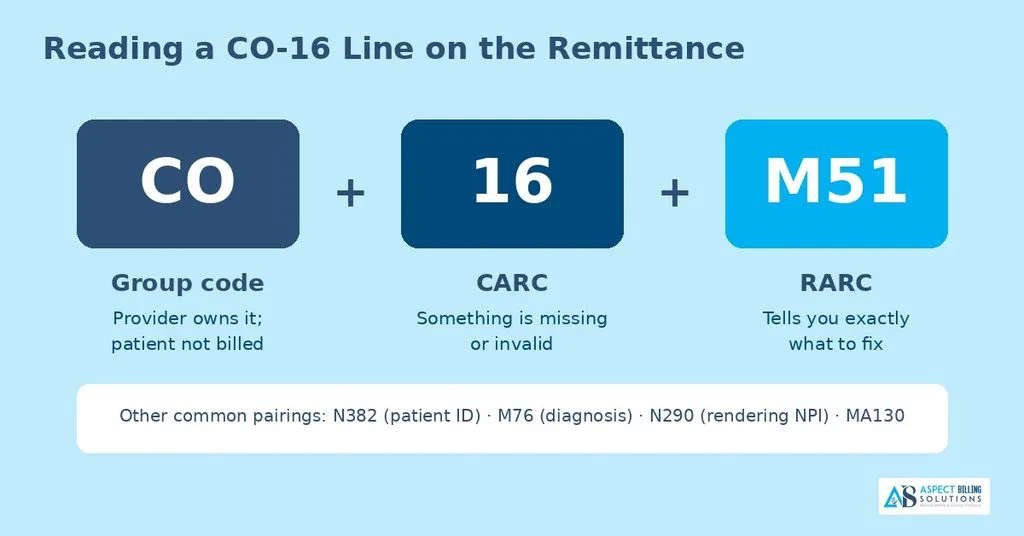
Every denial line has two parts. The group code says who owns the balance, and CO means contractual obligation, so the provider absorbs it. The claim adjustment reason code (CARC) 16 says required information is missing or invalid. CO-16 is administrative. It does not question medical necessity or coverage. That makes it different from denials like CO-45, which reflects contractual write-offs.
The Remark Code Is the Real Answer
CO-16 almost always arrives with a RARC that names the failed field. M51 points to a missing or invalid procedure code, and M76 to the diagnosis. N382 flags the patient identifier, while N290 flags the rendering provider NPI. Read the remark code first, then fix only what it names.
| RARC | What it flags | Where to look |
| M51 | Procedure code missing or invalid | CPT/HCPCS and modifiers |
| M76 | Diagnosis missing or invalid | ICD-10 codes and pointers |
| N382 | Patient identifier invalid | Member ID or MBI |
| N290 | Rendering provider identifier invalid | Rendering NPI and enrollment |
| MA130 | Claim unprocessable; no appeal rights | Resubmit as a new claim |
Table 2. Common CO-16 remark code pairings. Source: X12 RARC list and Medicare contractor guidance; confirm current wording.
Denial or Rejection?
A clearinghouse rejection stops a claim before the payer sees it. CO-16 appears on the remittance after the payer receives the claim. With Medicare, however, CO-16 plus MA130 means the claim was returned as unprocessable, never adjudicated.
Resubmit, Correct, or Appeal
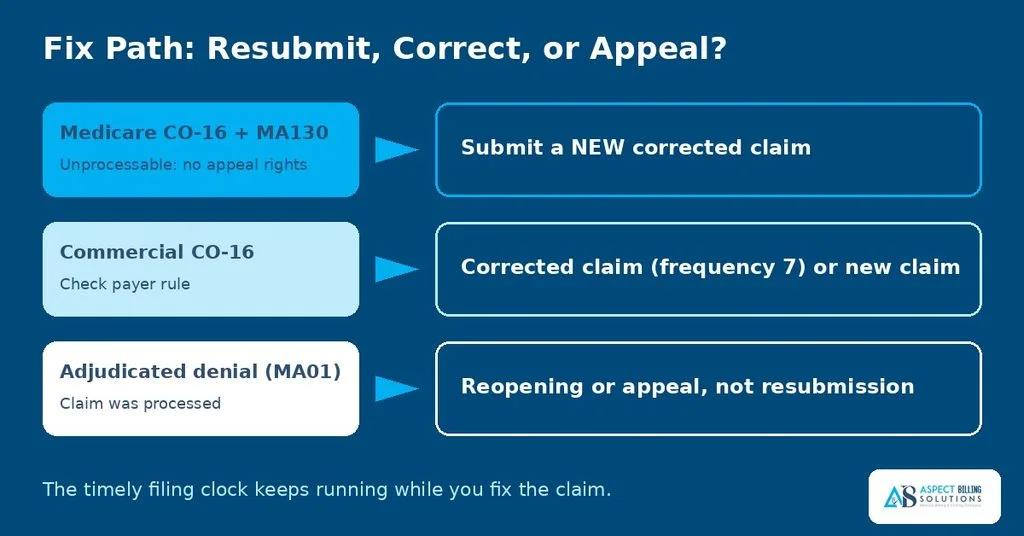
The fix path depends on the payer and the remark code. CMS transmittal guidance pairs CARC 16 with MA130, which states that no appeal rights exist and a new claim is required. CGS Medicare guidance adds that these claims cannot go through redetermination or reopening. First Coast Service Options warns that appealing only delays payment and can cause a timely filing denial.
Commercial payers vary. Many want a corrected claim with frequency code 7 and the original claim number, while others want a new claim. If Medicare adjudicated the claim with MA01 instead, use a reopening or appeal. Our Medicare appeals guide explains that process.
Worked example — timely filing runway. Formula: filing deadline − date the CO-16 is posted. A Medicare visit on February 10, 2026 must be filed by February 10, 2027. If the CO-16 posts on December 1, 2026, only 71 days remain. An appeal filed by mistake could use most of that runway.
Illustrative scenario (not an actual client record): a clinic appeals every CO-16 by habit. Medicare claims with MA130 sit in appeal queues until two pass timely filing and become unrecoverable. Routing MA130 claims straight to resubmission stops the loss. If your team is short on rework capacity, our denial management and appeals service can take that queue.
Where CO-16 Denials Start?
Most CO-16 denials begin at the front desk or in charge entry. Typical sources are outdated insurance, misspelled names, missing referring or ordering NPIs, invalid dates, and missing prior authorization numbers. A claim scrubber catches many before submission, but only if its edits match payer rules. Running eligibility verification before every visit closes the largest gap.
Worked example — CO-16 share of denials. Formula: CO-16 denials ÷ all denials × 100. With 67 of 470 denials coded CO-16, the share is 14.3%, above an illustrative 10% target. Worked example — clean claim rate. With 1,820 of 1,950 claims paid first pass, the rate is 93.3%.
| Location | All denials | CO-16 denials | CO-16 share |
| Main office | 200 | 16 | 8.0% |
| North clinic | 150 | 14 | 9.3% |
| Satellite site | 120 | 37 | 30.8% |
| Blended | 470 | 67 | 14.3% |
Table 3. Illustrative figures, not from a named source. Actual rates vary; verify against your own data.
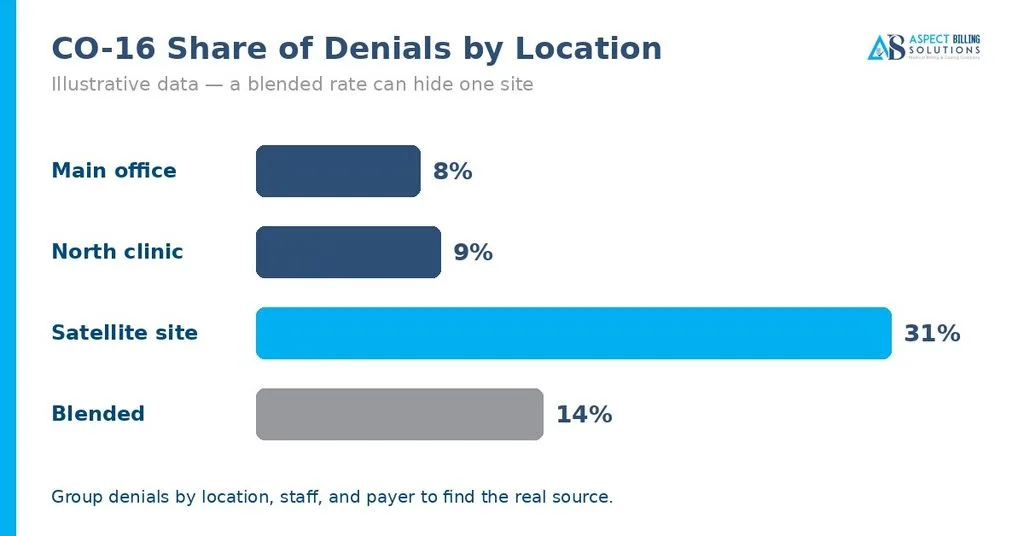
Two sites sit under the illustrative 10% target, yet the blended rate looks only moderately high. The satellite site produces more than half of all CO-16 denials. That usually points to one registration workflow or one staff training gap. Break CO-16 down by location, staff member, and remark code every month.
Judging Your CO-16 Rate Fairly
Compare CO-16 rates only against practices with similar payers, specialties, and claim volume. A practice heavy in Medicaid or secondary claims may run higher naturally. Use the same reporting period for every comparison. One high month is a signal to investigate, not a verdict.
How Fast CO-16 Fixes Take Hold?
| Fix | Early signs | Fuller results |
| Route MA130 claims to resubmission | Next billing cycle | 30–60 days |
| Eligibility check before every visit | 2–4 weeks | 60–90 days |
| Scrubber edits for top remark codes | 30 days | 60–90 days |
| Front-desk registration training | 30–60 days | 3–6 months |
Table 4. General planning ranges only, not a guarantee for any specific practice.
CO-16 Denial Code Explained: Quick Recap
- CO-16 means missing or invalid claim data; the provider owns the balance.
- The RARC, such as M51, M76, N382, or N290, names the exact fix.
- Medicare CO-16 with MA130 has no appeal rights; submit a new claim.
- Medicare timely filing is 12 months and keeps running during rework.
- 95% clean claims and 5% denials are commonly reported targets, not mandates.
Score Your CO-16 Workflow
Answer yes or no, then count your yes answers.
- Do billers read the RARC before fixing a CO-16?
- Are Medicare MA130 claims resubmitted rather than appealed?
- Do you know each commercial payer’s corrected-claim rule?
- Is eligibility verified before every scheduled visit?
- Does your scrubber include edits for your top remark codes?
- Are CO-16 claims resubmitted within five business days?
- Is CO-16 under 10% of all denials?
- Is your clean claim rate 95% or higher?
- Do you track CO-16 by location and staff member?
Scoring: 8–9 yes = strong workflow. 5–7 = targeted fixes needed. 0–4 = a front-end billing review is overdue.
When to Bring in Denial Support?
Having the CO-16 denial code explained helps, but some signs show in-house denial work has hit its limits. CO-16 keeps returning with the same remark codes. Claims pass timely filing while waiting for rework. Nobody knows which payers want corrected versus new claims. Front-end errors are fixed claim by claim, never at the source. Good outside support offers remark-code analysis, scrubber tuning, eligibility checks, and payer-specific resubmission rules. Aspect Billing Solutions follows that structure. Each provider gets a dedicated agent across end-to-end revenue cycle management: coding, billing, credentialing, denial management, and HIPAA compliance. Results vary by practice.
Final Considerations
With the CO-16 denial code explained, the lesson is simple. Read the remark code, choose the right fix path, and correct the source. Resubmitting fast protects the timely filing window, while tracking CO-16 by location stops repeats.
Medicare’s 12-month filing limit and the MA130 no-appeal rule are published CMS standards. The 95% clean claim and 5% denial figures are commonly reported ranges. The CO-16 share, eligibility, and turnaround targets are practical or illustrative goals.
Frequently Asked Questions
What does CO-16 mean in medical billing?
It means the claim lacks information or has a submission or billing error. The provider owns the balance until the claim is fixed.
Can I bill the patient for a CO-16 denial?
No. The CO group code makes it a contractual obligation, so the patient is not responsible.
Can I appeal a CO-16 denial?
Not when Medicare adds MA130, because the claim was never processed. Correct the error and submit a new claim instead.
What remark codes come with CO-16?
Common pairings include M51, M76, N382, N290, and MA130. Each points to a specific field to correct.
Is CO-16 the same as a clearinghouse rejection?
No. Rejections stop before the payer, while CO-16 appears on the payer’s remittance.
What is a good CO-16 rate?
No official figure exists. Keeping CO-16 under 10% of denials is an illustrative target; compare against similar practices.
What is a good clean claim rate?
Many practices aim for 95% or higher, a commonly reported range. It is not a regulatory standard.
What is a good denial rate overall?
Five percent or lower is a commonly report target. Check it by payer and location, since averages hide problem areas.
Sources and Methodology
(a) Published standards: X12 CARC and RARC definitions and CMS guidance on CARC 16 and MA130. CGS and First Coast guidance on unprocessable claims, plus Medicare’s 12-month filing rule.
(c) Practical and illustrative targets: clean claim and denial figures are commonly report ranges. CO-16 share, eligibility, and turnaround targets are practical or illustrative, and worked examples use invented numbers.
(b, d) Named benchmarking providers and survey data: none used. Actual results vary by practice; figures reflect information available in September 2026.