
EMG and Nerve Conduction Study Billing CPT 95907-95913
Short Answer: One NCS Code, Then Same-Day EMG Add-Ons
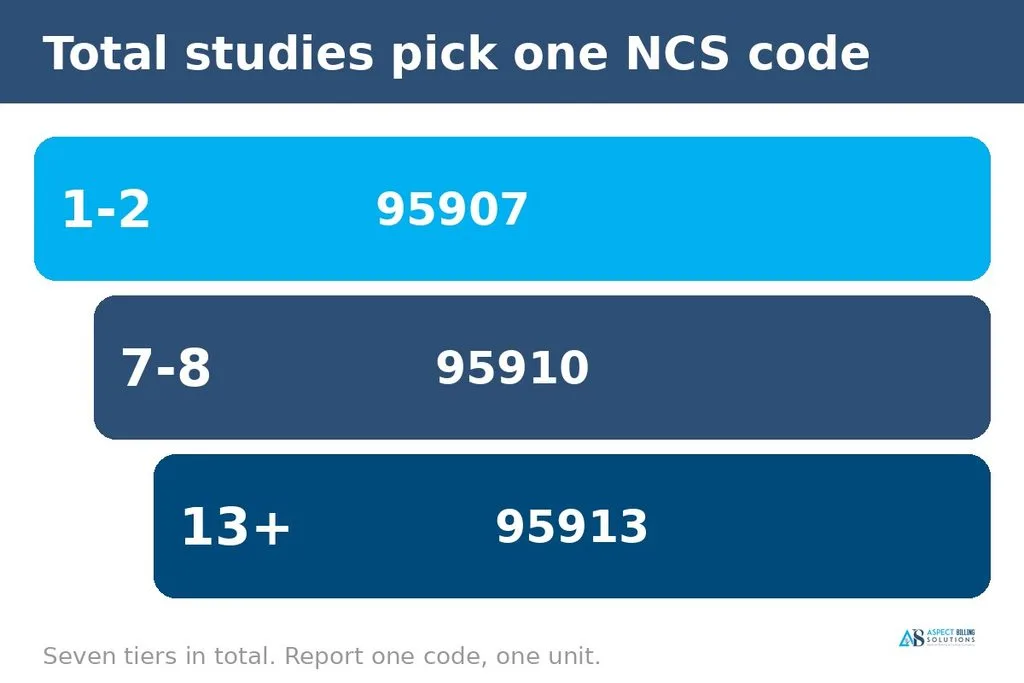
EMG and nerve conduction study billing CPT 95907-95913 means reporting one NCS code, chosen by the total studies performed that day [A]. The tiers run from 95907 for one to two studies up to 95913 for thirteen or more. Same-day needle EMG is reported separately with add-on codes 95885, 95886, or 95887.
Why Electrodiagnostic Claims Stumble?
One miscounted nerve can move a claim to the wrong code, and payers rarely say so. Many practices lose money to quiet downcoding, not obvious denials. This guide to EMG and nerve conduction study billing CPT 95907-95913 starts with what that leakage costs, then explains the seven NCS codes, how needle EMG pairs with them, and what to do when a payer disagrees. A self-assessment near the end scores your workflow.
Numbers at a Glance
Key numbers for electrodiagnostic billing
| Metric | Practical Target/Range | Review Frequency | Primary Source |
| NCS tiers | 95907: 1–2 studies; 95908: 3–4; 95909: 5–6; 95910: 7–8; 95911: 9–10; 95912: 11–12; 95913: 13+ | Every claim | [A] AMA CPT |
| NCS units per day | One code, one unit | Every claim | [A] CPT; [C] payer edits |
| 95885 vs. 95886 | 95885: 4 or fewer muscles; 95886: 5+ muscles across 3+ nerves or 4+ spinal levels | Every claim | [A] AMA CPT |
| Combined 95885/95886 units | Up to 4 per day, one per extremity | Every claim | [G] AANEM policy |
| Multi-unit 95885 share | 20% is a review prompt, not a denial rule | Quarterly | [G] AANEM policy |
| Clean claim rate | About 95% or higher | Monthly | [C] Commonly reported |
Source labels: [A] = AMA CPT definition; [G] = society guidance (AANEM, AAPC), not a payer mandate; [C] = commonly reported; [D] = illustrative example or target.
What Quiet Downcoding Costs?
Downcoding hides in averages. Your clean claim rate shows whether counting errors reach payers, and a steady denial management workflow traces each miss to its cause.
Example 1: Clean claim rate
Formula: clean claim rate = claims accepted on first pass ÷ claims submitted × 100. Illustration: 188 of 200 claims gives 94%, just under the commonly cited 95% [C]. That gap is a prompt to review rejected claims.
Example 2: Cost of downcoding
Formula: monthly leakage = payment gap × affected claims. Illustrative scenario (not an actual client record): a $60 gap on 25 claims equals $1,500 per month, or $18,000 a year [D].
Where Averages Hide Trouble?
Illustrative scenario (not an actual client record): a practice sees a blended denial rate of 7.5%. Splitting by payer tells a different story.
Illustrative denial rates by payer [D]
| Payer group | Claims | Denied | Denial rate |
| Payer A | 300 | 15 | 5% |
| Payer B | 200 | 10 | 5% |
| Payer C | 100 | 20 | 20% |
| Blended | 600 | 45 | 7.5% |
Illustrative only; actual figures vary, so verify against your own data. Payer C produces 44% of denials from 17% of claims.
How to Count Studies for CPT 95907-95913?
Each nerve conduction study is a sensory test, a motor test with or without an F-wave, or an H-reflex on one named nerve. Every type counts once per nerve, even when several sites are stimulated. Motor and sensory testing on the same nerve count as two studies. Add the studies from every limb, then report one code with one unit per encounter. The CMS billing article A57478 repeats these counting rules [A], and CPT’s Appendix J lists typical maximum studies per diagnosis.
Example 3: Picking the tier
Formula: total studies = sensory + motor + H-reflex studies across all named nerves. Illustration: each arm has median and ulnar sensory and motor testing, eight studies in total, so you report 95910 once. See also our guide to coding for EEGs, EMGs, and other specialized procedures.
Pairing Needle EMG With a Same-Day NCS
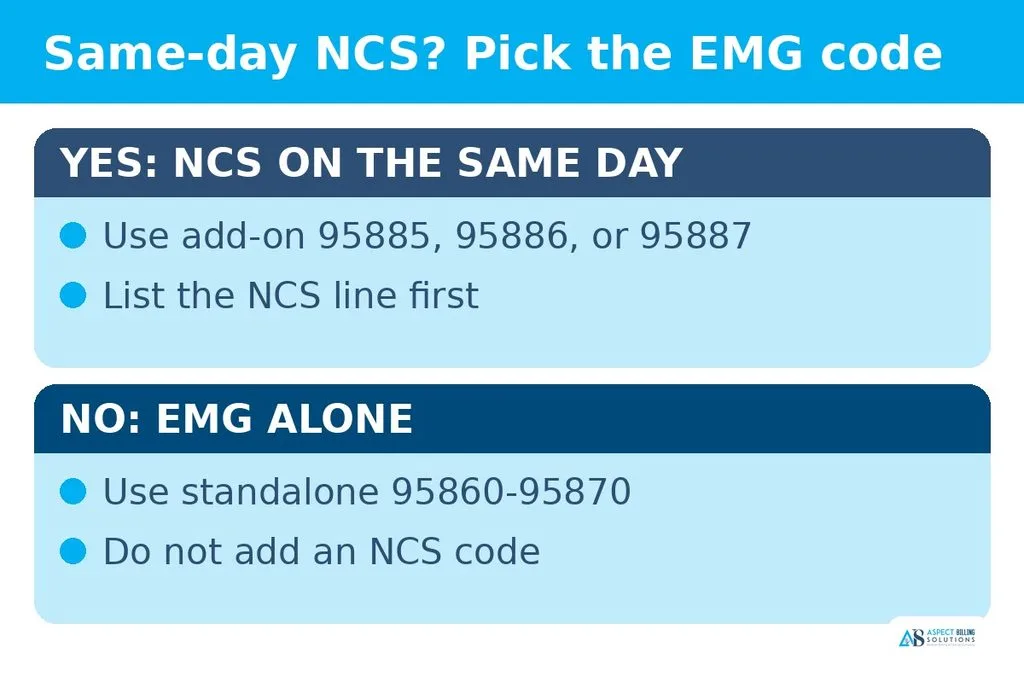
Start with one question: did an NCS happen the same day? If yes, report add-on codes. Use 95885 for four or fewer muscles in an extremity and 95886 for five or more. Code 95887 covers non-extremity muscles. Standalone EMG codes 95860–95864 and 95867–95870 apply only when no NCS occurs that day. List the NCS line first, and never pair a standalone extremity EMG with an NCS code on the same date. Our neurology billing CPT codes guide covers the wider code set.
Example 4: Watching multi-unit use
Formula: multi-unit share = studies with two or more units of 95885 ÷ total needle EMG studies × 100. Illustration: 12 of 40 studies gives 30%. The AANEM recommended policy says that when multiple 95885 units appear in more than 20% of a provider’s needle EMG studies, a payer may wish to consult the provider, and peer review may be appropriate [G]. It sets no 25% or 30% audit trigger and no denial rule; any audit is the payer’s decision. So 30% is not a violation, but it is a pattern to explain.
Modifiers, Split Billing, and Payer Edits
Many payers apply NCCI edits to these pairings. If you own the equipment and perform the study, bill globally. If the physician only interprets, append modifier 26, and the facility bills TC. Reflexively adding modifier 59 can backfire, because the add-on structure already describes the pairing; confirm each payer’s policy. Modifier 25 applies only to a separate, significant E/M visit. Our neurology CPT modifiers guide covers more cases.
Documentation That Survives an Audit
Reports should name every nerve, every study type, and every muscle tested. Vague wording like “bilateral upper extremity NCS” pushes payers toward the lowest supportable code. Link each claim to a specific ICD-10 code, such as G56.01 for right-sided carpal tunnel syndrome, so medical necessity is clear.
When a Payer Disagrees With a Study Count?
Payers sometimes downcode 95910 to 95909 or question multi-unit 95885. Ask for the study-by-study basis, then answer with a report listing every nerve, study type, and muscle. AANEM’s model policy treats its maximum-studies table as a tool to spot outliers, not an absolute limit, and says it should not be used to deny automatically [G]. For the roughly 10% of cases AANEM expects above the table, attach documentation explaining the extra testing [G]. Original Medicare allows 120 days to request a redetermination and 180 days for the next level, per the CMS Claims Processing Manual [A]. For a peer-to-peer, bring a count worksheet and the clinical question.
Reading These Benchmarks Fairly
A benchmark helps only when compared like for like: similar payer mix, comparable volume, and the same reporting period. A carpal tunnel-heavy practice will look different from one treating neuromuscular disease. One missed number is a signal to investigate, not a verdict.
How Long Improvements Usually Take?
General planning ranges (not guarantees for any practice)
| Fix | First visible change | Fuller results |
| Report template with nerve and muscle lists | 2–4 weeks | 2–3 months |
| Payer edit corrections and appeals | 1–2 months | 3–6 months |
Recap in Five Lines
- Report one NCS code, one unit, chosen by total studies.
- With a same-day NCS, use 95885–95887 for EMG.
- Treat 20% [G] and 95% [C] as review points, not mandates.
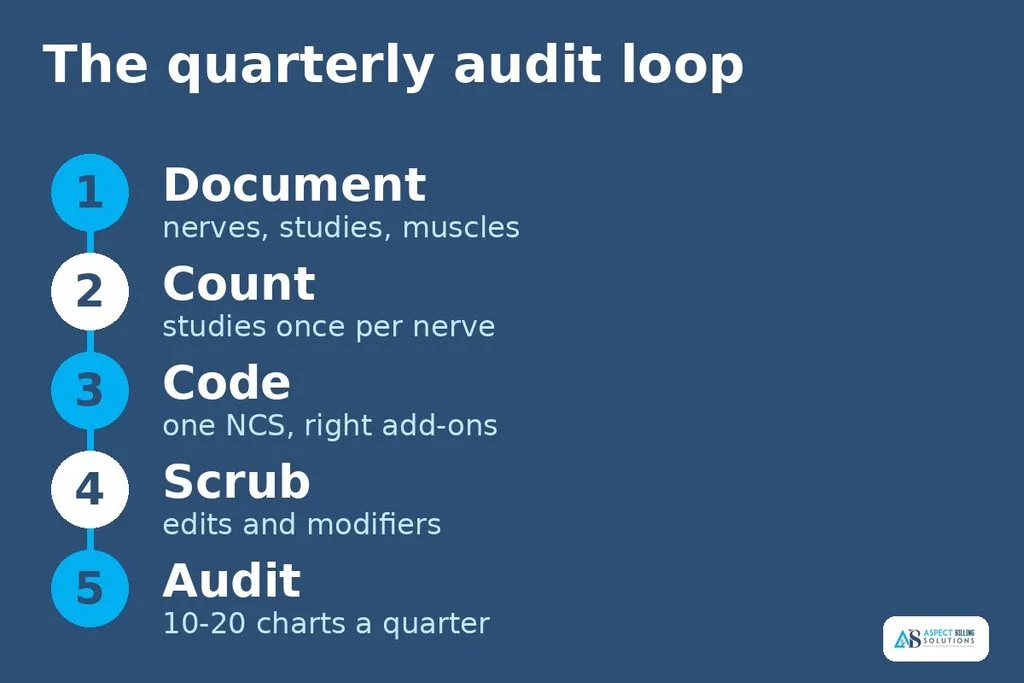
- Audit a small chart sample each quarter.
Score Your Workflow in Two Minutes
- Do reports name every nerve and study type? (Yes / No)
- Do you bill one NCS code, one unit, per day? (Yes / No)
- Do you use 95885–95887 on same-day NCS claims? (Yes / No)
- Does every 95886 line show five muscles and three nerves or four spinal levels? (Yes / No)
- Do you keep combined 95885/95886 units at four or fewer? (Yes / No)
- Do you track multi-unit 95885 use against 20%? (Yes / No)
- Is your clean claim rate near or above 95%? (Yes / No)
- Do you split denial rates by payer? (Yes / No)
- Do you audit charts each quarter? (Yes / No)
Scoring guide
| Yes answers | What it suggests |
| 8–9 | Strong workflow. Keep auditing. |
| 5–7 | Some gaps. Fix the “No” items. |
| 0–4 | High risk. Consider outside review. |
Final Considerations
Most revenue loss here is quiet, coming from downcoding rather than loud denials. A short quarterly chart review catches problems before they become habits.
Know which numbers are firm. The 95907–95913 tiers, the 95885–95887 descriptors, and the 95886 thresholds are published standards [A]. The four-unit ceiling and 20% review point are society guidance [G], not payer mandates. The 95% clean claim rate, audit cadence, timeframes, and all dollar or payer examples are practical or illustrative targets [C][D].
Frequently Asked Questions
What does CPT 95907 cover?
One to two nerve conduction studies. Tiers rise by two until 95913, which covers thirteen or more.
Can I bill two NCS codes on the same day?
No. Add every study and report one code, one unit. Payer edits generally cap these codes at one unit per day.
Can 95860 be billed with 95907?
Not on the same day. Report 95885, 95886, or 95887 instead.
How many muscles does CPT 95886 require?
Five or more per extremity, across three nerves or four spinal levels.
When do I use modifier 26 or TC?
Use 26 when the physician only interprets. The equipment owner bills TC. If you do both, bill globally.
What is a good clean claim rate for EMG and NCS claims?
Many industry sources cite 95% or higher. It is a practical target, not a standard.
What is a good multi-unit 95885 rate?
AANEM says payers may consult a provider above 20% of needle EMG studies. Treat it as a review prompt, not a limit.
What is a good audit frequency for electrodiagnostic claims?
Ten to twenty charts each quarter is an illustrative start.
When Outside Billing Support Makes Sense?
- Downcoded or denied claims with no clear cause.
- Coders and physicians disagreeing on study counts.
- A clean claim rate below about 95% for months.
For electrodiagnostic billing, look for coders who check every nerve and muscle count against the report before submission, track downcoding by payer, and keep a count worksheet ready for peer-to-peer calls. Aspect Billing Solutions is one example of this structure. It provides HIPAA-compliant medical billing and coding across ICD-10, CPT, and HCPCS, including claim and denial management, eligibility verification, prior authorization, accounts receivable, and credentialing. Each provider gets a dedicated agent, so one person learns your report formats and each payer’s study-count edits. Fit and results vary by practice. See its revenue cycle management services.
Where Our Facts Come From?
- (a) Published standards [A]: AMA CPT descriptors for 95907–95913 and 95885–95887, as reproduced in CMS article A57478; CMS Claims Processing Manual, Chapter 29.
- Society guidance [G]: AANEM recommended policy and model policy; AAPC Knowledge Center.
- (b) Named benchmarking data providers: none used.
- (c) Practical or illustrative targets [C][D]: the 95% clean claim rate, audit sample, timeframes, and examples.
- (d) Survey data: none used.
Results vary by practice. Figures reflect September 2026 research; verify against current CPT and payer policies.