
Epilepsy & Seizure Management Billing: EEG Monitoring Codes
Epilepsy and seizure management billing (EEG monitoring codes) means choosing the right EEG code by study type, duration, video use, and who performed each component. Routine studies use 95812 through 95822. Long-term monitoring uses technical codes 95700 and 95705 through 95716, plus professional codes 95717 through 95726. Payers expect medical necessity, correct modifiers, and, for Medicare ambulatory EEG, a prior routine study.
Epilepsy and seizure management billing (EEG monitoring codes)-EEG billing mixes duration, video, monitoring level, and setting, so small coding slips are common. This guide sorts epilepsy-related EEG codes by study type, then covers payer rules, denials, and fix timelines. Worked examples show how to pick codes and count units. A short readiness check near the end scores your workflow. Terms like technical component and professional component are explained plainly for practice owners and office managers.
EEG and Neurostimulator Codes on One Page
Quick-reference numbers for EEG monitoring billing
| Metric | Practical Target/Range | Review Frequency | Primary Source |
| Extended routine EEG | 95812 for 41-60 minutes; 95813 over 60 | Every claim | [A] CPT descriptors |
| Long-term setup (95700) | Once per monitoring period | Every study | [G] AAN code summary |
| 95719 and 95720 | One unit per 24-hour period | Every study | [G] AAN code summary |
| Multi-day tiers | 36-60, 60-84, and over 84 hours | Every study | [G] AAN code summary |
| Routine EEG before ambulatory | Claim within 1 year (Palmetto GBA article) | Every ambulatory order | [A] CMS article A56771 |
| VNS programming | 95976: 1-3 parameters; 95977: over 3 | Every visit | [G] AAN neurostimulator guide |
| Authorization lead time | Start 1-2 weeks ahead for ambulatory | Each study | [D] Illustrative target |
| EEG claim denial rate | Under 5% | Monthly | [D] Illustrative target |
Source labels: [A] = published definition or rule from a named body; [G] = society guidance, not a payer mandate; [D] = illustrative practical target.
Three Questions That Pick the Code
- How long was the recording? Under 24 hours points to routine codes; longer studies use the long-term set.
- Was video used, and how was the report written? These choose between paired professional codes.
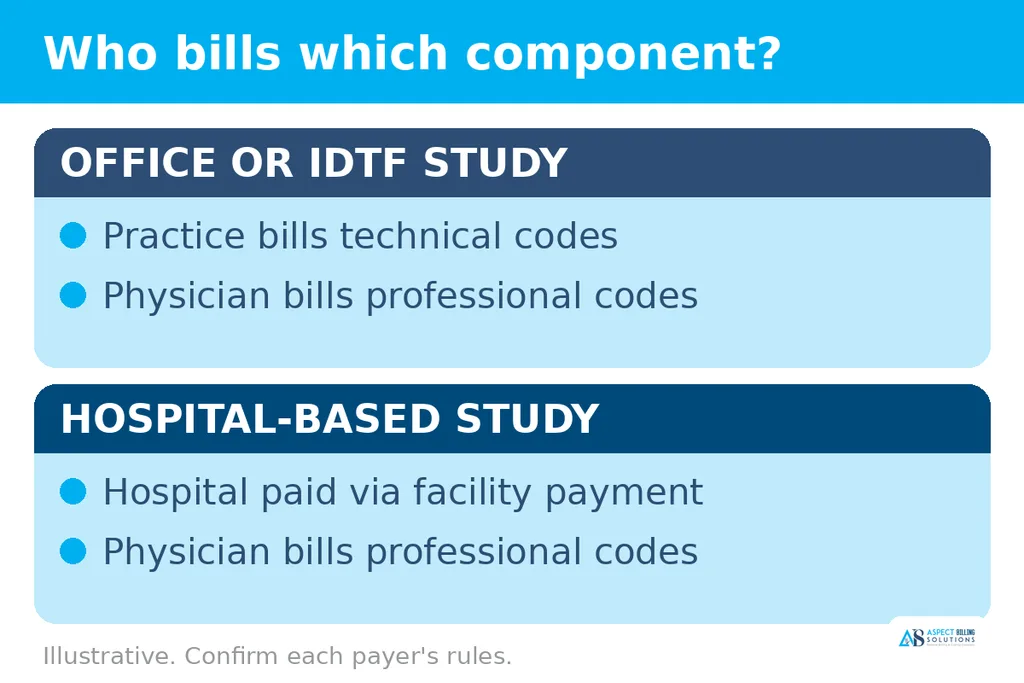
- Who owns each component? The setting decides who bills the technical part.
Routine codes are 95816 (awake and drowsy), 95819 (awake and asleep), 95822 (coma or sleep only), and 95812 or 95813 for extended studies. Long-term monitoring splits into a technical component, where 95700 covers setup once, and professional codes 95717 through 95726. The AAN coding summary [G] notes that older codes 95950, 95951, 95953, and 95956 were deleted in 2020. Technical codes 95705 through 95716 vary by length, video, and monitoring level. See our neurology CPT codes guide.
Professional Codes by Recording Length
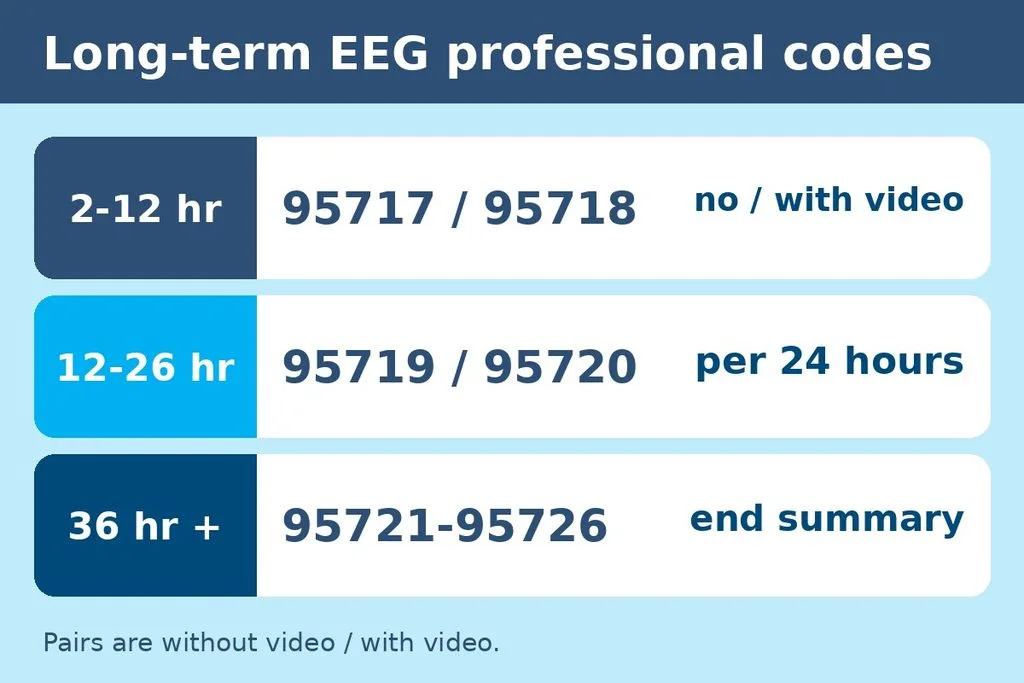
Long-term EEG professional codes (AAN summary of the 2020 code set)
| Recording Length | Without Video | With Video | Report Timing |
| 2-12 hours | 95717 | 95718 | End of the study |
| 12-26 hours | 95719 | 95720 | Each 24 hours |
| 36-60 hours | 95721 | 95722 | Summary at the end |
| 60-84 hours | 95723 | 95724 | Summary at the end |
| Over 84 hours | 95725 | 95726 | Summary at the end |
Worked Examples: Units, Codes, and Timing
Example 1: Daily units
Formula: units = number of 24-hour periods reported. A 48-hour inpatient video study with daily reports bills 95720 × 2.
Example 2: Code selection
Formula: code = total hours + video use + report timing. A 72-hour home study without video, read at the end, falls in the 60-84 hour tier: 95723 × 1.
Example 3: The routine EEG clock
Formula: ambulatory date − routine EEG date must be 365 days or fewer. February 15 to the next January 20 is 339 days, so the one-year requirement is met.
Rules Payers Enforce Around the Recording
Medicare rules come from local contractors. Palmetto GBA’s Special EEG article A56771 covers Alabama, Georgia, Tennessee, North Carolina, South Carolina, Virginia, and West Virginia. It requires a routine EEG claim within one year before an ambulatory study [A]. The article states the rule, not the reason; our reading is that the routine study documents the clinical question before the costlier study is paid. Check your own contractor. Commercial plans commonly require prior authorization for ambulatory and long-term studies, while routine outpatient EEG usually does not [C]. Our prior authorization services can own that step. Modifiers follow ownership: TC for equipment and technologist work, 26 for interpretation, and no technical codes for hospital-based studies [G]. See our neurology modifiers guide.
Device Programming Codes
Vagus nerve stimulator visits use 95976 for simple programming (one to three parameters) and 95977 for complex programming (more than three), per AAN guidance [G]. Code 95970 reports analysis without programming. Count parameters, not minutes.
Common Denials and the Blended Average Trap
EEG denials usually trace to authorization, sequencing, or ownership errors. A solid denial management workflow sorts each denial by cause and study type. Measure long-term studies apart from routine EEG. Our overview of recent neurology coding changes may also help.
Table 3. Common EEG denial patterns (triggers are commonly reported)
| Reason (CARC) | Typical Trigger | Practical Fix |
| CO-197: authorization absent | Ambulatory study without approval | Verify at scheduling |
| CO-50: not medically necessary | No routine EEG on file first | Check history at intake |
| CO-97: bundled service | Routine code billed with a long-term code | Add a scrubber pairing rule |
Example 4: Denial rate
Formula: denial rate = denied EEG claims ÷ submitted EEG claims × 100. Twelve denials on 200 claims is 6%, above the illustrative 5% goal [D].
The Blended Average Trap
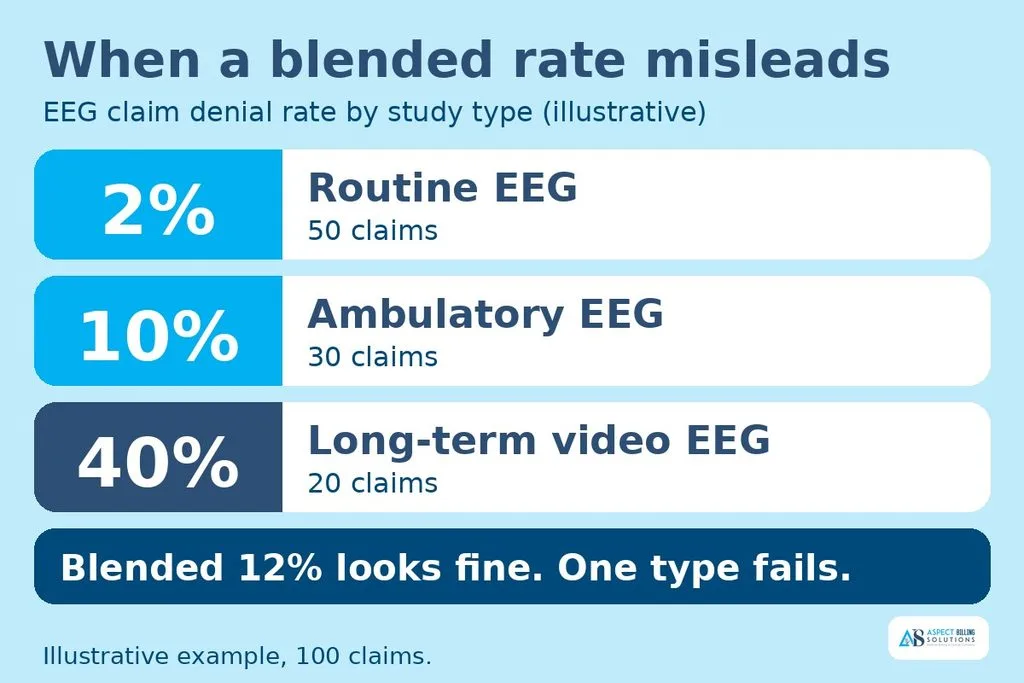
Illustrative scenario (not an actual client record): a practice submits 100 EEG claims. Routine EEG has 50 claims with 1 denial (2%). Ambulatory EEG has 30 with 3 denials (10%). Long-term video EEG has 20 with 8 denials (40%). Overall, 12 ÷ 100 gives 12%, which looks acceptable. Yet 40% of long-term claims fail, and only a study-level view shows it.
When the Payer or MAC Disagrees With the Guidance?
Society guidance persuades but does not bind. For Medicare, a contractor’s LCD controls claims in its jurisdiction, even when an AAN document reads differently. To fix one claim, use the appeal ladder: 120 days to request a redetermination and 180 days for the next level, per the CMS Claims Processing Manual [A]. To change the policy itself, ask the contractor in writing for an LCD reconsideration. It is not a claim appeal and needs new published evidence [A]. For commercial denials, request the written policy, then use the peer-to-peer to walk a same-specialty reviewer through the order, recording, and interpretation. Keep every reference number.
Comparing Practices Fairly
A benchmark helps only when compared like for like. Match setting, study mix, payer mix, and reporting period first. One missed target is a signal to investigate, not a verdict.
How Fast Fixes Pay Off?
Table 4. General planning ranges (not a guarantee for any practice)
| Fix | Early Signs | Fuller Results |
| Modifier and ownership scrubber rules | 2-4 weeks | 2-3 months |
| Routine-EEG-first check at scheduling | 4-8 weeks | About 3 months |
| Study-level denial review | 60-90 days | 4-6 months |
Recap in Five Lines
- Pick routine codes by patient state, and long-term codes by hours, video, and report timing.
- Bill 95700 once, and report 95719 or 95720 per 24 hours.
- Confirm a routine EEG and any authorization before ambulatory studies.
- Track denials by study type; under 5% is an illustrative goal.
Is Your EEG Billing Ready? Nine Questions
Choosing the code
- Do you pick routine codes by patient state and study length? (Yes / No)
- Do you choose long-term codes by hours, video, and report timing? (Yes / No)
- Do you report 95719 and 95720 per 24-hour period? (Yes / No)
- Do you count VNS parameters, not minutes? (Yes / No)
Before and during the study
- Do you confirm a routine EEG precedes ambulatory studies? (Yes / No)
- Do you confirm authorization for ambulatory and long-term studies? (Yes / No)
- Do you apply TC, 26, or global correctly? (Yes / No)
- Do you bill 95700 once per monitoring period? (Yes / No)
After the claim
- Do you review denials by study type monthly? (Yes / No)
Scoring guide: 8-9 yes answers suggest a strong process. 5-7 point to gaps worth fixing this quarter. 4 or fewer means a full workflow review is due.
Signals You Need Outside Billing Help
- Long-term EEG claims keep denying or paying short.
- Authorizations are missing when studies start.
- Staff cannot tell which component the practice may bill.
- Aged receivables on EEG claims keep growing.
For EEG, look for support that assigns each component to the right biller by setting, reconciles recording hours and video against the study report, and confirms routine-EEG sequencing and authorization before ambulatory or long-term orders. Aspect Billing Solutions is one example of this structure. It provides HIPAA-compliant US medical billing and coding (ICD-10, CPT, HCPCS). Services include claim and denial management, eligibility verification, prior authorization, accounts receivable, and credentialing. Each provider gets a dedicated agent, so one person learns how each payer treats component billing. Fit and results vary by practice. See its revenue cycle management service for details.
Final Considerations
EEG billing rewards sorting before coding. Identify the study type, confirm sequencing and authorization, and assign each component to the right biller.
The code structure and the one-year routine EEG requirement (in one contractor’s article) are published [A]; the AAN summaries of them are society guidance [G]. The 5% denial goal, lead times, and timeframe ranges are practical or illustrative targets [C][D].
Frequently Asked Questions
Epilepsy and seizure management billing (EEG monitoring codes)
What separates 95816 from 95819?
95816 reports awake and drowsy recording. 95819 reports awake and asleep. Choose by what the record documents.
Which codes report long-term video EEG?
Professional codes are 95718, 95720, 95722, 95724, and 95726, chosen by length. Technical codes 95711-95716 apply in office or IDTF settings.
How is 95700 billed?
Once per monitoring period, for setup, takedown, and patient education.
Can a hospital-based study use technical codes?
Per AAN, no. The hospital is paid through its facility payment.
What is a good EEG claim denial rate?
An illustrative goal is under 5%, tracked monthly by study type and payer.
What is a good lead time for ambulatory EEG authorization?
Many practices start 1-2 weeks ahead, an illustrative range.
What is a good documentation standard for EEG claims?
An order with the indication, actual recording duration, video status, and a signed interpretation.
Does routine EEG need prior authorization?
Usually not for routine outpatient studies; ambulatory and long-term studies commonly do.
Sources and Method
- (a) Published standards [A]: CMS article A56771 (Palmetto GBA); CMS LCD process guide; CMS Claims Processing Manual, Chapter 29; CPT descriptors; X12 reason codes. Society guidance [G]: AAN summary of the 2020 long-term EEG codes; AAN neurostimulator coding guidance.
- (b) Named benchmarking data providers: none used.
- (c) Commonly reported or illustrative [C][D]: routine study patterns, lead times, the 5% goal, and timeframes, from industry billing guides.
- (d) Survey data: none used.
Results vary by practice. Figures reflect information available at research time (September 2026); confirm current CPT, MAC, and payer policies.