
Efficient Neurology Insurance Billing in Michigan
Efficient neurology insurance billing in Michigan means a short, measurable cycle from date of service to payment: billing lag under 48 hours, a high first-pass clean claim rate (so claims aren’t reworked and resubmitted), and cycle time tracked by claim type rather than one blended average that can hide a slow category like EMG/NCS testing. “Efficient” should be a set of tracked numbers, not a general impression of speed.
“Efficient” gets used to describe almost any billing operation that doesn’t obviously fail, but efficiency is actually measurable: efficient neurology insurance billing in Michigan-how many days pass between the date of service and claim submission, how many times a claim gets touched before it’s paid, and whether that cycle time holds steady across claim types or balloons for the complex ones. This guide breaks efficiency into those specific, trackable pieces, covers Michigan’s claim-payment rules, and ends with a self-assessment checklist so you can score your current billing process on what it actually measures, not how fast it feels.
Efficiency, Defined in Trackable Numbers
What “Efficient” Should Actually Track?
| Metric | Practical Range | Review Frequency | Primary Source |
| Billing lag (date of service to claim submission) | Under 48 hours target; up to 7 days in complex/hospital settings | Weekly | Commonly reported RCM industry benchmark |
| Clean claim / first-pass rate | 95%-98% target; 98%+ best-in-class | Monthly | HFMA (MAP Keys) / MGMA DataDive |
| Touches per claim | Commonly reported around 1.5 for a clean claim, rising toward 2.5+ with rework | Monthly | Commonly reported across industry RCM analyses |
| Denial rework cost | Commonly reported at $25-$118 per denied claim, depending on complexity | Per incident | Attributed to MGMA/HFMA by multiple industry publications* |
| Days in A/R | 30-40 days target; 25 or fewer best-in-class | Monthly | HFMA (MAP Keys) / MGMA DataDive |
| Michigan clean-claim payment deadline | 45 days to pay; 30 days to notify of defects; 12% annual interest on late payment | Statutory, not a KPI | MCL § 500.2006 |
Source key: “HFMA / MGMA” and the Michigan statute = a published standard directly attributable to that named body. “*Attributed by industry publications” and “commonly reported” = figures repeated consistently across multiple secondary industry sources but not independently confirmed by this guide against one named primary report; treat them as reported estimates. Michigan’s deadline is a legal requirement, not a performance target, and applies to health insurers, HMOs, and Blue Cross Blue Shield of Michigan underwritten plans specifically — verify applicability for other payer types, including self-funded ERISA plans, before relying on it.
“Efficient” Should Be a Measurement, Not an Impression
A billing operation can feel efficient — responsive staff, a modern portal, quick phone calls — while its actual cycle time and rework rate tell a different story. Efficiency has specific, trackable components: how quickly a claim moves from the visit to submission, how often it gets reworked before it’s paid, and whether that speed holds up across every type of claim a neurology practice generates, not just the easy ones.
Billing Lag: The Clock Starts Before the Payer Sees Anything
Billing lag is the time between the date of service and the date a claim is actually submitted. A commonly cited target is under 48 hours for standard outpatient claims, with more complexity — like hospital settings — extending that to up to seven days. Every day of billing lag is a day added to the front of Michigan’s statutory payment clock before it has even started counting.
Touches Per Claim: The Hidden Cost of Rework
Industry analyses commonly report that a clean claim requiring no correction is touched by staff roughly 1.5 times on average, while a claim that enters a rework cycle can climb toward 2.5 touches or more. Each additional touch is staff time that a genuinely efficient process avoids by getting the claim right — and complete — the first time.
Cycle Time Has to Hold Across Claim Types
A practice’s average days-to-payment can look healthy while its most complex claim type — for neurology, typically EMG and nerve conduction studies — runs well past that average. A blended number that includes fast, routine E/M claims alongside slow, complex diagnostic claims can hide exactly where the inefficiency actually lives.
The Same Claim, Two Very Different Timelines
The comparison below shows how the same underlying payer review window plays out very differently depending on how quickly a claim gets coded and submitted in the first place — and how much rework gets added to the middle of the process.
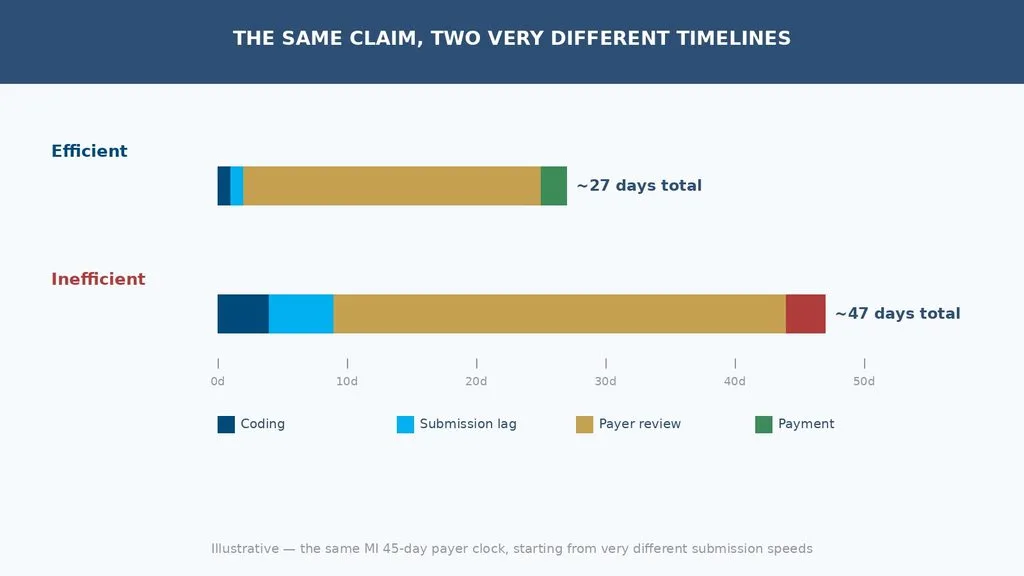
In this illustration, the efficient timeline reaches payment in roughly 27 days by keeping coding and submission lag under two days combined and avoiding rework. The inefficient timeline adds days at the front end (slower coding and submission) and expands the middle stage with rework, stretching total cycle time to nearly 47 days — even though both claims are subject to the same underlying Michigan payer review window.
Why a Good Average Cycle Time Can Hide a Slow Claim Type?
Routine E/M visits typically move through the billing cycle quickly. EMG and nerve conduction studies, with their higher NCCI bundling complexity and documentation requirements, often take meaningfully longer — but because they’re a smaller share of total claim volume, they can be outweighed by faster, more common claim types in a blended average.
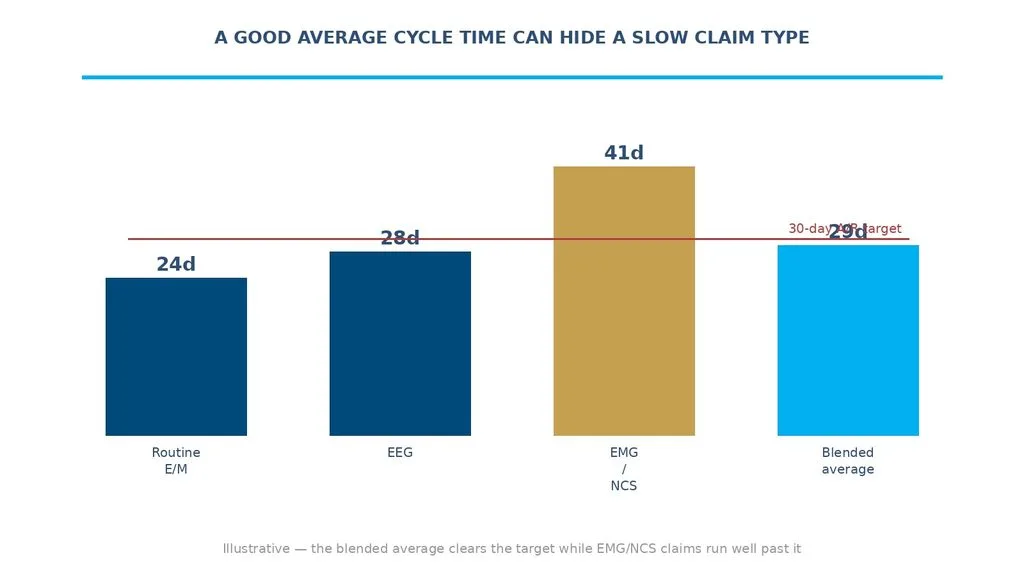
In this illustration, the blended average sits right at the 30-day A/R target while EMG/NCS claims specifically run 41 days — well past it. A practice tracking only the blended number would have no way to see that its most complex, and often highest-value, claim type is the one actually dragging on cash flow.
The Math Behind Efficient Billing
The Cost of Billing Lag
Formula: Cash Flow Delay ≈ Daily Charges × Extra Days of Billing Lag.
Worked example: a Michigan neurology practice generating $2,800 a day in charges that submits claims 5 days after the date of service, instead of the commonly cited 2-day target, is carrying roughly $8,400 in additional claims sitting unsubmitted at any given time — before Michigan’s 45-day payer clock has even started running on those claims.
The Cost of Extra Touches Per Claim
Formula: Extra Rework Cost ≈ (Actual Touches − 1.5) × Claim Volume × Cost Per Touch.
Worked example: a practice submitting 500 claims a month at an average of 2.2 touches per claim, against a 1.5-touch benchmark for clean claims, is generating roughly 350 extra touches a month. At a commonly cited rework cost in the $25-$118 per-incident range, that’s somewhere between $8,750 and $41,300 a month in avoidable rework cost, depending on complexity — a wide range, but one that starts at a meaningful number even at the low end.
Michigan’s Prompt-Pay Interest
Formula: Interest Owed = Claim Amount × 12% (annual) × (Days Late ÷ 365).
Worked example: a $3,200 claim paid 15 days after Michigan’s 45-day clean-claim deadline (15 days late) accrues interest of $3,200 × 0.12 × (15 ÷ 365) ≈ $16 under MCL § 500.2006. Individually modest, but a billing process that tracks this deadline per claim — rather than treating it as background law — is demonstrating exactly the kind of measurable diligence “efficient” should include.
Michigan-Specific Factors an Efficient Process Tracks
The 45-Day Clean-Claim Deadline
Under MCL § 500.2006, enacted as Public Act 316 of 2002 and applicable to claims with dates of service on or after October 1, 2002, a health plan must pay a clean claim within 45 days of receipt. The health plan must notify the provider within 30 days of any defects preventing the claim from being “clean,” and the 45-day clock is tolled while the provider corrects those defects. Claims paid late bear simple interest at 12% per year. This law applies to health insurers, HMOs, and Blue Cross Blue Shield of Michigan underwritten plans; self-funded employer plans are generally governed by federal ERISA rules instead.
Michigan Medicaid Health Plans
Michigan delivers most Medicaid coverage through nine Medicaid Health Plans (MHPs) under its Comprehensive Health Care Program: Aetna Better Health of Michigan, Blue Cross Complete of Michigan, HAP CareSource, McLaren Health Plan, Meridian Health Plan of Michigan, Molina Healthcare of Michigan, Priority Health Choice, UnitedHealthcare Community Plan, and Upper Peninsula Health Plan (serving the Upper Peninsula specifically). Which plans are available varies by county, and a separate track — MI Coordinated Health (MICH) — coordinates care for dually eligible beneficiaries with its own, separately updated participating-plan list by county. An efficient billing process tracks which plan and which track apply per patient rather than assuming a single statewide Medicaid category. This roster shifts periodically (most recently under contracts effective October 1, 2024) and should be verified against MI ENROLLS or MDHHS directly before being relied on.
Medicare Administrative Contractor
Wisconsin Physicians Service (WPS) Government Health Administrators is the Medicare Administrative Contractor for Jurisdiction 8, which covers Michigan and Indiana. An efficient billing process tracks WPS-specific claim edits and Local Coverage Determinations for neurology diagnostic testing separately from commercial and Medicaid managed care workflows.
What to Actually Ask About Efficiency?
Ask for Billing Lag, Not Just Turnaround Time
“Fast turnaround” is vague. Billing lag — the specific number of days from date of service to submission — is checkable and comparable to the sub-48-hour benchmark.
Ask How Touches Per Claim Are Tracked
A partner that only reports a denial rate can’t show you how much rework is happening on claims that eventually get paid without being formally denied.
Ask for Cycle Time by Claim Type
A partner reporting only a blended average cycle time cannot show you whether EMG/NCS or other complex claim types are quietly running past target.
For the collections side of cycle time, see how to lower accounts receivable days and effective accounts receivable strategies.
Reducing the rework that adds extra touches, see building an effective denial management workflow.
For the coding side specifically, see neurology billing CPT codes.
How Aspect Billing Solutions Approaches “Efficient”?
The metrics above only matter if a billing partner actually tracks and reports them. Aspect Billing Solutions’ process is built around a few specific, checkable commitments:
- Claims are coded and submitted on a tight, tracked turnaround, rather than sitting unsubmitted for days.
- Denials and rework are tracked as their own metric. Separate from the raw denial rate, so extra touches per claim stay visible.
- Cycle time is reviewed by claim type. So EMG/NCS and other complex neurology claims don’t hide inside a comfortable blended average.
- Michigan’s 45-day statutory clock is tracked per claim, with a dedicated agent per provider accountable for the outcome.
This describes process and structure, not a performance guarantee. Actual results depend on a practice’s starting point, payer mix, and claim volume. A free consultation starts by reviewing your actual billing lag and cycle time, not a general pitch.
Using These Numbers Correctly
A cycle-time or touches-per-claim benchmark is only meaningful compared like-for-like. Similar claim volume, comparable payer mix, and the same reporting period. A single slow week is a signal to look closer, not a verdict. But a claim type that’s consistently slower than the rest, month after month. It is a pattern worth acting on specifically, not averaging away.
How Long Efficiency Gains Typically Take?
General Timeline to a Measurably Efficient Process
| Milestone | What to Expect | General Timeframe |
| Baseline established | Billing lag, touches per claim, and cycle time by claim type measured | 30 days |
| Billing lag improves | Coding and submission turnaround tightens toward the sub-48-hour target | 30-45 days |
| Touches per claim decline | Front-end accuracy reduces rework cycles | 60-90 days |
| Full efficiency picture | Cycle time confirmed stable across claim types, not just improved once | 120-150 days |
These are general planning ranges based on commonly reported billing-transition patterns, not a guarantee for any specific practice. A practice with an existing rework backlog or unresolved coding gaps. On complex claim types may take longer to see the full picture.
Quick Summary
- “Efficient” should mean tracked numbers. Billing lag under 48 hours, touches per claim near 1.5, and cycle time held steady across claim types.
- A good blended average days-to-payment can hide a slow, complex claim type like EMG/NCS running well past target.
- Michigan’s 45-day clean-claim deadline (MCL § 500.2006) carries 12% annual interest and a 30-day defect-notification requirement.
- Michigan Medicaid runs through nine county-varying MHPs plus a separate MI Coordinated Health track for dually eligible patients.
- WPS Government Health Administrators processes Medicare claims for Michigan and Indiana as Jurisdiction 8.
- Expect a measured baseline within 30 days and a full efficiency picture within four to five months.
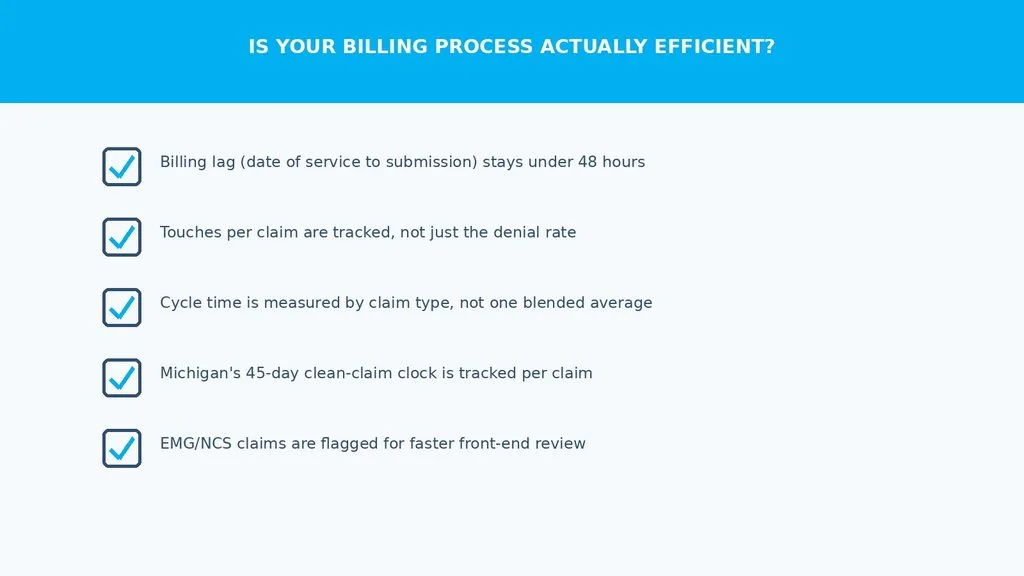
Is Your Billing Process Actually Efficient?
Answer yes or no to each question, then check the scoring guide below.
1. Do you know your practice’s average billing lag, in days or hours?
2. Is touches per claim tracked, not just the denial rate?
3. Is cycle time measured by claim type, not one blended average?
4. Do your EMG/NCS claims get flagged for faster front-end review?
5. Is Michigan’s 45-day clean-claim deadline tracked per claim?
6. Do you know your practice’s actual days in A/R, and is it trending toward 30-40 days?
7. Would your billing partner know, specifically, which claim type is currently slowest?
8. Is your billing lag closer to 48 hours or closer to a week?
9. Do you know how much rework is costing you per month, in dollars?
10. Could you distinguish, right now, a claim that’s slow from one that’s actually been denied?
Scoring: 8-10 “yes” answers suggests your current process tracks and performs well on genuine efficiency measures. 5-7 suggests some real numbers are missing, often billing lag or cycle time by claim type. 0-4 suggests “efficient” in your current setup is more of an impression than a measured fact, and a fuller review is worth prioritizing.
When “Efficient” Stops Being True?
A few signals tend to show up together when a billing process has quietly become inefficient, even if it still feels fast day to day:
- Claims routinely sit for several days before submission, with no one tracking the exact lag.
- Nobody can say how many times, on average, a claim gets touched before it’s paid.
- EMG/NCS or other complex claims take noticeably longer to resolve, with no separate tracking to confirm it.
- Days in A/R has drifted upward with no clear, claim-type-specific explanation.
- Michigan’s 45-day deadline is treated as background law rather than something actively tracked per claim.
Illustrative scenario (not an actual client record): using the worked examples earlier in this guide, a practice with both a 3-day billing-lag gap and a 0.7-touch-per-claim gap above benchmark could be facing two compounding efficiency problems — slow submission and expensive rework — that a single “days in A/R” number would never separate. Closing each requires a different fix: faster front-end coding turnaround for the lag, better first-pass documentation for the rework. This is hypothetical math to illustrate why the two need separate tracking, not a projection for any specific practice’s results.
Aspect Billing Solutions provides HIPAA-compliant medical billing and coding for US healthcare providers, including Michigan neurology practices, covering claim and denial management, eligibility verification, prior authorization, accounts receivable follow-up, and credentialing — through a dedicated agent per provider. The company offers a free, no-commitment consultation that starts by reviewing your actual billing lag and cycle time before any quote is given.
Learn more at aspectbillingsolutions.com.

Final Considerations
Efficient neurology insurance billing in Michigan should be judged on specific, trackable numbers — billing lag, touches per claim, and cycle time by claim type — not a general sense that things move quickly. A process that feels efficient day to day can still be quietly slow on its most complex claims, and the only way to know is to measure by claim type rather than rely on a comfortable blended average.
A few numbers in this guide are firm, published figures: Michigan’s MCL § 500.2006 clean-claim deadline and interest rate, and HFMA/MGMA’s clean claim rate and days-in-A/R benchmarks. Others, including the billing-lag target, touches-per-claim figures, and rework-cost range, are commonly reported across industry sources rather than confirmed against one single named primary report, and the timeline and cycle-time comparisons are explicitly illustrative. Keep that distinction in mind when comparing your own numbers against anything in this guide.
Frequently Asked Questions
Efficient neurology insurance billing in Michigan
What does “efficient” actually mean for neurology billing?
It means specific, trackable numbers: billing lag (days from service to submission) under 48 hours, a high first-pass clean claim rate so claims aren’t reworked, and cycle time that holds steady across claim types rather than ballooning for complex ones like EMG/NCS testing.
What is a good billing lag for a medical practice?
Under 48 hours from date of service to claim submission is a commonly cite target for standard outpatient claims. With up to seven days considered acceptable in more complex hospital settings.
How many times should a claim be touched before it’s paid?
Industry sources commonly report around 1.5 touches for a clean claim that needs no correction. Rising toward 2.5 or more when a claim enters a rework cycle. Tracking this number separately from the denial rate reveals hidden inefficiency that a clean/denied binary misses.
How long Michigan give health does plans to pay a claim?
Under MCL § 500.2006, a health plan must pay a clean claim within 45 days of receipt. With 30 days to notify the provider of any defects. Claims paid late accrue simple interest at 12% per year. This applies to health insurers, HMOs, and Blue Cross Blue Shield of Michigan underwritten plans.
Does Michigan’s prompt pay law apply to self-funded employer health plans?
Generally no. Michigan’s MCL § 500.2006 governs health insurers, HMOs, and Blue Cross Blue Shield of Michigan underwritten plans; self-fund employer plans are typically govern by federal ERISA rules instead.
How Michigan Medicaid does managed care work for neurology practices?
Michigan delivers most Medicaid coverage through nine Medicaid Health Plans (MHPs), with availability varying by county. A separate track, MI Coordinated Health (MICH), coordinates care for beneficiaries dually eligible for Medicare and Medicaid, with its own county-specific participating-plan list.
Who processes Medicare claims for Michigan neurology practices?
Wisconsin Physicians Service (WPS) Government Health Administrators is the Medicare Administrative Contractor for Jurisdiction 8, which covers Michigan and Indiana.
What is a good days-in-A/R number for a neurology practice?
A days-in-A/R range of 30 to 40 days is a commonly cite target, with best-in-class practices reaching 25 days or fewer. A number that stays in range for routine claims but climbs for complex ones like EMG/NCS testing points to a claim-type-specific gap worth investigating.
Can a billing process be efficient on average but inefficient for certain claim types?
Yes. A blended average cycle time can look healthy while a specific, more complex claim type — commonly EMG and nerve conduction studies in neurology — runs well past target. Tracking cycle time by claim type, not just overall, is the only way to catch this.
How long does it take to see measurable efficiency improvements?
A baseline measuring billing lag, touches per claim, and cycle time by claim type typically takes about 30 days to establish. Billing-lag improvements often show up within 30 to 45 days, while confirming a genuine, sustained reduction in touches per claim generally takes four to five months of stable reporting.
Sources & Methodology
(a) Published standards and definitions, verified directly against the primary source:
- MCL § 500.2006 (Public Act 316 of 2002) — the 45-day clean-claim payment deadline, 30-day defect-notification requirement, and 12% annual interest penalty for health insurers, HMOs, and Blue Cross Blue Shield of Michigan underwritten plans. Full text available via the Michigan Legislature (legislature.mi.gov).
- Michigan’s nine current Medicaid Health Plans and the MI Coordinated Health (MICH) program, as documented by the Michigan Department of Health and Human Services (michigan.gov/mdhhs) under Comprehensive Health Care Program contracts effective October 1, 2024.
- CMS Medicare Administrative Contractor records confirming WPS Government Health Administrators as the Jurisdiction 8 (Michigan, Indiana) Part A/B contractor.
(b) Named benchmarking data providers, cited but not independently re-verified against the primary report:
HFMA’s MAP Keys framework and MGMA DataDive Practice Operations benchmarking for clean claim rate and days in A/R. The billing-lag target (under 48 hours), the touches-per-claim figures, and the $25-$118 denial rework. Cost range are all commonly report across multiple independent industry RCM publications. This guide did not independently confirm any of these three against one single name primary report, so all should be treat as reported estimates rather than confirm primary statistics.
(c) Practical and illustrative content:
The efficient-vs-inefficient claim lifecycle timeline and the cycle-time-by-claim-type comparison are explicitly label illustrative — built to demonstrate the underlying concepts, not drawn from a specific practice’s real performance data.
(d) Survey data:
No additional name survey data was use beyond the sources list above.
Legal note:
MCL § 500.2006 applies to Michigan-regulated health insurers, HMOs, and Blue Cross Blue Shield of Michigan underwritten plans; self-fund employer plans are generally govern by federal ERISA law instead. This is general information, not legal advice.
Actual results vary by practice, payer mix, and claim volume. Figures in this article reflect information available at the time of research (September 2026) and are not a guarantee for any specific practice.