
Low-Cost Neurologist Billing Services in Georgia
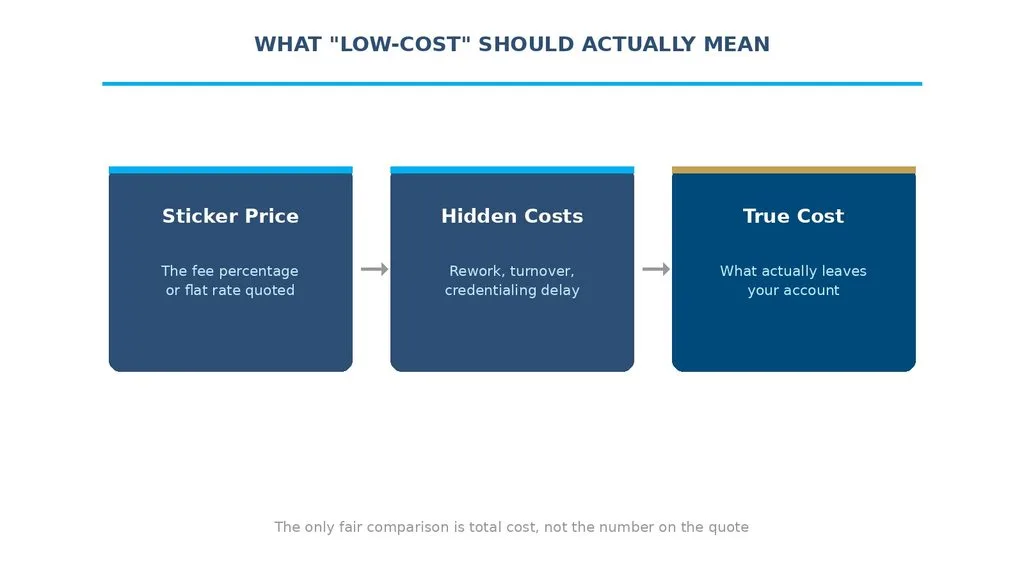
Low-cost neurologist billing services in Georgia should mean a low total cost — the fee plus what a cheap vendor’s mistakes actually cost in denial rework, staff turnover, and credentialing delay — not just a low number on the initial quote. A vendor charging less upfront can end up costing more once those hidden categories are added in. The only fair comparison is total cost, not the sticker price.
“Low-cost” is the easiest claim in medical billing to make and low-cost neurologist billing services in Georgia, the hardest to actually verify from a quote alone. A fee percentage or flat rate is only one line in a larger cost picture that includes denial rework, the cost of staff turnover at a high-volume vendor, and revenue lost to slow credentialing. This guide breaks down what “low-cost” should actually mean once those categories are counted, covers Georgia’s specific claim-payment rules, and ends with a self-assessment checklist so you can compare your current setup on total cost, not just the quote.
What Low-Cost Billing Actually Involves?
The Categories a Fee Quote Doesn’t Show
| Metric | Practical Range | Review Frequency | Primary Source |
| Outsourced billing fee | Commonly 4%-10% of collections; often 6%-8% for neurology specifically | At contract review | Commonly reported across industry billing-cost comparisons |
| Coding-error revenue leakage | Commonly reported at 3%-5% of net revenue annually | Annually | Attributed to MGMA by multiple industry publications* |
| Neurology-specific denial rate | ~18% average reported, vs. 5%-10% for other specialties | Monthly | Attributed to MGMA benchmarking by industry publications* |
| Billing staff turnover (business operations support staff) | 33.3% in 2022 (business operations support staff, including billing) | Annually | MGMA 2023 DataDive Practice Operations report |
| Georgia prompt-pay claim deadline (insured plans) | 15 working days to pay or deny | Statutory, not a KPI | O.C.G.A. Title 33, Ch. 24 prompt-pay provisions (1999 law) |
Source key: “MGMA 2023 DataDive” = a published benchmarking figure directly attributable to that named report. “*Attributed by industry publications” = secondary sources name MGMA as the origin, but this guide has not independently located and confirmed the primary MGMA report and table for these rows; treat them as reported estimates. Georgia’s prompt-pay deadline applies to traditional insured health plans; a 2011 attempt to extend similar deadlines to self-funded ERISA plans administered by third-party administrators was struck down as federally preempted (America’s Health Insurance Plans v. Hudgens, 11th Cir. 2014) — self-funded plans are governed by ERISA instead. The exact current interest rate on late payments could not be independently re-verified at the time of writing; see Sources & Methodology.
The Sticker Price Isn’t the Total Cost
A billing fee quote answers one question: what percentage or flat rate will this vendor charge? It says nothing about how many of your claims that vendor’s coders get wrong. How often your account gets reassigned as staff turn over, or how quickly they get a new provider credentialed. Those three categories — rework, turnover, and credentialing delay — are where a “low-cost” quote can quietly become an expensive relationship.
Denial Rework Is Not Free
A denied claim doesn’t just delay payment — reworking it costs staff time whether that time is billed to you directly or baked into a vendor’s overhead. A vendor pricing itself below the market on fee percentage has to make that margin back somewhere, and a common place is thinner staffing per account, which shows up as a higher denial rate and more rework.
Turnover Resets What a Vendor Knows About Your Account
MGMA’s 2023 DataDive Practice Operations report found 33.3% turnover among business operations support staff, the category that includes medical billing, in 2022. A vendor with high internal turnover loses payer-specific and practice-specific knowledge repeatedly, and a newly assigned biller is more likely to miss a nuance that a longer-tenured one would have caught.
Slow Credentialing Is Lost Revenue, Not Just an Inconvenience
Every week a provider sits uncredentialed with a payer is a week of claims to that payer that cannot be billed at all. A vendor’s fee percentage says nothing about how quickly it moves a new provider through credentialing — but a slow credentialing process is a direct, calculable revenue cost.
The Math Behind “Low-Cost”
Total Cost of Ownership, Not Just the Fee
Formula: True Annual Cost = (Fee % × Collections) + Denial Rework Cost + Turnover-Driven Cost + Credentialing Delay Cost.
Worked example: a Georgia neurology practice collecting $600,000 a year compares two vendors. The “cheapest” vendor quotes a 4% fee ($24,000) but, being thinly staffed, generates $14,000 in denial rework cost, $9,000 in turnover-driven revenue disruption, and $7,000 in credentialing-delay losses — a true annual cost of $54,000. A mid-tier vendor quotes 7% ($42,000) but keeps rework, turnover, and credentialing costs low, at $5,000, $2,000, and $2,000 respectively — a true annual cost of $51,000. The “cheaper” vendor is actually more expensive once the full picture is counted.
Coding-Error Revenue Leakage
Formula: Estimated Annual Leakage ≈ Net Revenue × Coding Error Rate (commonly cited at 3%-5%, attributed to MGMA by multiple industry sources).
Worked example: at the midpoint 4% commonly cited rate, a $600,000-revenue practice is looking at roughly $24,000 a year in coding-error-driven leakage alone — a category that a cut-rate vendor, thinly staffed on coding review, is more exposed to than one that invests in it.
Georgia’s Prompt-Pay Clock
Formula: Claims Outstanding Exposure ≈ Average Weekly Charges × (Payment Deadline in Weeks).
Worked example: a practice billing $12,000 a week to Georgia-regulated insured plans, paid on the state’s 15-working-day (roughly 3-week) deadline, is carrying approximately $36,000 in claims outstanding under that statutory window at any given time. A vendor that doesn’t actively track this deadline per claim has no way to know whether that number is accurate or growing.
Why the Cheapest Quote Isn’t Always the Cheapest Vendor?
The illustration below breaks the total-cost worked example above into its four components for both vendors, showing how the categories a fee quote doesn’t mention can close — or reverse — the gap the sticker price seems to offer.
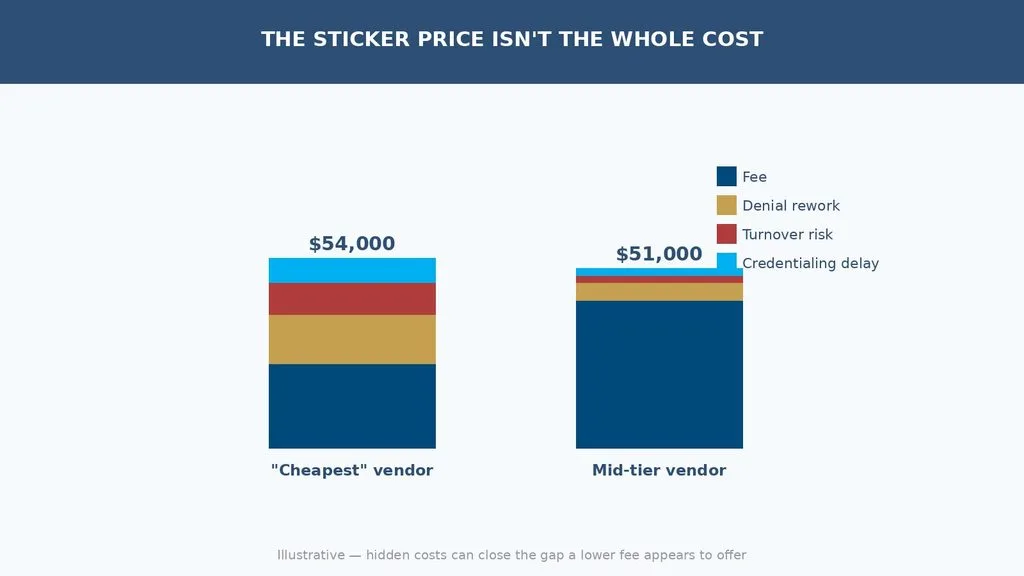
In this illustration, the “cheapest” vendor’s lower fee is more than offset by its higher rework, turnover, and credentialing costs — landing at a higher true annual cost than the mid-tier vendor’s higher-but-more-complete quote. Neither vendor’s fee percentage alone predicted this outcome; only the full cost breakdown did.
Georgia-Specific Factors That Affect the Real Cost
The 15-Working-Day Prompt-Pay Clock
Georgia has required insurers to pay or deny a claim within 15 working days since a 1999 prompt-pay law. A 2011 amendment (the Insurance Delivery Enhancement Act) attempted to extend similar deadlines and a reduced interest rate to third-party administrators processing claims for self-funded employer plans — but the U.S. Court of Appeals for the Eleventh Circuit ruled in 2014 (America’s Health Insurance Plans v. Hudgens) that this extension was federally preempted by ERISA. The practical result: Georgia’s prompt-pay deadline reliably applies to traditional insured health plans, but self-funded employer plans are governed by federal ERISA rules instead — a distinction with real litigation history behind it, not just a general caveat.
Georgia Medicaid Managed Care
Georgia delivers most Medicaid coverage through managed care organizations under its Georgia Families program. The current roster of participating plans changes periodically and should be verified directly against the Georgia Department of Community Health rather than assumed static — this guide has not independently re-confirmed the current plan list at the time of writing.
Medicare Administrative Contractor
Georgia’s Medicare Part A/B claims are processed by a CMS-designated Medicare Administrative Contractor whose jurisdiction covers Georgia alongside neighboring states. This guide has not independently re-confirmed the current contractor’s name and exact jurisdiction letter at the time of writing; verify directly against CMS’s published MAC directory before relying on it.
What to Actually Ask a “Low-Cost” Vendor?
Ask for an Itemized Cost Breakdown, Not Just a Fee Percentage
A vendor confident in its total cost should be willing to discuss denial rework rates, staff turnover, and credentialing turnaround time alongside the fee — not just the fee alone.
Ask About Staffing Ratios
A fee well below market often means fewer staff hours per account. Ask directly how many accounts a given biller or coder handles.
Ask How Georgia’s Prompt-Pay Deadline Is Tracked
A vendor that can’t describe how it monitors the 15-working-day clock per claim is not actively capturing the interest and leverage that deadline is meant to provide.
For a fuller line-by-line cost breakdown, see the true cost of medical billing: in-house vs. outsourcing.
For the coding side of revenue leakage, see accurate neurology billing strategies.
Credentialing delays specifically are covered in credentialing mistakes that delay payments.
How Aspect Billing Solutions Approaches “Low-Cost”?
The categories above only matter if a billing partner is willing to be measured against them. Aspect Billing Solutions’ process is built around a few specific, checkable commitments:
- A free consultation reviews your actual claim volume and payer mix before any fee is quote, rather than leading with a flat rate card.
- Denials are track by payer segment, so rework cost stays visible rather than folded into a vendor’s overhead.
- A dedicated agent per provider limits the turnover-driven knowledge loss that comes with a high-churn, rotating-queue staffing model.
- Credentialing status is review on a set quarterly cycle rather than only after a claim bounces for an out-of-network denial.
This describes process and structure, not a performance guarantee — actual total cost depends on a practice’s starting point, payer mix, and claim volume. The consultation is built to produce a real cost comparison, not just a quote.
Using These Numbers Correctly
A fee comparison is only meaningful once rework, turnover, and credentialing speed count alongside it, and only when compare like-for-like: similar claim volume, comparable payer mix, and services actually included in the quote. A single low number on a quote is a starting point for questions, not a decision by itself.
How Long a True Cost Comparison Takes?
Low-cost neurologist billing services in Georgia–General Timeline to a Verified Total-Cost Picture
| Milestone | What to Expect | General Timeframe |
| Cost baseline established | Fee, rework, turnover, and credentialing costs measured against your own claims | 30-45 days |
| Denial rework declines | Coding and documentation gaps close, reducing rework cost | 60-90 days |
| Credentialing backlog clears | New and existing providers credentialed on a predictable cycle | 60-120 days |
| Full cost comparison | Enough data to confidently compare true total cost to the prior setup | 120-180 days |
These are general planning ranges based on commonly reported billing-transition patterns, not a guarantee for any specific practice. A practice with an existing credentialing backlog or a high current denial rate may take longer to see the full financial picture.
Quick Summary
- “Low-cost” should mean low total cost — fee plus rework, turnover, and credentialing delay — not just the number on the quote.
- A vendor pricing below market often makes the margin back through thinner staffing, which shows up as more rework and slower credentialing.
- Georgia’s 15-working-day prompt-pay deadline applies to insure health plans; self-fund ERISA plans are govern separately, per a 2014 federal court ruling.
- Billing staff turnover among business-operations support staff ran 33.3% in 2022, per MGMA — a real driver of hidden cost at high-churn vendors.
- Expect a real cost baseline within 30-45 days and a full comparison within four to six months.
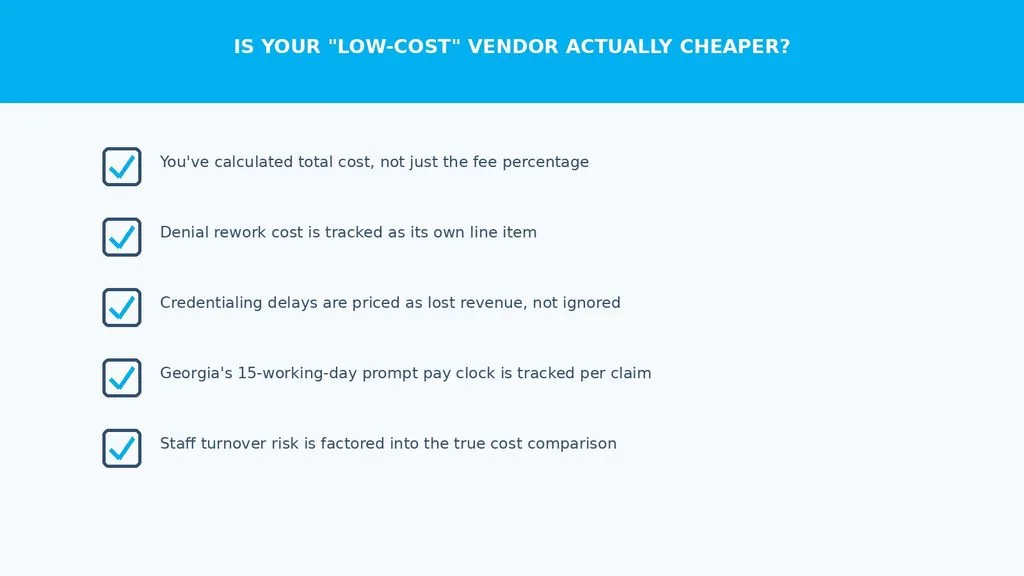
Is Your “Low-Cost” Vendor Actually Cheaper?
Answer yes or no to each question, then check the scoring guide below.
1. Have you calculated your vendor’s true total cost, not just the fee percentage?
2. Do you know your current denial rework cost as its own line item?
3. Do you know your billing team’s turnover rate and what it’s costing you?
4. Is credentialing turnaround tracked and priced as lost revenue when it’s slow?
5. Is Georgia’s 15-working-day prompt-pay deadline tracked per claim?
6. Do you know how many accounts your biller or coder handles, relative to industry norms?
7. Would your vendor provide an itemized cost breakdown if you asked for one?
8. Have you compared at least two vendors on total cost, not just fee percentage?
9. Do you know whether your practice’s claims run through insured plans, self-funded plans, or both?
10. Could you explain, specifically, what your current fee does and doesn’t include?
Scoring: 8-10 “yes” answers suggests you have a clear, accurate picture of your true billing cost. 5-7 suggests some real numbers are missing from the comparison, often rework or turnover cost. 0-4 suggests your current cost comparison is likely based on the fee alone, and a fuller review is worth prioritizing.
When “Low-Cost” Stops Being Low-Cost?
A few signals tend to show up together when a cut-rate vendor’s hidden costs have caught up with its fee advantage:
- Denial rate has climbed since switching to a lower-fee vendor.
- The person handling your account keeps changing without explanation.
- New providers routinely wait longer than expected to get credentialed.
- Nobody has calculated your vendor’s true cost — only the fee percentage.
- Your vendor can’t or won’t provide an itemized cost breakdown when asked.
Illustrative scenario (not an actual client record): using the total-cost work example from earlier in this guide, a practice that switch to the “cheapest” vendor to save $18,000 a year in fees could end up roughly $3,000 worse off overall once rework, turnover, and credentialing delay are add back in — the opposite of the intend outcome. This is hypothetical math to illustrate how a fee-only comparison can mislead, not a projection for any specific practice’s results.
Aspect Billing Solutions provides HIPAA-compliant medical billing and coding for US healthcare providers, including Georgia neurology practices, covering claim and denial management, eligibility verification, prior authorization, accounts receivable follow-up, and credentialing — through a dedicated agent per provider. The company offers a free, no-commitment consultation that reviews your actual claim volume and cost drivers before any quote is given.
Learn more at aspectbillingsolutions.com.

Final Considerations
Low-cost neurologist billing in Georgia should be judge on total cost — fee plus rework, turnover, and credentialing delay — not the number on the initial quote. The cheapest sticker price and the cheapest total relationship are not always the same vendor, and the only way to know which is which is to ask for the full breakdown before signing anything.
A few numbers in this guide are firm: Georgia’s 15-working-day prompt-pay deadline and the 2014 federal court ruling on its ERISA limits, and MGMA’s published 33.3% 2022 turnover figure for business-operations support staff. Others, including the neurology-specific denial rate and coding-error leakage figures, are attribute to MGMA by secondary industry sources rather than confirm against a primary name report, and the total-cost worked example is explicitly illustrative. Two additional details — Georgia’s current Medicaid manage care plan roster and the exact current prompt-pay interest rate — could not be independently re-verify at the time of writing and should be confirm before this article is finalize for publication.
Frequently Asked Questions
Low-cost neurologist billing services in Georgia
What does “low-cost” actually mean for neurology billing in Georgia?
It should mean a low total cost — the fee plus what a vendor’s denial rework, staff turnover, and credentialing delays actually cost — not just a low number on the initial quote. A vendor pricing below market often makes up the difference through thinner staffing, which shows up as hidden costs elsewhere.
Is the cheapest billing fee always the best deal?
Not necessarily. A lower fee combined with higher denial rework, turnover-driven errors, and slower credentialing can add up to a higher total cost than a vendor charging a higher fee but keeping those hidden categories low. Comparing fee percentage alone can be misleading.
What is a good billing fee percentage for a Georgia neurology practice?
A range of 4% to 10% of collections is commonly cite industry-wide, with neurology often landing at 6% to 8% given its coding complexity. The right number depends more on what’s included and how well the vendor performs on rework and turnover than on the percentage alone.
How long does Georgia give insurers to pay a claim?
Georgia has required insurers to pay or deny a claim within 15 working days since a 1999 prompt-pay law. A 2011 attempt to extend similar rules to self-fund employer plans was struck down by a federal appeals court in 2014 as preempt by ERISA, so self-fund plans follow federal rules instead.
Does Georgia’s prompt pay law apply to self-funded employer health plans?
No. A 2014 ruling by the U.S. Court of Appeals for the Eleventh Circuit (America’s Health Insurance Plans v. Hudgens) found that extending Georgia’s prompt-pay deadlines to self-fund ERISA plans was federally preempt. Those plans are govern by ERISA’s own claims-processing rules instead.
What is a good coding-error revenue leakage rate?
Industry sources commonly attribute a 3%-5% annual net revenue loss to coding errors to MGMA, though this guide was unable to independently confirm that figure against a primary MGMA report. Whatever the precise number, it underscores why coding accuracy is part of any real cost comparison, not just the billing fee.
How much does staff turnover at a billing vendor actually cost a practice?
MGMA’s 2023 DataDive Practice Operations report found 33.3% turnover among business-operations support staff, including billing, in 2022. Each departure resets payer-specific and practice-specific knowledge, which shows up as more errors and slower resolution at high-churn vendors.
What questions should I ask a low-cost billing vendor before signing?
Ask for an itemized cost breakdown beyond the fee percentage, the staffing ratio per account, average credentialing turnaround time, and how the vendor tracks Georgia’s prompt-pay deadline per claim. A vendor confident in its total cost should be willing to discuss all four.
Is a higher-fee vendor always the safer choice?
Not automatically — a higher fee doesn’t guarantee lower rework, turnover, or credentialing delay either. The fee is one input, not the whole answer; the total-cost comparison in this guide applies regardless of which direction a vendor’s fee sits relative to the market.
How long does it take to see the real cost difference after switching vendors?
A cost baseline measuring fee, rework, turnover, and credentialing speed together typically takes 30 to 45 days to establish, with a full, confident total-cost comparison generally available within four to six months of stable reporting.
Sources & Methodology
(a) Published standards and definitions, verified directly against primary or well-corroborated sources:
- Georgia’s 1999 prompt-pay law (15 working days to pay or deny a claim) and the 2011 Insurance Delivery Enhancement Act amendments, as described in contemporaneous legal and healthcare-industry reporting.
- America’s Health Insurance Plans v. Hudgens, 11th Cir., decided February 14, 2014 — the federal appellate ruling finding Georgia’s extension of prompt-pay deadlines to self-funded ERISA plans preempted.
- MGMA’s 2023 DataDive Practice Operations report, cited for its 33.3% 2022 turnover figure among business-operations support staff (as reported in secondary industry analyses; see note below).
(b) Named benchmarking data providers, cited but not independently re-verified against the primary report:
The neurology-specific 18% denial rate and the 3%-5% coding-error revenue leakage figures are both attribute to MGMA by multiple secondary industry publications. This guide located that attribution in secondary sources. But did not independently confirm either figure against MGMA’s original report and tables. The MGMA turnover figure above is drawn from the same category of secondary reporting use. Consistently across this article series and treated with the same standard of care.
(c) Details flagged as unverified at time of writing:
Two Georgia-specific details referenced in this article. The current Georgia Families Medicaid managed care organization roster, and the exact current interest rate. On late prompt-pay claims (a 2011 amendment proposed reducing it from 18% to 12%. But that amendment was substantially invalidate for self-fund plans, and this guide could not confirm what rate currently applies. To the insured plans still cover by the law) — could not be check against a live primary source due to a search-tool outage during research. Both should be verify against the Georgia Department of Community Health and the Georgia Department of Insurance, respectively, before this article is publish.
(d) Practical and illustrative content:
The total-cost-of-ownership worked example and cost-stack comparison are explicitly label illustrative. Built to demonstrate the concept that a fee percentage is not the whole cost. Not drawn from a specific vendor’s real pricing or performance.
(e) Survey data:
No additional name survey data was use beyond the sources listed above.
Actual results and costs vary by practice, vendor, payer mix, and claim volume. Figures in this article reflect information available at the time of research (September 2026) and are not a guarantee for any specific practice.