
Top-Rated Internal Medicine Billing Services in Iowa
Top-rated internal medicine billing services in Iowa combine HIPAA-compliant medical billing with accurate ICD-10 coding, CPT codes, and HCPCS codes to reduce denials and speed up reimbursement. The strongest providers assign a dedicated billing agent to every practice, verify eligibility before each visit, and track hard numbers like clean claim rate and days in accounts receivable (A/R) to keep internal medicine practices financially healthy.
top-rated internal medicine billing services in Iowa-Iowa’s internal medicine physicians manage some of the most complex patients in primary care. A single visit might involve evaluation and management (E/M) coding, chronic disease oversight, and coordination with specialists across two or three counties. Add a shrinking rural physician workforce, thin front-office staff, and constantly shifting payer rules, and billing becomes a full-time liability rather than a background task. Many internists lose thousands of dollars every month to preventable claim denials, missed prior authorizations, or credentialing delays that keep new patients from ever generating revenue.
This guide breaks down what separates a top-rated internal medicine billing partner from a generic vendor, the coding and compliance challenges unique to Iowa practices, and the specific services that protect your revenue cycle, from eligibility verification to provider credentialing. We also show how Aspect Billing Solutions structures its process around one dedicated agent for every Iowa-based internal medicine practice, so nothing slips through the cracks between the front desk and the final payment.
Why Internal Medicine Practices in Iowa Need Specialized Billing Support?
Iowa ranks 44th nationally in physicians per capita, with roughly 200 direct-care doctors per 100,000 residents against a national figure closer to 254. That shortage means the internists who remain often carry larger, older, and more medically complex patient panels than peers in other states. Every additional chronic condition on a patient’s chart adds another layer of documentation, another set of diagnosis codes, and another chance for a claim to be rejected. Specialized billing support exists precisely to absorb that complexity so physicians can spend their limited time with patients instead of chasing payers for payment.
The Coding Complexity Behind Internal Medicine Claims
Internal medicine claims rarely involve a single diagnosis or procedure. A routine visit for a patient with diabetes, hypertension, and COPD requires multiple ICD-10 coding entries, correctly sequenced CPT codes for the visit level, and often HCPCS codes for supplies or injections given in-office. Coders must also apply modifiers correctly when preventive and problem-based services happen during the same encounter. A single missing modifier or mismatched diagnosis pointer can trigger an automatic denial, no matter how well the physician documented the visit.
Rural Access and Reimbursement Pressures in Iowa
Many Iowa internists serve rural counties where Medicare and Medicaid make up a larger share of the payer mix than in metro markets. These government programs enforce strict timely filing limits and detailed documentation standards, and both plans revise coverage policy throughout the year. A billing partner unfamiliar with Iowa’s rural health clinic designations, critical access hospital rules, or regional Blue Cross Blue Shield policy will submit claims that look correct nationally but still fail locally.
What Makes a Billing Partner “Top-Rated” for Internal Medicine in Iowa?
Not every medical billing company understands the daily realities of an internal medicine practice. The strongest partners combine deep coding expertise with transparent reporting and a compliance-first mindset, so practices never have to choose between getting paid quickly and staying audit-ready.
HIPAA-Compliant Processes and Data Security
Every step of the billing workflow, from intake through claim transmission, must protect patient health information under strict HIPAA-compliant standards. Look for partners who encrypt data in transit and at rest, restrict staff access on a need-to-know basis, and maintain documented breach-response policies. Iowa practices that store data with vendors lacking these safeguards carry legal exposure that goes well beyond the cost of one denied claim.
Dedicated Agent Model vs. Call-Center Billing
Large national vendors often rotate staff across dozens of accounts, so a different representative answers every question about your claims. A dedicated billing agent, by contrast, learns your provider mix, payer contracts, and common denial patterns over time. That familiarity shortens the time between a denial and its resolution, because the agent already knows what each payer expects on resubmission.
Certified Coders Fluent in Internal Medicine CPT Codes
Coders working internal medicine accounts need fluency in a specific set of code families, not just general billing knowledge. They should know chronic care management billing, annual wellness visit codes, and transitional care management rules cold, because these recurring services are easy to under-bill or miss entirely without specialty-specific training.
Common Internal Medicine CPT Code Families
- Office/outpatient E/M visits (99202–99215)
- Chronic Care Management (99490, 99491)
- Annual Wellness Visits (G0438, G0439)
- Transitional Care Management (99495, 99496)
- Advance Care Planning (99497, 99498)
Top-rated internal medicine billing services in Iowa, For a deeper breakdown of code sets and modifiers specific to this specialty, see Aspect Billing Solutions’ internal medicine CPT codes guide.
Core Services Iowa Internists Should Expect
A complete revenue cycle partnership covers far more than claim submission. Iowa internists should expect dedicated support at every stage of the patient and payer relationship, from the first eligibility check to the final posted payment.
Eligibility Verification & Prior Authorization
Eligibility verification before every appointment confirms active coverage, remaining deductible, and referral requirements, which prevents the single most common cause of denied claims: coverage that lapsed or changed without anyone noticing. Prior authorization support matters just as much for internal medicine, since many diagnostic tests, durable medical equipment orders, and specialist referrals require payer approval before the service is rendered.
Claims Submission & Coding Accuracy
Clean, correctly coded claims should go out within 24 to 48 hours of an encounter being closed. Coders should audit high-risk claims, especially those involving multiple chronic conditions or same-day preventive and problem visits, before submission rather than after a denial arrives.
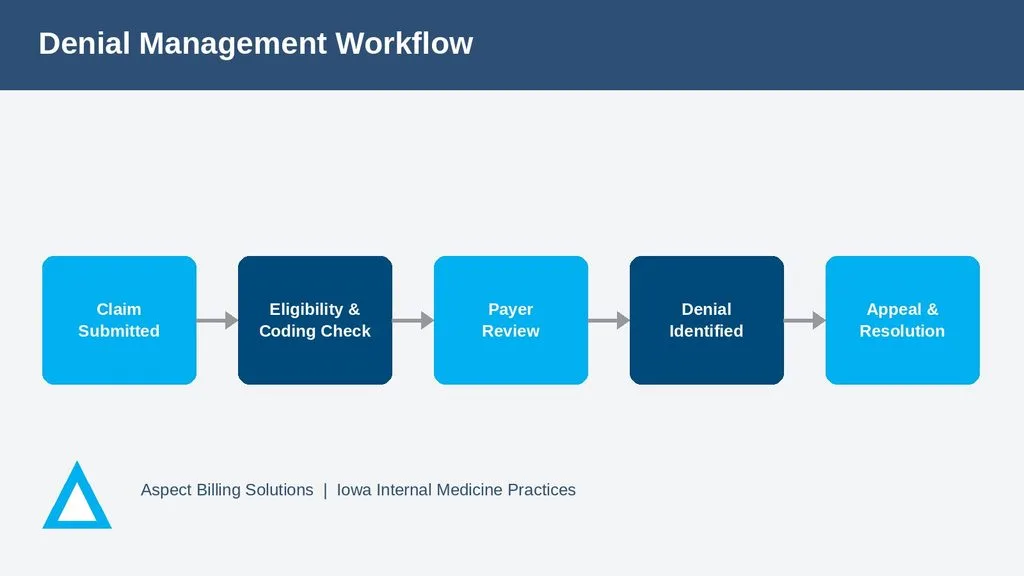
Denial Management & Appeals
When a claim is denied, a structured claim denial management process should identify the root cause, correct it, and refile or appeal within days rather than weeks. Practices that let denials sit lose the ability to appeal once timely filing windows close, turning a fixable error into permanently lost revenue.
Accounts Receivable Recovery
Aging accounts receivable (A/R) should be worked on a fixed schedule, with balances over 90 days flagged for immediate attention. A dedicated agent tracks which payers are slow to respond and escalates accordingly, rather than letting old claims quietly write themselves off the books.
Credentialing & Payer Enrollment
Provider credentialing delays can keep a new internist from billing for services for 60 to 120 days after hire. A billing partner that manages CAQH profiles, payer applications, and re-credentialing deadlines proactively prevents that revenue gap before it ever starts.
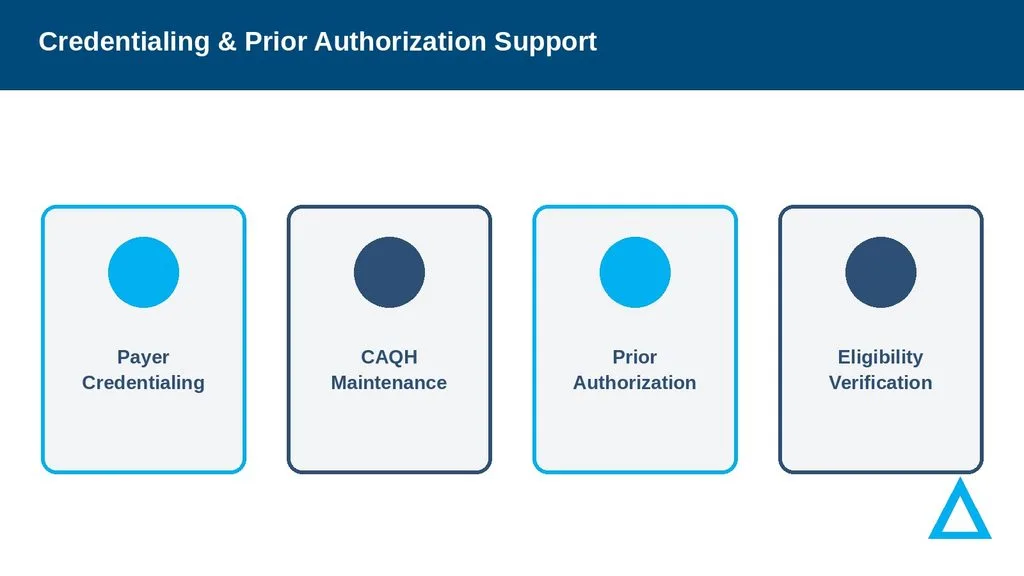
Aspect Billing Solutions’ internal medicine credentialing services walk through this same enrollment process step by step and apply directly to Iowa payer panels.
Benchmarking Internal Medicine Billing Performance
Numbers tell the real story of whether a billing partner is performing. Practices should ask any prospective vendor to report against these standard revenue cycle benchmarks and compare results with recognized industry medians rather than vague promises.
| Metric | Industry Average (MGMA) | Top-Performing Practices | Aspect Billing Solutions Target |
| Clean Claim Rate | 85–90% | 95%+ | 96%+ |
| First-Pass Denial Rate | 10–12% | Under 5% | Under 4% |
| Days in A/R | 40–50 days | Under 35 days | 30–32 days |
| Net Collection Ratio | 92–95% | 96–97% | 97%+ |
| A/R Over 90 Days | 15–20% | Under 12% | Under 10% |
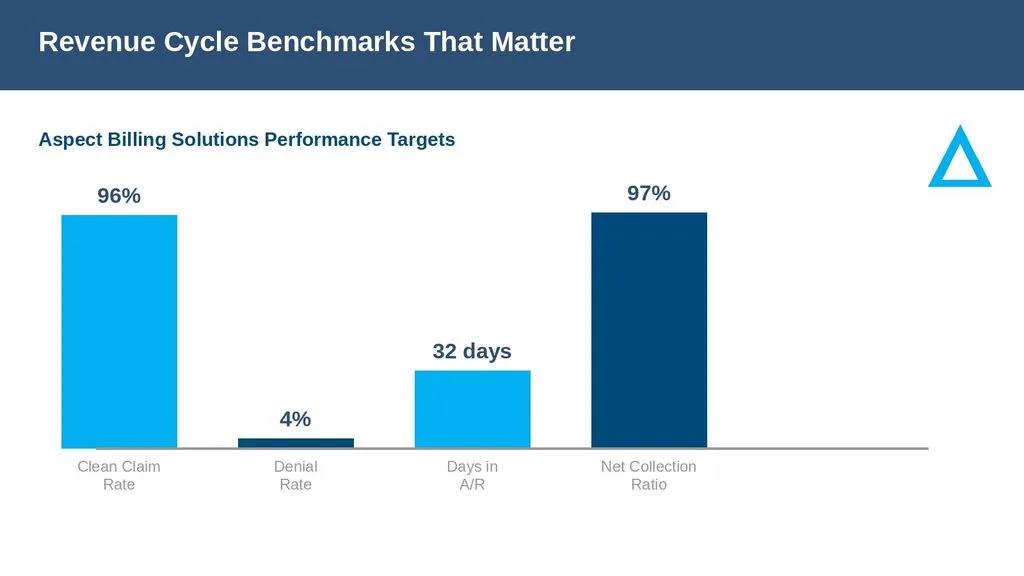
These figures align with data published by the Medical Group Management Association, which tracks first-pass denial rates and revenue cycle performance across thousands of U.S. medical groups.
How Aspect Billing Solutions Supports Internal Medicine Practices in Iowa?
Aspect Billing Solutions builds its Iowa internal medicine service around one core idea: every practice gets a single dedicated billing agent who understands its provider mix, payer contracts, and denial history. That agent oversees eligibility verification, ICD-10 coding, claims submission, denial appeals, A/R recovery, and provider credentialing under one HIPAA-compliant workflow, so nothing gets lost in a handoff between departments. Explore the full range of medical billing services Aspect Billing Solutions provides to internal medicine and multi-specialty practices nationwide.
For practices weighing outsourced versus in-house billing, the decision usually comes down to bandwidth and specialization. In-house teams juggle scheduling, patient calls, and billing simultaneously, while a specialized partner focuses entirely on collecting what internists are owed. This outsourced vs. in-house medical billing comparison breaks down the trade-offs in more detail for practices still deciding.
Quick Summary
- Iowa’s physician shortage makes internal medicine coding accuracy and payer follow-up more important, not less.
- ICD-10 coding, CPT codes, and HCPCS codes must reflect multiple chronic conditions accurately on every claim.
- Favor HIPAA-compliant, dedicated-agent billing partners over rotating call-center models.
- Eligibility verification and prior authorization prevent most avoidable denials before they happen.
- Track clean claim rate, denial rate, days in A/R, and net collection ratio against MGMA benchmarks.
- Proactive credentialing prevents 60–120 day revenue gaps for new or relocating internists.
Final Considerations
Internal medicine billing in Iowa carries more complexity than most specialties because of the chronic, multi-condition patients internists manage every day. Between coding accuracy, payer-specific rules, and a shrinking statewide physician workforce, practices that treat billing as an afterthought are almost guarantee to leave revenue on the table. The practices that perform best treat their billing partner as an extension of the clinical team rather than a distant vendor somewhere out of state.
Choosing a top-rated internal medicine billing service comes down to three things: proven coding expertise, transparent reporting against real benchmarks, and a dedicated point of contact who actually knows your practice. Aspect Billing Solutions was built around exactly that model for internal medicine practices across Iowa and beyond, pairing compliance-first processes with one assigned agent per account.
If your practice is losing revenue to denials, slow credentialing, or inconsistent coding. A second opinion costs nothing but a short conversation. Reviewing your current denial rate and days in A/R against the benchmarks. Above is a useful first step before any vendor conversation begins.
Frequently Asked Questions
Top-rated internal medicine billing services in Iowa
What does an internal medicine billing service in Iowa typically include?
A full-service partner handles eligibility verification, ICD-10 and CPT coding, claims submission, denial management, A/R follow-up, and provider credentialing. For Iowa practices, it should also account for rural payer mixes and regional Medicare Administrative Contractor rules.
How much does outsourced internal medicine billing cost?
Most billing companies charge a percentage of collections, typically between 4% and 9%, depending on claim volume and services included. Practices should compare that fee against the cost of in-house salaries, benefits, software, and lost revenue from denials.
How long does provider credentialing take in Iowa?
Initial credentialing with commercial and government payers. Usually takes 60 to 120 days, depending on the payer and completeness of the application. Starting the process before a new internist’s start date helps avoid a gap where services cannot be billed.
What is a good denial rate for an internal medicine practice?
Industry benchmarks put a strong denial rate under 5%, with top-performing practices closer to 2% to 4%. The national median sits closer to 10% to 12%, so anything meaningfully above that signals a process problem worth investigating.
Does Aspect Billing Solutions work with small or solo internal medicine practices in Iowa?
Yes, solo providers, small groups, and larger clinics all receive the same dedicated-agent model and HIPAA-compliant workflow. Practice size changes reporting cadence, not the level of attention each account receives.
How does HIPAA compliance affect medical billing vendors?
HIPAA compliance requires encrypted data handling, restricted access controls, and documented breach-response procedures at every stage of billing. A vendor that cannot demonstrate these safeguards exposes the practice to compliance risk beyond ordinary claim errors.
Major Industry Leader
Aspect Billing Solutions provides HIPAA-compliant medical billing and coding for internal medicine practices across Iowa, backed by certified coders and one dedicated agent per account. Request a free consultation and revenue cycle audit to see exactly where your practice is losing revenue and how quickly it can be recovered, at www.aspectbillingsolutions.com.