
How Collaborative Care Management Billing Actually Works
Collaborative care management billing covers CPT 99492, 99493, 99494, and HCPCS G2214, the codes Medicare uses to pay for the Psychiatric Collaborative Care Model (CoCM). These are often confused with the general behavioral health integration (BHI) codes, 99484 and G0323, a different, lighter-touch model. This guide covers what separates the two families, how to bill each CoCM code month to month, and what changed for FQHCs and RHCs on January 1, 2026.
CoCM billing sits inside the larger set of mental health billing rules covered in Aspect Billing Solutions’ mental health billing guide, which walks through claim submission, payer enrollment, and documentation for behavioral health practices generally. This guide goes deeper into one specific, high-value billing model inside that broader picture.
| Key Takeaways CoCM (99492, 99493, 99494, G2214) and general BHI (99484, G0323) are two separate code families built around two different care-team models; a practice cannot bill both for the same patient in the same month. 99492 covers only the first month of CoCM; every later month is billed with 99493, with 99494 as an add-on for each additional complete 30-minute block. Every CoCM code requires a psychiatric consultant, a behavioral health care manager, and a patient registry; a supervising clinician alone does not meet the requirement. Starting January 1, 2026, FQHCs and RHCs stopped billing the bundled code G0512 for CoCM and now report the individual codes directly, the same way other practices do. Total actual behavioral health care manager minutes before picking a code each month; billing the higher-paying code without meeting its time threshold is a common, avoidable denial. |
CoCM vs. General BHI: Two Different Code Families
Collaborative care management billing and general BHI billing both pay for integrating behavioral health into primary or specialty care, but they describe two different care-team models, and Medicare treats them as mutually exclusive for the same patient in the same calendar month. Mixing the two families is one of the most common reasons these claims come back denied.
CoCM requires a formal care team: the billing practitioner, a behavioral health care manager (BHCM), and a psychiatric consultant who reviews the patient caseload on a set schedule. General BHI, billed with 99484 or G0323, does not require a psychiatric consultant and pays less per month as a result. The table below lines up all six codes side by side.
| Code | Time Threshold | Team Required | Model |
| 99492 | First 70 min/month (first month only) | Psychiatric consultant + BHCM + registry | CoCM |
| 99493 | First 60 min/month (subsequent months) | Same CoCM team as 99492 | CoCM |
| 99494 | Each additional 30 min/month (add-on) | Billed with 99492 or 99493 only | CoCM add-on |
| G2214 | First 30 min/month (below 99492/99493) | Same CoCM team, lower intensity | CoCM |
| 99484 | At least 20 min/month | No psychiatric consultant or BHCM required | General BHI |
| G0323 | At least 20 min/month | Billed directly by a clinical psychologist or LCSW | General BHI |
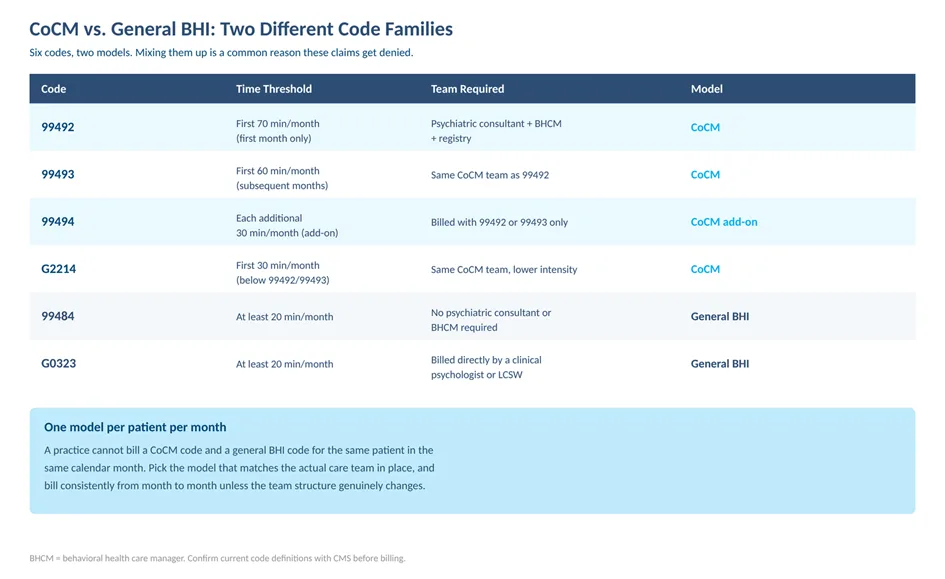
A practice cannot bill a CoCM code and a general BHI code for the same patient in the same calendar month. Pick the model that matches the actual care team in place, and bill consistently from month to month unless the team structure genuinely changes.
What Every CoCM Claim Has to Document
Medicare pays CoCM codes separately each calendar month, and CPT’s general time rules apply: a code requires that the practice actually meet its full time threshold, not estimate it. Before billing any CoCM code, the practice must have three elements in place, regardless of which code it bills.
- An initiating visit on file for a new CoCM patient: an annual wellness visit, an initial preventive physical exam, a comprehensive evaluation and management visit, or a transitional care management visit all qualify.
- Document the patient’s consent, including the required disclosure that cost sharing applies; the patient needs new consent only if they change billing practitioners.
- A behavioral health care manager tracking validated rating scales and care-plan updates in a patient registry, with a weekly caseload review documented with the psychiatric consultant.
These requirements come directly from CMS’s Behavioral Health Integration Services booklet, which lays out the time thresholds, qualifying initiating visits, and consent rules for every CoCM and general BHI code. A general supervision relationship alone, without an actual psychiatric consultant and behavioral health care manager on the case, does not satisfy CoCM’s team requirement.
Monthly Billing Workflow for a CoCM Program
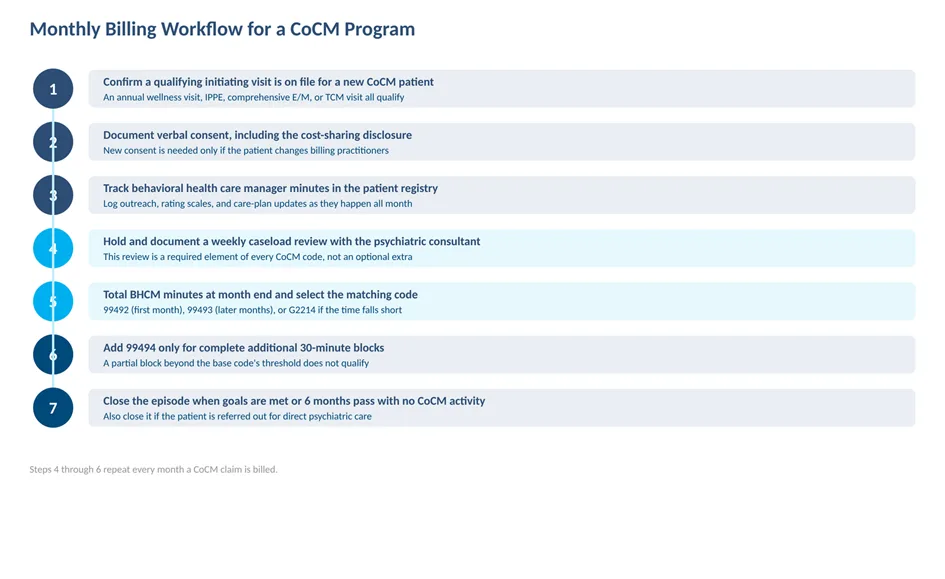
CoCM billing runs on a monthly cycle, and the same sequence repeats for every active patient. The steps below follow that cycle from a new patient’s first qualifying visit through code selection at month end.
- Confirm a qualifying initiating visit is on file for a new CoCM patient.
- Document verbal consent, including the cost-sharing disclosure.
- Track behavioral health care manager minutes in the patient registry all month.
- Hold and document a weekly caseload review with the psychiatric consultant.
- Total BHCM minutes at month end and select the matching code: 99492, 99493, or G2214.
- Add 99494 only for complete additional 30-minute blocks beyond the base code’s threshold.
- Close the episode when the patient meets their treatment goals or 6 months pass with no CoCM activity.
What Changed for FQHCs and RHCs in 2026
Federally qualified health centers and rural health clinics used to bill CoCM differently from other practices, reporting a single bundled code, G0512, instead of the individual CPT and HCPCS codes. That changed on January 1, 2026.
As of that date, FQHCs report the individual codes 99492, 99493, 99494, and G2214 for CoCM services instead of G0512, according to CMS’s Federally Qualified Health Center guidance. Rural health clinics follow the same instruction under CMS’s parallel billing guidance for RHCs, reporting the same individual codes rather than the discontinued bundled code. Medicare pays these codes at the national non-facility Physician Fee Schedule rate, with standard 20 percent coinsurance.
Medicare Sets the Baseline; Commercial Payers Vary
Everything above describes Medicare’s rules for CoCM. Commercial payers and Medicare Advantage plans don’t have to follow the same code set or time thresholds, and many set their own CoCM policy in the provider manual.Confirm the payer’s manual covers the code and team composition before billing a commercial claim under any of these codes.
Common Mistakes and How to Prevent Them
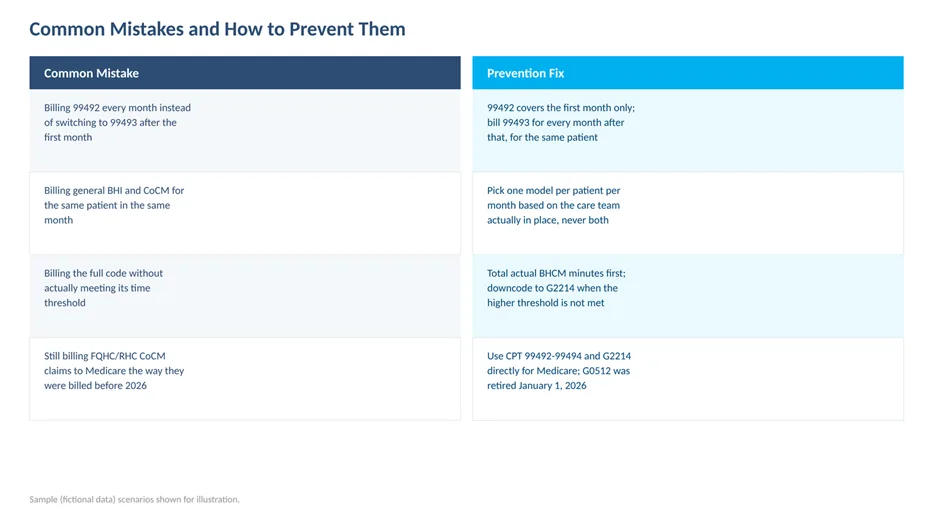
The same few mistakes account for most of the denials billing teams see on collaborative care management claims.
- Billing 99492 every month instead of switching to 99493 after the first month. 99492 covers the first month only; bill 99493 for every month after that, for the same patient.
- Billing general BHI and CoCM for the same patient in the same month. Pick one model per patient per month based on the care team actually in place, never both.
- Billing the full code without actually meeting its time threshold. Total actual BHCM minutes first; downcode to G2214 when the higher threshold is not met.
- Still billing FQHC/RHC CoCM claims to Medicare the way they were billed before 2026. Use CPT 99492-99494 and G2214 directly for Medicare; G0512 was retired January 1, 2026.
How CoCM Compares to Other Monthly Care-Management Codes
CoCM is one of several monthly, time-based care-management models Medicare pays for, and practices billing one of the others often bill CoCM too. Aspect Billing Solutions’ guide to chronic care management billing covers the parallel CCM codes for patients with multiple chronic conditions, and the remote patient monitoring billing guide covers the device-based monthly codes used alongside behavioral health programs. These code families describe different services, so a practice can generally bill more than one for the same patient, each with its own qualifying time that month.
For a lighter-touch alternative that skips the psychiatric consultant requirement, Aspect Billing Solutions’ behavioral health integration billing guide covers general BHI codes 99484 and G0323.
Frequently Asked Questions
Can a practice bill CoCM and general BHI for the same patient?
No. Medicare treats CoCM (99492, 99493, 99494, G2214) and general BHI (99484, G0323) as mutually exclusive for the same patient in the same calendar month. Choose the model that matches the actual care team in place, and bill that model consistently unless the team structure changes.
Who has to be on the care team to bill a CoCM code?
Three roles: the billing practitioner, a behavioral health care manager who tracks the patient in a registry and runs rating scales, and a psychiatric consultant who reviews the caseload weekly. A supervising clinician alone, without this team in place, does not meet the requirement.
What happens if a patient’s care falls short of 99492 or 99493’s time threshold?
Bill G2214 instead. It covers the first 30 minutes of behavioral health care manager time in a month when the patient’s care does not reach the higher thresholds required by 99492 or 99493, using the same CoCM care team.
Do FQHCs still bill G0512 for collaborative care management?
No. As of January 1, 2026, FQHCs and RHCs report the individual codes 99492, 99493, 99494, and G2214 directly, the same way other practices do, and Medicare retired the bundled code G0512.
Getting Collaborative Care Management Billing Right
Collaborative care management billing pays well when run correctly, but its team requirements, monthly time thresholds, and the 2026 FQHC/RHC change all create room for a claim to go out wrong. Aspect Billing Solutions’ medical billing and credentialing team tracks CoCM time thresholds, care-team documentation, and code selection every month, so a claim goes out only once it is actually billable.
Sources: CMS’s Behavioral Health Integration Services booklet (MLN909432) and CMS’s Federally Qualified Health Center guidance (MLN006397). Commercial payer policies vary; confirm current code definitions and coverage rules with each payer’s manual before billing. This article is general information, not legal or billing advice for any specific claim.