
Medicare Advantage Credentialing for Behavioral Health Providers
Medicare Advantage credentialing is the separate review each Medicare Advantage (MA) plan runs before a therapist, psychologist or psychiatric prescriber can join its network. Enrolling in Original Medicare does not put you in any MA network, so each plan needs its own application and contract. This guide covers how MA credentialing differs, what plans verify, the opt-out trap, network rules for behavioral health and a step-by-step workflow.
Practices joining several MA networks at once often hand the applications to a provider credentialing service. The steps below show what each plan expects.
| Key takeaways Each MA plan credentials you separately and recredentials at least every 3 years.Plans check Medicare eligibility, and they cannot pay opted-out practitioners for basic benefits.Behavioral health providers now count toward MA network adequacy in their own category.Plans may limit network size but cannot exclude you solely because of your license type. |
How Medicare Advantage credentialing differs from Medicare enrollment
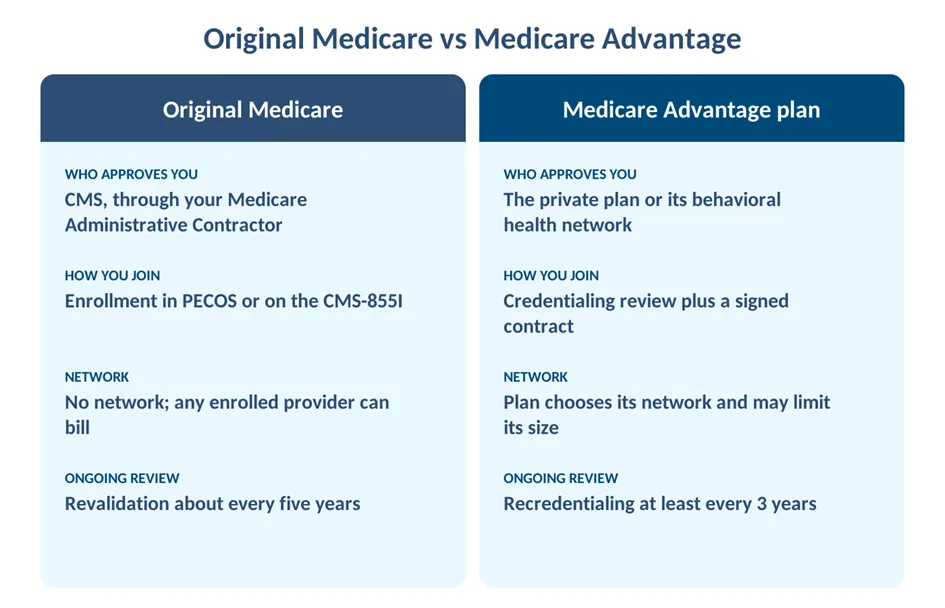
Original Medicare enrollment proves to CMS that you can bill Medicare. An MA plan is a private insurer paid by Medicare, and it builds its own network, so it runs its own credentialing review and offers its own contract.
| Feature | Original Medicare | Medicare Advantage plan |
| Who approves you | CMS through your Medicare Administrative Contractor | The plan or its behavioral health network |
| How you join | PECOS or the CMS-855I | Credentialing application plus a signed contract |
| Network | None; any enrolled provider can bill | The plan selects its network and may limit size |
| Ongoing review | Medicare revalidation cycle | Recredentialing at least every 3 years |
Billing rules for these plans also differ from Original Medicare, which our Medicare Advantage billing guide covers once you are in network.
What MA plans verify
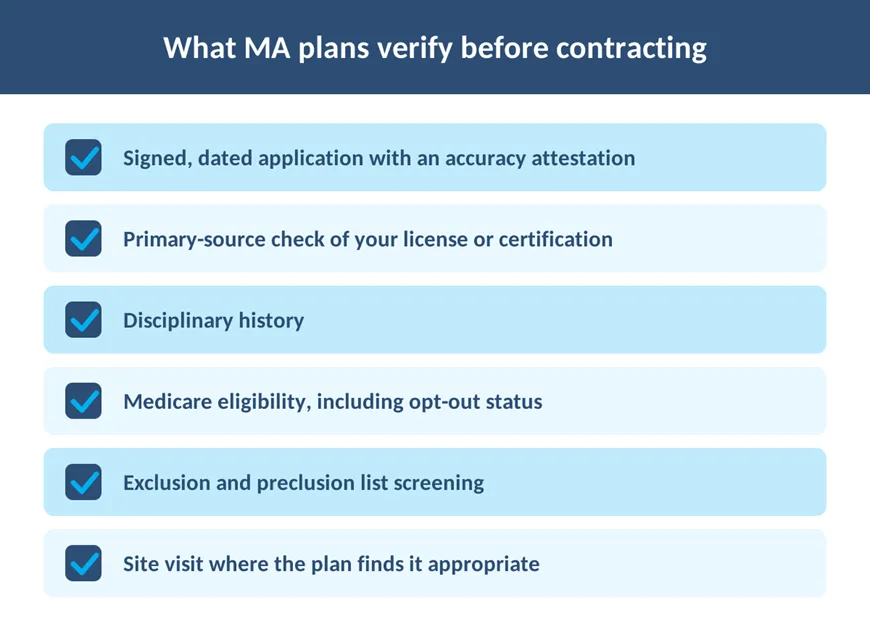
Under 42 CFR 422.204 and the related MA provider rules, each plan must keep written policies for selecting and evaluating providers. For clinicians, initial credentialing includes the items in the checklist, and recredentialing happens at least every three years using updated information and performance data such as grievances and enrollee satisfaction.
Most plans pull this data from CAQH ProView, and our overview of how CAQH supports credentialing explains how to keep the profile ready.
Why Medicare enrollment and opt-out status matter
MA plans verify Medicare eligibility, and the same federal rules bar a plan from paying, directly or indirectly, for basic benefits furnished by a practitioner who has opted out of Medicare. The only exceptions are emergency or urgently needed care without a private contract, and supplemental benefits.
In practice, a therapist who opted out of Medicare cannot join an MA network for covered mental health care. Many plans also expect active Medicare enrollment first, so complete PECOS before you apply. Our comparison of Medicare and Medicaid credentialing differences covers the government enrollment side.
Network rules that help behavioral health providers
The CMS fact sheet on the 2025 MA and Part D final rule describes a new Outpatient Behavioral Health category for network adequacy. It includes marriage and family therapists, mental health counselors, opioid treatment program providers, community mental health centers and addiction medicine physicians.
Nurse practitioners, physician assistants and clinical nurse specialists count in this category when they regularly furnish behavioral health counseling or therapy, verified by at least 20 patients in a 12-month period. Plans that need these specialties to meet network standards have a reason to credential you.
Federal rules also bar MA plans from discriminating in participation solely on the basis of license or certification. Plans can still cap network size, but a declined provider must receive written notice of the reason.
Medicare Advantage credentialing steps
Each MA plan is its own application, so the workflow repeats per plan. The diagram shows the order.
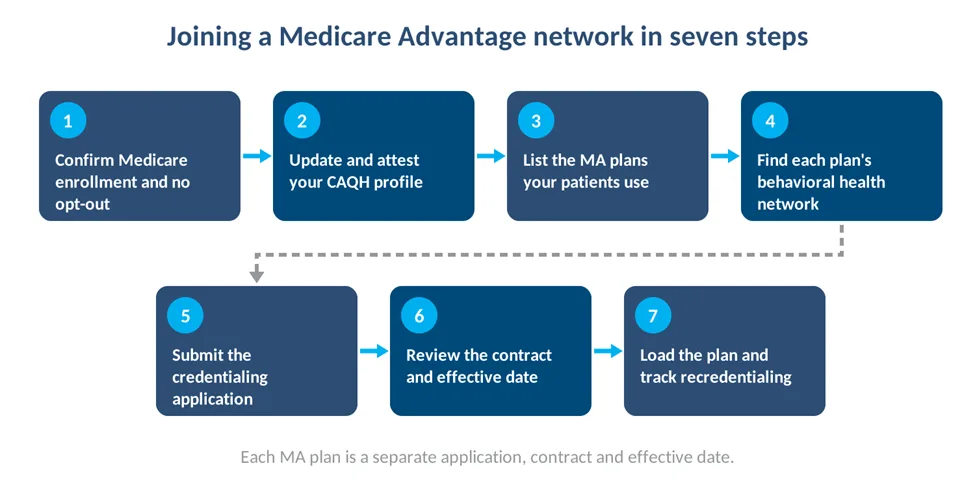
- Confirm Medicare status. Make sure you are enrolled and have not opted out.
- Update CAQH. Refresh documents, practice locations and attestation.
- List your patients’ MA plans. Check intake records to see which plans matter most.
- Find each plan’s behavioral health network. Many plans route behavioral health credentialing through a separate network or vendor.
- Submit the application. Ask about panel status and keep copies of everything.
- Review the contract. Check rates, covered services, telehealth terms and the effective date before signing.
- Load and track. Add the plan to your billing system and calendar recredentialing.
Sample (fictional data): A three-therapist group in Tampa finds that 40% of its older patients use two MA plans. It confirms each LCSW’s Medicare enrollment, updates CAQH and applies to both plans’ behavioral health networks, then holds MA patients as out of network until each contract shows an effective date. Replace the city, mix and plans with your own figures.
Common Medicare Advantage credentialing mistakes
| Mistake | How to prevent it |
| Assuming Medicare enrollment covers MA plans | Apply to each MA plan’s network separately |
| Applying after opting out of Medicare | Cancel or let the opt-out end before seeking MA contracts |
| Applying to the plan instead of its behavioral health network | Ask the plan where behavioral health credentialing is handled |
| Seeing MA members before the effective date | Hold or treat as out of network until the contract starts |
| Missing a recredentialing request | Track each plan’s cycle, which runs at least every 3 years |
Several of these mirror the credentialing errors that delay payments seen across all payers, and renewals follow the process in our article on recredentialing versus initial enrollment.
Frequently asked questions
Does Medicare enrollment make me in network with Medicare Advantage plans?
No. Medicare enrollment lets you bill Original Medicare, but each MA plan is a private network with its own credentialing and contract. You must apply to every plan you want to join, and each plan gives its own effective date.
Can an opted-out therapist join a Medicare Advantage network?
Not for covered mental health care. Federal rules bar MA plans from paying for basic benefits furnished by a practitioner who has opted out of Medicare, except emergency or urgently needed care without a private contract and supplemental benefits. End the opt-out before you apply.
How often do MA plans recredential providers?
At least every three years. Plans update the information from your initial credentialing and look at performance data such as quality measures, grievances, appeals and enrollee satisfaction. Keep your CAQH profile current so recredentialing goes smoothly.
Can an MA plan refuse to credential me?
Yes, a plan can limit its network to what its members need. It cannot discriminate solely based on your license or certification type, and it must give written notice of the reason when it declines a provider or group.
Do MFTs and mental health counselors count for MA network adequacy?
Yes. CMS added an Outpatient Behavioral Health category that includes marriage and family therapists, mental health counselors, opioid treatment programs, community mental health centers and addiction medicine physicians, plus qualifying NPs, PAs and clinical nurse specialists. Billing rules are covered in our complete mental health billing guide.
Final Considerations
Medicare Advantage credentialing rewards preparation: active Medicare enrollment, a current CAQH profile and a clear list of the plans your patients use. Treat each plan as its own project and confirm every effective date in writing.
If you want a dedicated agent to manage your MA network applications, contact our team and tell us which plans your patients use.
Sources: 42 CFR Part 422, Subpart E (eCFR), including 422.204, 422.205 and 422.220; CMS fact sheet, Contract Year 2025 Medicare Advantage and Part D Final Rule (CMS-4205-F). This article is general information, not legal advice. Confirm current requirements with each plan.