
PMHNP Credentialing for Psychiatric Nurse Practitioners
PMHNP credentialing gets a psychiatric mental health nurse practitioner approved to bill Medicare, Medicaid and commercial plans under their own NPI. It covers more ground than therapist credentialing, because payers also check prescribing authority and DEA registration. This guide covers the credential stack, Medicare’s NP rules, the own-NPI versus incident-to choice, a step-by-step workflow, payer panels and common mistakes.
Groups adding several nurse practitioners at once often hand the file work to a provider credentialing service. The sections below show what each file needs either way.
| Key takeaways Medicare requires state NP authorization, national certification and a master’s or DNP for newer NPs.Medicare pays NPs billing under their own NPI at 85% of the physician fee schedule amount.Prescribing credentials, including DEA registration in each state, are part of the payer review.Use the psychiatric NP taxonomy 363LP0808X consistently across NPPES, CAQH and applications. |
The PMHNP credential stack
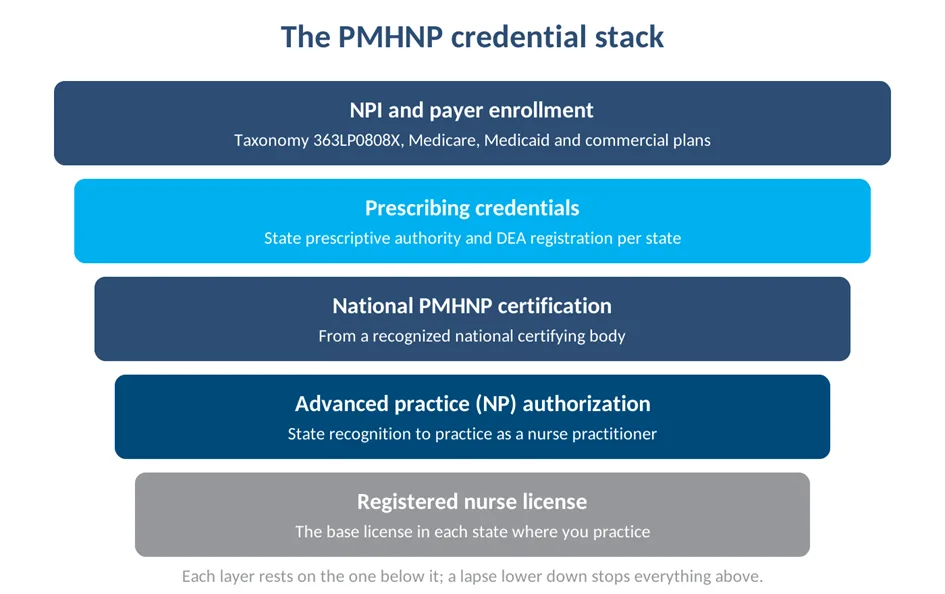
Payers verify each layer of a PMHNP’s credentials before approving the file, and every layer depends on the one beneath it. A lapsed RN license, for example, invalidates everything built on top of it.
| Credential | What it proves | Where it comes from |
| RN license | You can practice nursing in the state | State board of nursing |
| NP authorization | You can practice as a nurse practitioner | State board of nursing |
| National certification | Psychiatric mental health NP competence | A recognized national certifying body |
| Prescribing credentials | You can prescribe, including controlled substances | State authority and DEA registration for each state |
| NPI and taxonomy | Your identity and specialty on claims | NPPES, taxonomy 363LP0808X |
Medicare requirements for nurse practitioners
Under 42 CFR 410.75, a nurse practitioner must be a registered nurse authorized by the state to practice as an NP. NPs who first got Medicare billing privileges on or after January 1, 2003, also need national certification and a master’s degree in nursing or a Doctor of Nursing Practice degree.
The same regulation requires NPs to work in collaboration with physicians, following state law where it sets the terms. A collaborating physician does not need to be present for each visit. NP services are paid on an assignment-related basis, so you cannot charge Medicare patients more than the allowed limits.
The First Coast nurse practitioner enrollment page lists the CMS-855I or PECOS application, the CMS-588 form for electronic funds transfer (EFT) and payment at 85% of the physician rate.
Own NPI or incident-to?
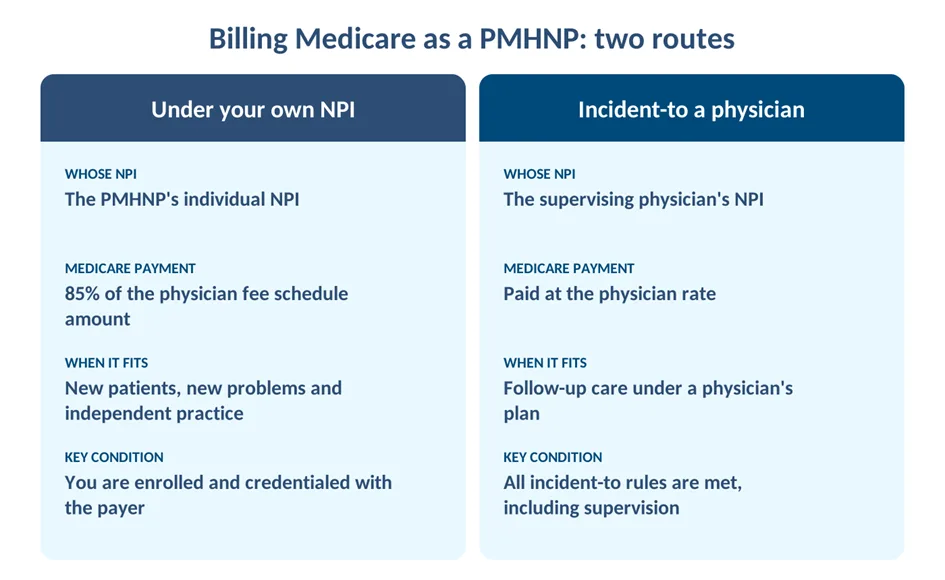
A PMHNP enrolled with Medicare can bill under their own NPI at 85%, or some follow-up visits can be billed incident-to a supervising physician at the full physician rate when every incident-to rule is met. New patients and new problems generally belong under the NP’s own NPI. Our guide to incident-to billing rules for NPs and PAs covers the conditions in detail.
PMHNP credentialing steps
The diagram shows the order. Licenses and prescribing registrations come first, because every payer checks them before approving you.
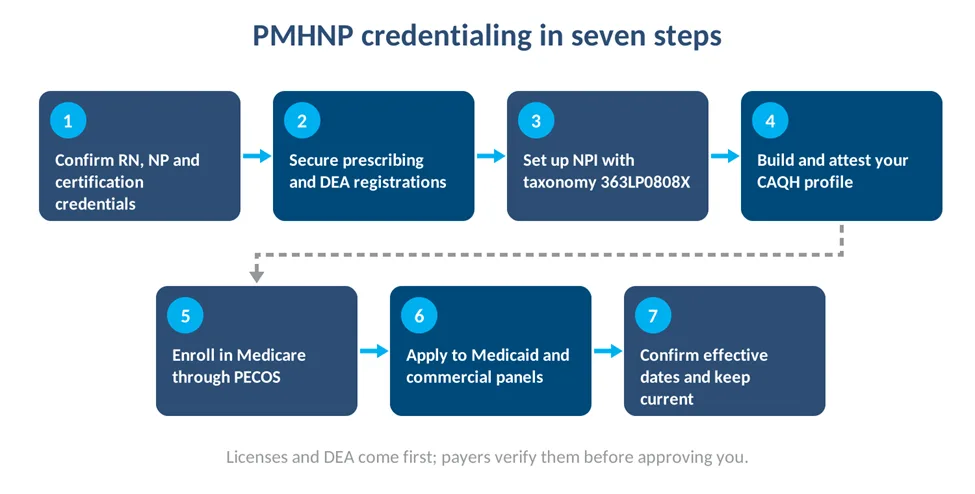
- Confirm core credentials. Check that your RN license, NP authorization and national certification are current in every state where you will see patients.
- Secure prescribing registrations. Confirm state prescriptive authority and hold DEA registration for each state where you prescribe controlled substances.
- Set up your NPI. In NPPES, the national NPI registry, select taxonomy 363LP0808X for psychiatric mental health NPs.
- Build your CAQH profile. Most commercial plans pull data from CAQH ProView, and our overview of how CAQH supports credentialing covers the profile. Upload documents, including any collaboration agreement your state requires, and attest.
- Enroll in Medicare. File in PECOS, add EFT and add reassignment if a group bills for you.
- Apply to Medicaid and commercial panels. Submit each application and keep copies of everything you send.
- Confirm and stay current. Get each effective date in writing, then calendar license, certification, DEA and revalidation dates.
Sample (fictional data): Jamie Torres, PMHNP-BC, joins a psychiatry group in Raleigh, North Carolina, and will also see telehealth patients in Virginia. Jamie needs NP authority and DEA registration in both states, Medicare enrollment with reassignment to the group, and separate applications to each state’s Medicaid program. Swap in your own name, states and group details when planning your file. Our guide to managing multi-state credentialing covers the tracking side.
Commercial and Medicaid panels for PMHNPs
Commercial plans run their own credentialing reviews, often through a behavioral health network, and some close to new clinicians in busy markets. Plans may ask for your collaboration agreement, prescribing credentials and malpractice coverage on top of the standard CAQH data.
Medicaid enrollment is run by each state, and NP rules differ widely from state to state. Our comparison of Medicare and Medicaid credentialing differences explains how the two government tracks diverge.
Common PMHNP credentialing mistakes
| Mistake | How to prevent it |
| Generic NP taxonomy on the NPI | Use 363LP0808X so payers see the psychiatric specialty |
| Missing DEA registration in a telehealth state | Register in each state where you prescribe controlled substances |
| Collaboration agreement not on file | Upload it to CAQH when your state requires one |
| Incident-to used for new patients | Bill new patients and new problems under the NP’s own NPI |
| Certification lapse | Calendar renewal dates and update CAQH after each renewal |
| Billing before the effective date | Hold claims until the payer confirms the start date in writing |
These overlap with the credentialing errors that delay payments seen across specialties.
Frequently asked questions
Can a PMHNP bill Medicare under their own NPI?
Yes. A PMHNP who meets Medicare’s NP qualifications and enrolls through PECOS or the CMS-855I can bill under their own NPI. Medicare pays 85% of the physician fee schedule amount for these services, and NP services are paid on an assignment-related basis.
What taxonomy code should a PMHNP use?
Psychiatric mental health nurse practitioners use taxonomy 363LP0808X. Select it in NPPES when you apply for or update your NPI, and use the same code in CAQH and payer applications. A generic NP taxonomy can route the file to the wrong network or trigger questions about your specialty.
Does a PMHNP need a collaborating physician?
Medicare requires NPs to work in collaboration with physicians, and state law sets the terms where it addresses collaboration. Some states require a written agreement, while others allow full independent practice. Follow your state’s rule and keep any required agreement on file for payers.
Do I need DEA registration in every state where I see patients?
You need DEA registration in each state where you prescribe controlled substances, along with that state’s prescriptive authority. Telehealth patients in another state generally count, because the patient’s location sets the state. Check each state’s rules before you schedule patients there.
Does credentialing affect which codes a PMHNP can bill?
Credentialing makes you eligible to bill, while your state scope and payer rules decide which services you can report. Many PMHNPs bill E/M visits with psychotherapy add-ons, and our complete mental health billing guide covers those coding rules.
Final Considerations
PMHNP credentialing works best when the full credential stack is current before any application goes out. Choose the right taxonomy, keep DEA and collaboration paperwork ready and confirm every effective date in writing.
If you want a dedicated agent to manage your PMHNP applications and follow-ups, contact our team and tell us which states and payers you need.
Sources: 42 CFR 410.75 (eCFR); First Coast Service Options, Nurse Practitioner enrollment. This article is general information, not legal advice. State NP and prescribing rules vary, so confirm requirements with your state board and each payer.