
E/M Coding 2026 Guidelines: MDM vs Time-Based Level Selection Explained
E/M coding 2026 guidelines let practitioners select an office or outpatient visit level (99202-99215) using either medical decision making (MDM) or total practitioner time on the date of the encounter. MDM is the level met by 2 of 3 elements: problems, data and risk. Time-based coding requires the documented total minutes to meet the code’s minimum.
Practices still lose money on E/M visits in 2026, sometimes by undercoding complex visits and sometimes by billing levels the note cannot defend when a payer downcodes or audits. This guide explains how each pathway works, when time beats MDM and the reverse, how prolonged-service rules differ between CPT and Medicare, and what changed for 2026 and the 2027 proposal. A ten-question self-assessment checklist near the end scores your E/M documentation in a few minutes.
Key Numbers Cheat Sheet
E/M numbers at a glance
| Metric | Practical target/range | Review frequency | Source type |
| Office E/M time minimums | 99212: 10, 99213: 20, 99214: 30, 99215: 40 minutes (new patient: 15, 30, 45, 60) | When CPT updates each January | [P] AMA CPT |
| First prolonged unit, level 5 visit | CPT 99417: 75 min (99205), 55 min (99215); Medicare G2212: 89 and 69 min | Annually | [P] AMA CPT; CMS MLN006764 (May 2026) |
| Level 4-5 share per provider | Close to same-specialty peers; investigate large outliers | Quarterly | [I] peer comparison |
| E/M downcode or denial rate by payer | Near zero; under 5% is a common practical ceiling | Monthly | [I] commonly reported across industry sources |
| Internal audit agreement on E/M level | 95% or higher | Quarterly sample | [I] common compliance audit threshold |
[P] = published standard from the AMA CPT code set or CMS. [I] = practical or industry-convention target, not a CMS, AMA, AAPC, MGMA or HFMA mandate. Targets vary by specialty, payer mix and place of service.
What changed in E/M coding for 2026?
Very little changed in the office E/M framework for 2026: the CPT 2026 code set kept the MDM-or-time structure introduced in 2021, and its E/M section changes focus on remote physiologic monitoring. The practical changes came from Medicare policy and payer behavior rather than new office visit rules.
CPT 2026 added codes 99445 and 99470 and revised other remote monitoring codes, with no change to 99202-99215 selection criteria. On the Medicare side, the CY 2026 Physician Fee Schedule extended G2211 (the visit complexity add-on) to home and residence E/M visits, and the 2.5% efficiency adjustment for CY 2026 does not apply to time-based services such as E/M visits.
Payer behavior moved more. Cigna’s E/M Coding Accuracy policy (R49), effective October 1, 2025, allowed automatic downcoding of 99204-99205, 99214-99215 and 99244-99245 by one level. It was paused in California, and Maryland regulators ordered Cigna to stop the practice in March 2026, so check its current status in your state. For 2027, CMS has proposed replacing G2211 with a modifier; that proposal is not final.
How does MDM-based E/M level selection work?
MDM-based selection assigns the visit level from three elements, and the level is set by whichever level 2 of the 3 elements meet or exceed. The elements are the number and complexity of problems addressed, the amount and complexity of data reviewed and analyzed, and the risk of patient management.
MDM levels for office and outpatient visits (simplified)
| MDM level | New / established | Problems addressed | Data (meet the level) | Risk of management |
| Straightforward | 99202 / 99212 | 1 self-limited or minor problem | Minimal or none | Minimal |
| Low | 99203 / 99213 | 2+ minor problems, 1 stable chronic illness, or 1 acute uncomplicated illness | Limited: 2 Category 1 items, or an independent historian | Low risk of morbidity from testing or treatment |
| Moderate | 99204 / 99214 | 1+ chronic illness with exacerbation, 2+ stable chronic illnesses, or 1 undiagnosed new problem with uncertain prognosis | Moderate: 1 of 3 categories | Moderate (for example, prescription drug management) |
| High | 99205 / 99215 | 1+ chronic illness with severe exacerbation, or an acute or chronic illness posing a threat to life or bodily function | Extensive: 2 of 3 categories | High (for example, decision about hospitalization) |
Simplified from the AMA CPT MDM table; the full table has more examples per cell. 99211 has no MDM or time requirement.
Problems addressed, not problems listed
A problem counts only when the practitioner addresses it during the encounter: evaluates it, treats it, or makes a documented decision about it. A diagnosis copied from the problem list without assessment does not raise the level. Many level disagreements in audits start with a long assessment list where only one item has a plan.
The three data categories
The AMA’s MDM table for E/M services divides data into categories. At the moderate level, Category 1 needs any 3 of: review of external notes from each unique source, review of each unique test result, ordering of each unique test, or assessment requiring an independent historian. Category 2 is independent interpretation of a test reported by someone else. Category 3 is discussion of management with an external physician or appropriate source.
Risk of patient management
Risk reflects the management options considered, including ones the patient declines. Prescription drug management is the most common moderate-risk example, and a decision about hospitalization is a common high-risk example. Social determinants of health that significantly limit diagnosis or treatment can also support moderate risk when documented.
In billing audits, a common pattern is MDM notes that support level 4 on problems and risk but never state the plan in words. “Continue meds” next to five diagnoses rarely survives review; “increase lisinopril to 20 mg, recheck BMP in two weeks” does.
How does time-based E/M coding work in 2026?
Time-based coding uses the total time the physician or other qualified health care professional personally spends on the patient’s care on the date of the encounter, face-to-face and non-face-to-face. Since CPT 2024, each office code lists a minimum time that must be met or exceeded rather than a range.
Office and outpatient E/M minimum total time (AMA CPT)
| Code | Patient | Minimum total time | Matching MDM |
| 99202 | New | 15 minutes | Straightforward |
| 99203 | New | 30 minutes | Low |
| 99204 | New | 45 minutes | Moderate |
| 99205 | New | 60 minutes | High |
| 99212 | Established | 10 minutes | Straightforward |
| 99213 | Established | 20 minutes | Low |
| 99214 | Established | 30 minutes | Moderate |
| 99215 | Established | 40 minutes | High |
Times are the CPT minimums. CMS publications such as MLN006764 still show the earlier ranges (for example, 99215 at 40-54 minutes) when explaining Medicare prolonged-service math.
What counts toward total time
Countable activities include preparing to see the patient and reviewing tests, obtaining a separately obtained history, the exam, counseling and education, ordering tests or medications, referring and communicating with other professionals, documenting in the record, independently interpreting results that are not separately reported, and care coordination.
What does not count
Exclude clinical staff time, travel, general teaching, and time spent on any separately reported service, such as a procedure, an EKG interpretation billed on its own, or monthly chronic care management time. Our chronic care management billing guide covers how those monthly minutes are tracked separately. Time on a different date also does not count toward an office visit.
E/M coding 2026 guidelines: MDM vs time-based coding, which should you use?
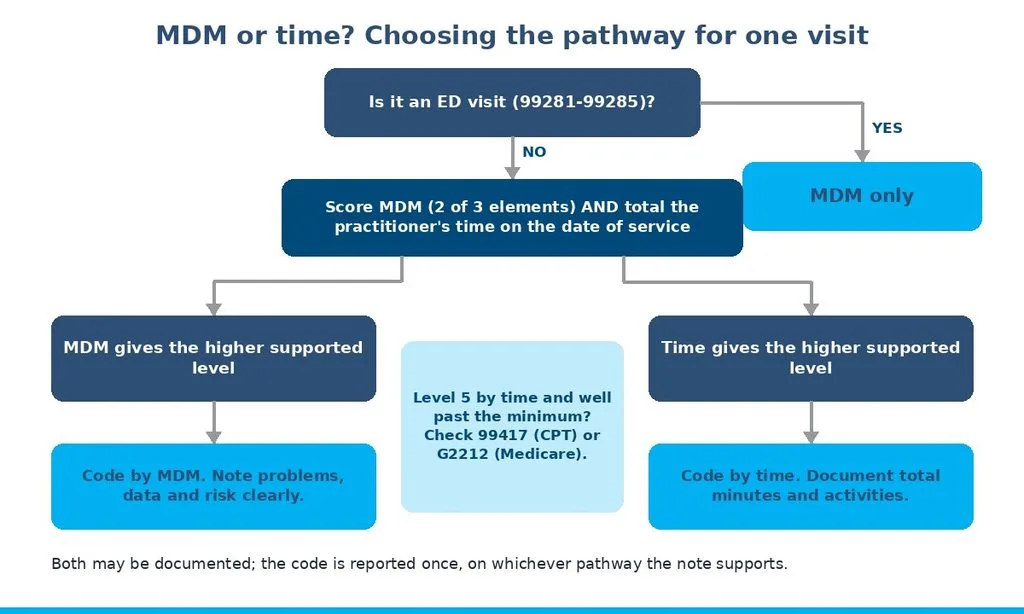
Use whichever pathway the documentation supports at the higher level for that specific visit. CPT lets the practitioner choose MDM or time for each encounter, and nothing prevents documenting both; the claim simply reports one level, supported by one complete pathway.
Time usually wins when counseling, coordination or review of outside records takes long but the medical decisions are moderate. MDM usually wins when a complex decision happens quickly, such as an experienced clinician managing a severe exacerbation in 25 minutes. Several articles claim documenting both is an audit flag; no CMS or AMA rule says so, and a note supporting both pathways is easier to defend.
Two settings break the pattern. Emergency department codes 99281-99285 are selected by MDM only, and critical care is time-only. Hospital inpatient and observation codes (99221-99223, 99231-99233) have used MDM or time since 2023, not the old history-and-exam key components.
Prolonged services: CPT 99417 vs Medicare G2212
Prolonged services codes apply only when a level 5 visit is selected by time. CPT 99417 starts at 75 minutes for 99205 and 55 minutes for 99215. Medicare uses G2212 instead, starting at 89 and 69 minutes, per the CMS Evaluation and Management Services booklet (MLN006764, May 2026). Our prolonged services billing guide covers both codes in detail.
Noridian’s E/M office visit questions and answers confirm G2212 is available only when the level is chosen by time, not by MDM. Check each commercial contract: some payers follow CPT thresholds and 99417, while Medicare Advantage plans may follow either.
How do the two pathways compare on real visits?
The same visit can land on different levels depending on the pathway, which is why a coder should test both before release. These worked examples use published CPT and CMS thresholds; dollar figures are illustrative.
Worked example 1: time beats MDM
Illustrative scenario (not an actual client record): an established patient with one stable chronic illness spends a long visit on medication counseling and coordination with a home health agency. MDM scores low (99213). The practitioner documents 34 minutes on the date. Time supports 99214, since 34 meets the 30-minute minimum. Coding by MDM alone would undercode the visit by one level.
Worked example 2: MDM beats time
Illustrative scenario: an established patient with a severe COPD exacerbation is evaluated, external ED records are reviewed, a chest X-ray is independently interpreted, and hospitalization is discussed. Total time is 25 minutes, which supports only 99213. Problems and risk are both high, so MDM is high even though data reaches only moderate (Category 2 alone), and 99215 is supported by MDM. The note must make that complexity explicit.
Worked example 3: prolonged time, CPT vs Medicare
Formula: units = whole 15-minute blocks beyond the threshold. Illustrative scenario: an established patient visit with 72 documented minutes. Under CPT, 99215 plus 99417 x 2 applies (55-69 minutes is one unit; 70-84 is two). Under Medicare, 99215 plus G2212 x 1 applies (69-83 minutes). The same note produces different claims by payer.
Worked example 4: level 4-5 share by provider
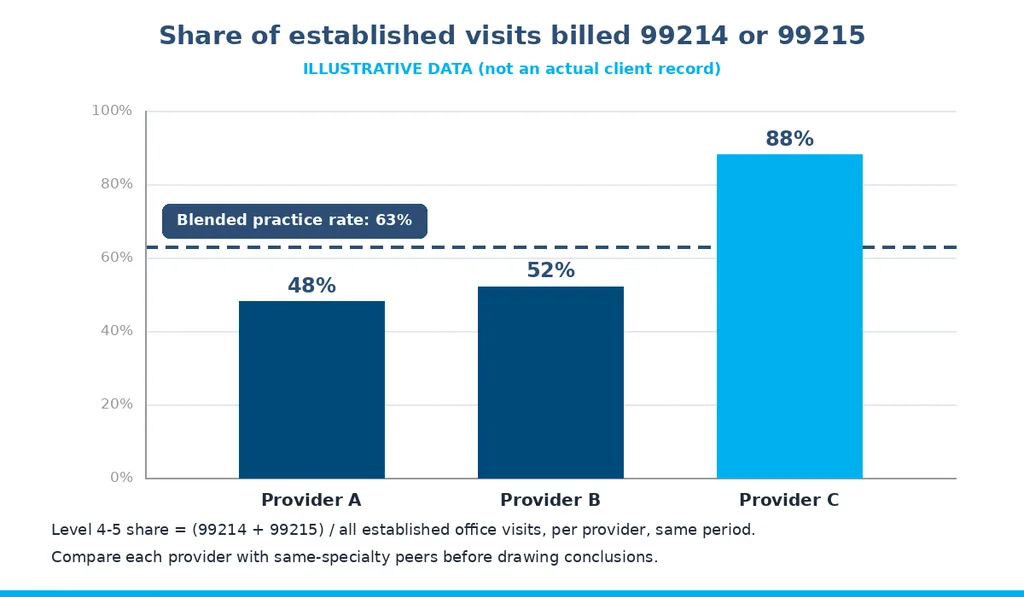
Formula: (99214 + 99215) ÷ all established office visits, per provider and period. Illustrative scenario: Provider A bills 408 of 850 visits at level 4-5 (48%), Provider B 390 of 750 (52%), and Provider C 748 of 850 (88%). The blended rate is 1,546 ÷ 2,450, or 63%. The average looks unremarkable, but Provider C is far from peers.
An 88% share is not proof of error; a provider with a complex panel may legitimately run high. It is the profile automated payer edits and auditors notice first, so it should trigger a focused chart review against same-specialty peers. Where results also vary by payer, split each ratio by payer before deciding whether the issue is documentation or a payer edit.
How should you read E/M benchmarks?
Compare like with like: same specialty, same visit type, same payer mix and same period. Endocrinology and dermatology panels produce very different level distributions, and new-patient mixes differ from established-patient mixes. Treat one outlier as a reason to pull charts, not as a verdict on a provider.
Look at pairs of numbers together. A high level 4-5 share with a low downcode rate suggests documentation is holding up. A high downcode rate at one payer with normal rates elsewhere points to that payer’s edit, not to provider behavior. Before changing coding habits, run an internal medical billing compliance audit on 10 to 20 charts per flagged provider.
How do Medicare, Medicare Advantage, Medicaid and commercial payers differ?
The MDM and time definitions come from CPT and apply across payers, but prolonged-service codes, split/shared rules, telehealth billing and downcoding programs differ. The level-selection logic rarely changes; the claim details often do.
Illustrative payer differences for E/M claims
| Topic | Medicare | Medicare Advantage | Medicaid | Commercial |
| Prolonged office time | G2212 (89/69 min) | Plan-specific; often G2212 | State-specific | Often 99417 (75/55 min) |
| G2211 add-on | Payable when criteria met | Varies by plan | Varies by state | Coverage varies |
| Split/shared (facility) | Substantive portion; modifier FS | Usually follows Medicare | State-specific | Varies |
| Automated level review | Targeted medical review | Plan programs | State programs | Programs such as Cigna R49 |
Illustrative summary from CMS, MAC and payer publications; check each payer’s current policy and your state Medicaid manual before billing.
For split/shared visits in facility settings, Medicare pays the practitioner who performs the substantive portion: more than half of the total time or a substantive part of the MDM, with modifier FS on the claim, per CMS MLN Matters MM13592. Office visits are not billable as split/shared. Telehealth visits use the same MDM and time rules; see our telehealth billing practices guide for place-of-service and modifier details.
What is the step-by-step process for leveling a visit?
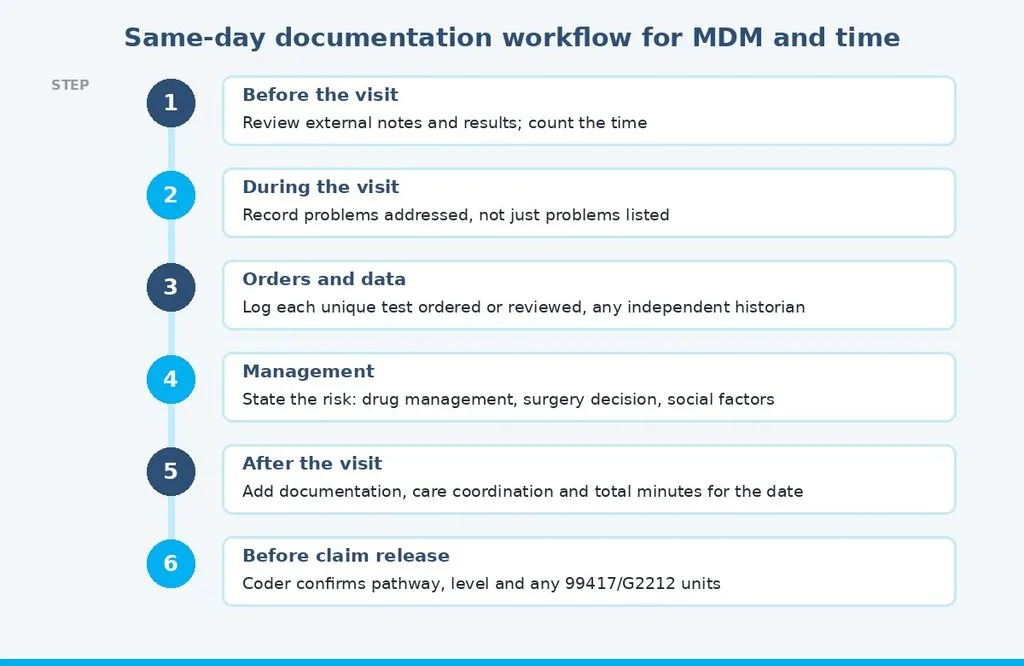
Run every office visit through the same six steps before the claim is released. Each step closes a gap that auditors commonly find.
- Confirm the visit type (office, inpatient, ED, telehealth) and whether the patient is new or established under the three-year rule.
- Score MDM: count problems addressed, data by category, and the management risk documented.
- Total the practitioner’s countable time on the date, excluding separately reported services.
- Compare the two pathways and select the higher level the note fully supports.
- For a time-based level 5, calculate prolonged units with the payer’s threshold: 99417 or G2212.
- Check payer rules for G2211, split/shared modifier FS and telehealth, then release the claim.
When a payer downcodes a level 4 or 5 visit that the note supports, appeal with the records and a short explanation of which MDM elements or minutes support the level. Our guide on how to write a claims appeal letter gives a structure, and for Medicare claims keep the 12-month timely filing limit in mind for corrections.
How long does it take to improve E/M coding accuracy?
Template and workflow fixes usually take weeks, while documentation habits and payer downcode rates take several months to settle. Treat these as general planning ranges, not guarantees.
EHR template changes, such as a total-time field and a structured assessment-and-plan section, are often in place within 2 to 6 weeks. Provider documentation changes typically take 1 to 3 months of chart feedback. Level distributions and downcode rates usually show partial improvement within 60 to 90 days of claims and steadier results across 3 to 6 months.
What are the most common E/M coding mistakes in 2026?
The most common mistakes are counting problems that were only listed, counting time that belongs to another service, and applying the wrong prolonged-service threshold. Each has a simple control.
Counting listed problems as addressed
Only problems with a documented assessment or decision count. Train providers to write a plan for each problem they want credited.
Counting time from separately billed services
Minutes spent on a separately reported procedure, interpretation or care management service cannot also count toward the visit. The guide to common medical coding mistakes covers related double-counting errors.
Using 99417 thresholds on Medicare claims
Medicare requires G2212 at 89 and 69 minutes. Billing 99417 to Medicare, or G2212 at CPT thresholds, leads to denials or overpayments.
Defaulting to 99213
Undercoding is an error too. Practices that rarely test the time pathway or give MDM credit for independent interpretation often leave level 4 visits on the table; see how to fix under-coded claims.
Vague diagnosis coding
Automated downcoding programs read diagnosis codes. “Diabetes” without complications looks like a lower-complexity visit than “type 2 diabetes with diabetic neuropathy.” Specificity supports the level the note already justifies; our ICD-10 coding errors guide explains common gaps.
A pattern that shows up repeatedly in E/M reviews is a total-time statement with no activities. “40 minutes spent” with nothing about what filled those minutes is weaker than a short list of activities, especially when the face-to-face portion was brief. For primary care code sets, see the family practice CPT codes guide.
Quick Summary
- Select office E/M levels by MDM (2 of 3 elements) or by total practitioner time on the date of service.
- Office time minimums are 15, 30, 45 and 60 minutes for new patients and 10, 20, 30 and 40 for established patients.
- Prolonged time uses 99417 under CPT (75/55 minutes) and G2212 for Medicare (89/69 minutes), only when level 5 is chosen by time.
- ED visits are MDM only; critical care is time only.
- Keep payer downcode rates near zero and internal audit agreement at 95% or higher as practical targets.
- Watch Cigna R49 status in your state and the CY 2027 proposal to replace G2211 with a modifier.
Self-Assessment Checklist
Answer yes or no for your practice:
- Does your EHR template include a total-time field for the date of service?
- Do providers write a specific plan for every problem they want credited?
- Do coders test both MDM and time before assigning a level?
- Does your team exclude separately reported services from counted time?
- Do you bill G2212 for Medicare and 99417 only where each payer accepts it?
- Do you track level 4-5 share per provider against same-specialty peers each quarter?
- Do you track E/M downcodes and denials by payer each month?
- Does your internal E/M audit agree with billed levels at 95% or higher?
- Do you use modifier FS correctly on facility split/shared visits?
- Have you checked whether automated downcoding programs affect your payers?
Scoring: 9 to 10 yes answers means strong E/M controls; keep quarterly reviews. 6 to 8 yes answers means targeted gaps; fix the “no” items within one quarter. 5 or fewer means meaningful undercoding or audit exposure; prioritize a documentation and claims review.
When should a practice consider professional support?
Consider outside support when E/M problems persist after template changes and provider education. These signals usually mean the in-house approach has reached its limits:
- One provider’s level 4-5 share stays far from peers after feedback.
- A payer downcodes or requests records on E/M claims month after month.
- Level 3 visits dominate even for complex panels, suggesting undercoding.
- Nobody owns CPT and Medicare E/M updates each January.
- Downcode appeals are backlogged past 60 days.
When evaluating help, look for certified coders who audit against the AMA MDM table and CMS guidance, reporting by provider and payer, a defined documentation feedback loop, and appeal support for downcoded claims. An independent medical billing audit service is a practical first step when you need a baseline.
Aspect Billing Solutions is one example of this kind of partner. Its medical billing and coding services cover end-to-end billing and coding, credentialing, eligibility verification and prior authorization, denial management, A/R follow-up and compliance support, with a dedicated agent assigned to each provider. Results vary by practice, specialty and payer mix. You can review how the team handles revenue cycle management for medical practices.
Final Considerations
E/M coding 2026 guidelines reward notes that make one pathway obvious: clear problems, data and risk for MDM, or clear minutes and activities for time. Testing both pathways before release protects against undercoding and against payer downcoding at the same time.
Some figures here are firm published standards: the CPT time minimums, the MDM table, the 99417 and G2212 thresholds, ED and critical care rules, and the split/shared definition. The 95% audit target, the 5% downcode ceiling and peer-comparison guidance are practical targets, and the worked-example and level-mix figures are illustrative.
The natural next question is where your own visits fall. Pull one quarter of established office visits, calculate the level 4-5 share by provider and payer, and score the checklist. If the gaps are larger than your team can close, explore E/M coding and revenue cycle support from Aspect Billing Solutions.
Frequently Asked Questions
Can you use both MDM and time for the same E/M visit?
You can document both, but the visit is reported at one level supported by one complete pathway. CPT lets the practitioner choose MDM or time for each encounter, so coders should score both and report the higher level the note fully supports. No CMS or AMA rule treats documenting both as an error.
What is a good time threshold to choose time over MDM for 99214?
For 99214, time-based coding needs at least 30 minutes of total practitioner time on the date of service. When MDM scores low but countable time reaches 30 minutes, time supports 99214. For a new patient, 99204 needs at least 45 minutes. Time must be documented in the note.
What is a good level 4-5 share for established office visits?
No national target exists. A practical approach compares each provider’s share of 99214 and 99215 with same-specialty peers, using CMS public utilization data where available, and reviews large outliers. Complex specialties legitimately run higher than others, so a high share signals a chart review, not an error.
What is a good audit accuracy rate for E/M coding?
Many compliance programs use 95% or higher agreement between billed and audited levels as a practical target. It is an industry convention, not a CMS or AMA mandate. Track disagreements by direction, because undercoding and overcoding need different fixes, and sample each provider at least quarterly.
When does Medicare pay G2212 instead of 99417?
Medicare does not pay 99417 for office visits; it uses G2212. G2212 applies only when 99205 or 99215 is selected by time, starting at 89 minutes for 99205 and 69 minutes for 99215, per CMS MLN006764. Each additional full 15 minutes adds another unit.
Are emergency department E/M codes selected by time?
No. Emergency department codes 99281-99285 are selected by medical decision making only, because ED care is typically delivered in shifts with many patients at once. Critical care codes work the other way and are time-based only. Office, inpatient and observation codes allow either MDM or time.
Sources and Methodology
(a) Published standards and definitions: AMA CPT 2026 code set and E/M Services Guidelines, including the MDM table and time minimums for 99202-99215 (revised to minimum times in CPT 2024); CMS MLN006764, Evaluation and Management Services (May 2026); CMS MLN Matters MM13592 on split or shared visits; CY 2026 Medicare Physician Fee Schedule final rule (CMS-1832-F); CY 2027 proposed rule (CMS-1848-P, July 2026); Noridian JE Part B E/M and prolonged-service guidance.
(b) Named benchmarking data providers: none used. No MGMA, HFMA or vendor benchmark is cited for level distribution, because peer comparison should use specialty-matched data.
(c) Practical or illustrative targets: the 5% downcode ceiling is commonly reported across industry sources; the 95% audit agreement rate is a common compliance threshold; improvement timeframes are general planning ranges; all worked-example and level-mix figures are illustrative scenarios, not client records. Payer program details draw on AAFP, AMA-affiliated and Maryland Insurance Administration reporting on Cigna policy R49 (2025-2026).
(d) Survey or study data: none cited as a statistic in this article.
Results vary by practice, specialty, payer mix and documentation quality. Figures reflect information available at the time of research (October 2026). CPT and HCPCS codes, E/M guidelines, the Medicare Physician Fee Schedule and payer policies change at least annually.