
Incident-To Billing Rules for NPs and PAs: 2026 Medicare Guide
Incident-to billing rules for NPs and PAs are Medicare conditions that let a nurse practitioner’s or physician assistant’s office service be billed under a supervising physician’s NPI at 100% of the fee schedule. The service must follow a physician-initiated plan of care, occur in a non-institutional setting, and be performed under direct supervision.
When any condition fails, the visit must be billed under the NP’s or PA’s own NPI at 85%, and billing it incident-to anyway creates overpayment and false-claim exposure. This guide sets out each Medicare condition, the 2026 virtual supervision change, how other payers differ, and how to measure your own compliance with four formulas. A ten-question self-assessment checklist near the end scores your incident-to process in a few minutes.
Key Numbers Cheat Sheet
Incident-to numbers at a glance
| Metric | Practical target/range | Review frequency | Source type |
| Medicare payment, incident-to vs direct NP/PA billing | 100% vs 85% of the physician fee schedule | Fixed by statute | [P] CMS / Social Security Act |
| Share of NP/PA office visits billed incident-to (national) | About 40% in 2018 | Context only | [S] Patel et al., cited by MedPAC (March 2026) |
| Internal audit pass rate on incident-to claims | 95% or higher, measured per location | Quarterly sample | [I] common compliance audit threshold |
| Incident-to claims with a new problem and no physician involvement | 0% | Monthly | [P] CMS Benefit Policy Manual; [I] target |
| NP/PA clinic hours with a supervising physician available | 100% of hours billed incident-to | Monthly schedule check | [P] 42 CFR 410.26; [I] tracking method |
[P] = published standard or rule from CMS or federal regulation. [S] = named study data. [I] = practical or industry-convention target, not a CMS, AMA, AAPC, MGMA or HFMA mandate. Results vary by specialty, payer mix and practice structure.
What are the Medicare incident-to billing rules for NPs and PAs?
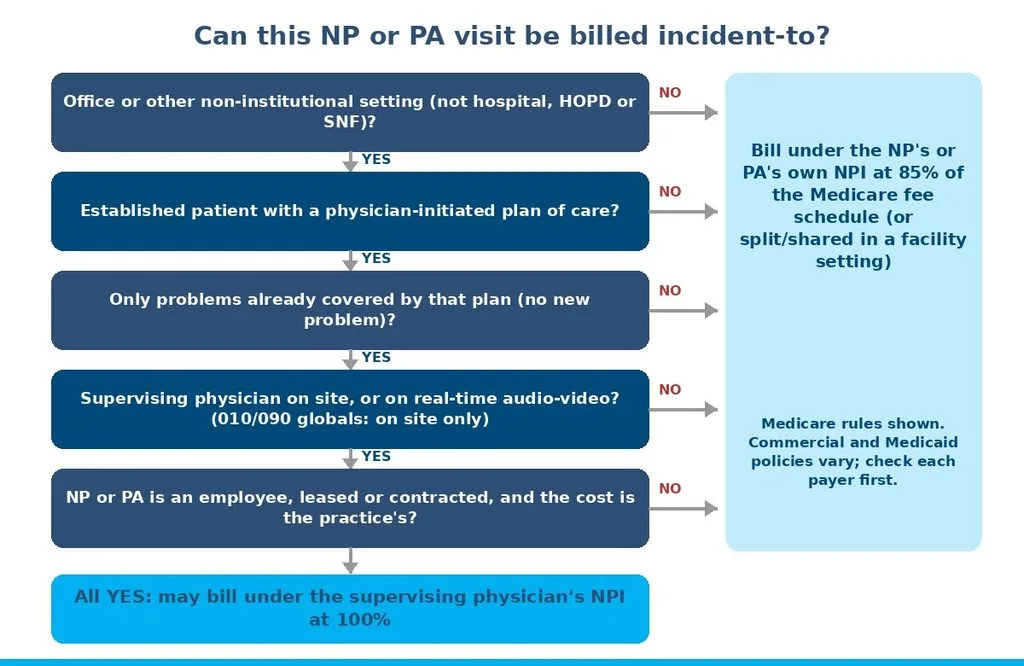
Medicare allows an NP’s or PA’s service to be billed under a physician’s NPI only when every condition in 42 CFR 410.26 and Chapter 15, Section 60 of the Medicare Benefit Policy Manual is met. Missing any single condition means the service must be billed under the NP’s or PA’s own NPI.
The conditions, in plain terms, are these. The service is furnished in a non-institutional setting, such as a physician office, not a hospital or skilled nursing facility. The physician personally performed the initial service and remains actively involved in the course of treatment. The service is an integral, although incidental, part of that treatment. A physician provides direct supervision. The NP or PA is an employee, leased employee or contractor whose cost the practice bears. Only the supervising physician bills.
The physician-initiated plan of care
The Benefit Policy Manual requires a direct, personal, professional service by the physician to start the course of treatment. That is why a new patient cannot be billed incident-to, and why an established patient with a new problem cannot be billed incident-to unless the physician personally evaluates that problem. The manual sets no numeric interval for follow-up physician visits. Noridian’s incident-to services guidance frames it as seeing the patient at a frequency that reflects the physician’s active involvement in the case.
Who bills, and whose NPI goes on the claim
Only the physician who supervises the service may bill it incident-to, and the claim carries that supervising physician’s NPI. The ordering physician does not have to be the supervising physician, which lets a group cover NP clinics with whichever physician is present. Follow your Medicare Administrative Contractor’s (MAC) claim instructions for reporting an ordering physician who differs from the supervising one.
In billing audits, a common pattern is incident-to claims billed under the NP’s collaborating physician by default, even on days that physician was off site. The supervising physician on the claim must be the one actually present or available that day, which a simple daily supervision log can prove.
How does direct supervision work in 2026?
Direct supervision means the supervising physician is immediately available to assist during the NP’s or PA’s service. Since January 1, 2026, that availability can be met by real-time audio and video, not only by physical presence in the office suite, except for services with a 010 or 090 global surgery indicator.
The CMS CY 2026 Physician Fee Schedule final rule fact sheet confirms CMS permanently adopted this definition of virtual direct supervision. Audio-only does not qualify. A phone number on a sticky note has never counted as direct supervision, and still does not; the physician must be able to join by live video promptly.
Exceptions that allow general supervision
Two categories under 42 CFR 410.26(b)(5) may use general supervision: designated care management services, and behavioral health services furnished by auxiliary personnel incident to a physician’s or practitioner’s services. General supervision means the physician directs the service but need not be immediately available. These exceptions do not turn an ordinary NP office visit into a general-supervision service.
Practical supervision tips
Schedule NP and PA clinics against physician availability, and record the supervising physician in the note each day. Test the video connection before relying on virtual supervision, and keep a written policy on how the NP reaches the physician. Satellite offices without on-site physicians are where supervision gaps appear most often.
When must an NP or PA bill under their own NPI?
An NP or PA must bill under their own NPI whenever any incident-to condition is not met: a new patient, a new problem the physician did not evaluate, a facility setting, a day without a qualifying supervising physician, or a payer that does not recognize incident-to. Medicare then pays 85% of the fee schedule amount.
Common NP and PA visit scenarios under Medicare
| Scenario | Bill incident-to (physician NPI, 100%)? | Correct billing |
| New patient seen only by the NP | No | NP’s own NPI, 85% |
| Established patient, follow-up within physician’s plan, physician supervising | Yes, if all conditions met | Supervising physician’s NPI, 100% |
| Established patient with a new problem, NP only | No | NP’s own NPI, 85% |
| Established patient with a new problem, physician evaluates it during the visit | Physician may bill, if the physician performs the visit work | Physician’s NPI |
| Hospital outpatient department or provider-based clinic | No | NP’s own NPI; facility rules apply |
| Inpatient or ED visit shared with a physician | No (incident-to does not apply) | Split/shared rules with modifier FS |
| No physician on site or on live video | No | NP’s own NPI, 85% |
Summarized from CMS Benefit Policy Manual Ch. 15 §60 and MAC guidance. State scope-of-practice law and payer policy still apply.
The CGS Medicare incident-to fact sheet uses the same scenario logic: an established patient with a new problem seen only by the NPP must be billed under the NPP’s NPI. Urgent care is a common example, since most visits involve a new problem; our urgent care billing guide covers that workflow.
Incident-to vs split/shared visits
Incident-to applies only in non-institutional settings. In hospitals and other facility settings, an NP’s and physician’s joint work is billed under split/shared visit rules: the practitioner who performs the substantive portion bills, with modifier FS. Mixing the two frameworks is a frequent error when a practice is acquired by a hospital and its clinic becomes provider-based.
How do Medicare Advantage, Medicaid and commercial payers handle incident-to?
Incident-to is a Medicare Part B rule, and other payers decide for themselves whether to recognize it. Many commercial plans and state Medicaid programs require NPs and PAs to be credentialed and to bill under their own NPI, and some pay them a set percentage of the physician rate.
Illustrative payer comparison for NP and PA billing
| Payer type | Recognizes incident-to? | Typical NP/PA billing | What to check |
| Medicare (fee-for-service) | Yes, under 42 CFR 410.26 | Own NPI at 85%, or incident-to at 100% | Supervision, plan of care, setting |
| Medicare Advantage | Varies by plan | Often own NPI; some follow Medicare | Plan provider manual and contract |
| Medicaid | Varies by state | Often own NPI at a state-set rate | State Medicaid manual and fee schedule |
| Commercial | Often not recognized | Own NPI after credentialing | Payer policy, contract, credentialing status |
Illustrative summary; actual rules vary by plan, state and contract year. Confirm in writing with each payer before billing NP or PA services under a physician.
Credentialing is the practical bottleneck. A practice that cannot bill an NP under their own NPI because enrollment is incomplete may be tempted to route claims under a physician, which is not what incident-to permits for new patients or new problems. Our credentialing and enrollment guide for physician groups covers enrolling NPs and PAs, and common credentialing mistakes explains where enrollment stalls. State rules differ widely, as our multi-state billing compliance guide shows.
What changed recently, and what is MedPAC saying?
The main 2026 change is permanent virtual direct supervision for most incident-to services. Policy pressure on incident-to itself continues: MedPAC has long argued that incident-to hides NP and PA work from Medicare data, though Congress has not changed the statute.
MedPAC’s March 2026 report chapter on physician and other health professional services cites a study estimating that about 40% of APRN and PA office visits in 2018 were billed incident-to a physician. In June 2019, MedPAC recommended that Congress require APRNs and PAs to bill Medicare directly, which would end the 15-point payment difference. That recommendation has not been enacted.
The CY 2027 proposed rule summaries reviewed for this guide do not propose changes to the core incident-to conditions, though CMS proposed new codes for clinical staff time on advance care planning furnished incident to a practitioner’s service. The rule is not final; check the final rule, typically published in early November, before updating policies.
How do you measure incident-to compliance and value?
Measure incident-to performance with four formulas: payment differential, audit pass rate by location, new-problem leakage and supervision coverage. Calculate each by location and provider, because a blended average can hide the one office where conditions routinely fail.
Worked example 1: the 15% payment differential
Formula: eligible incident-to visits × average allowed amount × 15%. Illustrative scenario (not an actual client record): 3,000 NP established-patient visits a year meet every condition, with an average allowed amount of $110. The differential is 3,000 × $110 × 0.15 = $49,500. Use the CMS Physician Fee Schedule Look-Up Tool for your locality’s actual rates.
That figure is the most a practice can gain, not a guaranteed gain. It is worth pursuing only where documentation and supervision are reliable; otherwise the same 15% becomes an overpayment to refund, with interest and penalty risk on top.
Worked example 2: audit pass rate by location
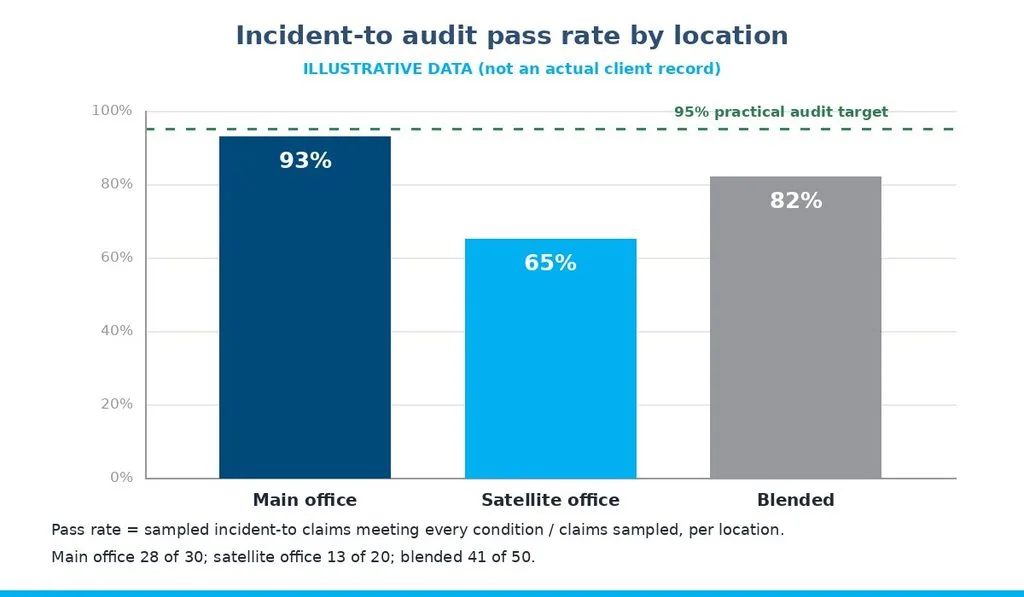
Formula: sampled incident-to claims meeting every condition ÷ claims sampled. Illustrative scenario: 41 of 50 sampled claims pass, an 82% blended rate. By location, the main office passes 28 of 30 (93%), and the satellite office passes only 13 of 20 (65%). The blended rate hides a satellite office where physicians are often not available to supervise.
Worked example 3: new-problem leakage
Formula: incident-to claims where an NP alone addressed a new problem ÷ all incident-to claims. Illustrative scenario: 60 of 400 incident-to claims (15%) involved a new problem with no physician evaluation. At $110 average allowed, the overpayment is 60 × $110 × 0.15 = $990, and those claims should be corrected under the NP’s NPI.
Worked example 4: supervision coverage
Formula: NP or PA clinic hours with a qualifying supervising physician available ÷ total NP or PA clinic hours billed incident-to. Illustrative scenario: an NP runs 40 clinic hours a week, and a physician is on site or on live video for 32 of them, or 80%. Visits in the other 8 hours must be billed under the NP’s own NPI.
How should you interpret these numbers?
Compare like with like: the same location, the same NP or PA, the same payer and the same period. A satellite office with part-time physician coverage will behave differently from a main office, so judge each against its own supervision schedule. One failed audit sample is a reason to pull more charts, not a verdict.
Read the metrics together. A high payment differential with a low audit pass rate means the practice is collecting money it may have to return. A low incident-to share with a strong pass rate may simply reflect a payer mix where most plans require direct NP billing. Run an internal medical billing compliance audit on at least 10 to 20 claims per location before changing policy.
What is the step-by-step process for billing an NP or PA visit?
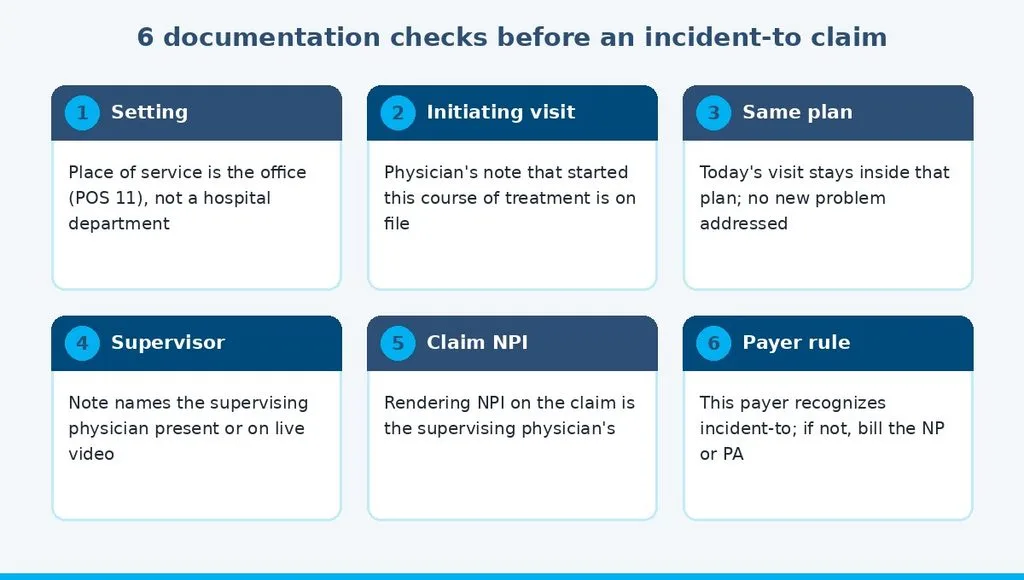
Run every NP or PA visit through the same seven checks before the claim is released. Most incident-to errors are caught at steps 2, 3 and 4.
- Confirm the payer recognizes incident-to; if not, bill under the NP’s or PA’s own NPI.
- Confirm the place of service is non-institutional, such as an office (POS 11).
- Confirm the patient is established and a physician-initiated plan of care covers today’s problems.
- Confirm a supervising physician was on site or available by real-time audio-video, and that the service has no 010 or 090 global indicator if supervision was virtual.
- Record the supervising physician’s name in the note.
- Put the supervising physician’s NPI on the claim and follow your MAC’s instructions for any different ordering physician.
- If any check fails, bill under the NP’s or PA’s own NPI at 85%.
When a past claim turns out to have failed a condition, correct it rather than waiting for an audit. Medicare’s 12-month timely filing limit applies to corrected claims, and identified overpayments generally must be reported and returned within 60 days of identification. For denials you believe are wrong, our guide on how to appeal a Medicare denial walks through the levels.
How long does it take to fix an incident-to process?
Scheduling and claim-routing fixes can be in place within weeks, while documentation habits and audit results usually take several months to stabilize. Treat these as general planning ranges, not guarantees.
Supervision schedules, a daily supervising-physician log and claim-scrubber rules routing new problems to the NP’s NPI are often live within 2 to 6 weeks. Provider documentation of the plan of care and supervising physician typically settles within 1 to 3 months of feedback. Audit pass rates usually show partial improvement within one quarter and steadier results across two quarters.
What are the most common incident-to billing mistakes?
The most common mistakes are billing new patients or new problems incident-to, billing under a physician who was not supervising, and applying Medicare’s rule to payers that do not recognize it. Each has a straightforward control.
Billing new patients incident-to
New patients always go under the NP’s or PA’s own NPI under Medicare, because the physician has not initiated care. Block this in the scrubber using the new-patient E/M codes.
Ignoring new problems at follow-up visits
An NP who addresses a new rash at a diabetes follow-up has stepped outside the physician’s plan unless the physician evaluates it. Train NPs to flag new problems so the claim routes correctly.
Naming an absent physician
The NPI on the claim must belong to the physician supervising that day. Claims under an off-site collaborating physician are a recurring finding in incident-to audits.
Using incident-to in a facility setting
Hospital outpatient departments and provider-based clinics are institutional settings. Use the NP’s own NPI or split/shared rules instead.
Assuming commercial plans follow Medicare
Many commercial plans do not recognize incident-to at all. Keep a payer matrix showing which plans accept it.
A pattern that shows up repeatedly in practice reviews is the physician’s initiating visit being too old or too thin to support the plan of care. When the last physician note was a year ago and did not address today’s conditions, the “active involvement” requirement is hard to defend.
Quick Summary
- Incident-to lets an NP’s or PA’s office service be billed under the supervising physician’s NPI at 100% instead of 85%.
- Every condition must be met: non-institutional setting, physician-initiated plan, no new problems, direct supervision, employment or contract, supervising physician bills.
- Since January 1, 2026, real-time audio-video meets direct supervision for most incident-to services, except 010 and 090 globals; audio-only never qualifies.
- New patients, new problems, facility settings and many commercial plans require billing under the NP’s or PA’s own NPI.
- Keep incident-to audit pass rates at 95% or higher per location and new-problem leakage at zero as practical targets.
Self-Assessment Checklist
Answer yes or no for your practice:
- Do you keep a payer matrix showing which plans recognize incident-to?
- Does your scrubber block incident-to billing for new-patient visits?
- Do NPs and PAs flag new problems so those visits route to their own NPI?
- Is the supervising physician named in every incident-to note?
- Does the claim NPI always match the physician actually supervising that day?
- Do you track supervision coverage for every NP and PA clinic session?
- Is virtual supervision limited to real-time audio-video and services without 010 or 090 globals?
- Do quarterly audits show incident-to pass rates of 95% or higher at every location?
- Are all NPs and PAs enrolled with Medicare and key payers under their own NPIs?
- Do you correct claims that fail a condition promptly instead of waiting for an audit?
Scoring: 9 to 10 yes answers means strong incident-to controls; keep quarterly audits. 6 to 8 yes answers means targeted gaps; fix the “no” items within one quarter. 5 or fewer means significant overpayment exposure; consider billing NP and PA services under their own NPIs until a compliance review is complete.
When should a practice consider professional support?
Consider outside support when incident-to compliance depends on individual memory rather than system rules. These signals usually mean the in-house approach has reached its limits:
- Audit pass rates stay below target at one or more locations after education.
- NPs or PAs cannot bill under their own NPIs because enrollment is incomplete.
- Nobody tracks which payers recognize incident-to.
- A practice acquisition or new satellite office changed settings or supervision coverage.
- A payer has requested records or flagged NP and PA claims for review.
When evaluating help, look for coders and auditors who test claims against 42 CFR 410.26 and the Benefit Policy Manual, credentialing support for NPs and PAs, payer-specific billing rules, and reporting by location and provider. An independent medical billing audit service is a sensible first step when you need a baseline.
Aspect Billing Solutions is one example of this kind of partner. Its medical billing and coding services cover end-to-end billing and coding, eligibility verification and prior authorization, denial management, A/R follow-up and compliance support, and its medical billing and credentialing services include NP and PA enrollment, with a dedicated agent assigned to each provider. Results vary by practice, specialty and payer mix. You can review how the team handles revenue cycle management for medical practices.
Final Considerations
Incident-to billing rules for NPs and PAs reward practices that build the conditions into scheduling and claim routing rather than relying on memory. The 15% differential is real, but only on visits that meet every condition, with a supervising physician who can be documented.
Some figures here are firm published standards: the 85% and 100% payment levels, the incident-to conditions in 42 CFR 410.26, and the 2026 virtual supervision rule. The 40% incident-to share is named study data cited by MedPAC. The 95% audit target, zero new-problem leakage and coverage tracking are practical targets, and all worked-example figures are illustrative.
The natural next question is how your own NP and PA claims hold up. Sample 20 incident-to claims per location, run the four formulas, and score the checklist. If the gaps are larger than your team can close, explore NP and PA billing and revenue cycle support from Aspect Billing Solutions.
Frequently Asked Questions
Can a nurse practitioner bill incident-to for a new patient?
No. Under Medicare, a new patient cannot be billed incident-to, because the physician has not personally initiated the course of treatment. The NP bills the visit under their own NPI at 85% of the fee schedule. Later follow-up visits may qualify for incident-to once a physician has established the plan of care.
Does the physician have to be in the office for incident-to billing in 2026?
Not always. Since January 1, 2026, Medicare permits direct supervision through real-time audio and video for most incident-to services, so the physician can be immediately available virtually. Audio-only does not count, and services with a 010 or 090 global surgery indicator still require the physician’s physical presence.
What is a good incident-to audit pass rate?
A practical target is 95% or higher of sampled incident-to claims meeting every condition, measured separately for each location. It is a common compliance convention, not a CMS mandate. Satellite offices with limited physician coverage often score lower, so a blended practice rate can hide the location that needs attention.
What is a good way to estimate incident-to revenue?
Multiply eligible visits by the average allowed amount and by 15%, the gap between 100% and 85% payment. For example, 3,000 visits at $110 equals $49,500. Count only visits that meet every condition, because ineligible visits billed incident-to become overpayments that must be refunded.
Do commercial insurers allow incident-to billing for NPs and PAs?
Many do not. Incident-to is a Medicare Part B rule, and commercial plans, Medicare Advantage plans and state Medicaid programs set their own policies. Many require NPs and PAs to be credentialed and bill under their own NPI. Confirm each payer’s policy in writing before billing NP or PA services under a physician.
Can incident-to billing be used in a hospital outpatient clinic?
No. Incident-to applies only in non-institutional settings such as a physician’s office. Hospital outpatient departments and provider-based clinics are institutional settings, so NP and PA services there are billed under their own NPIs, or under split/shared rules with modifier FS when a physician shares a facility visit.
Sources and Methodology
(a) Published standards and definitions: 42 CFR 410.26 (services and supplies incident to a physician’s professional services); CMS Medicare Benefit Policy Manual, Pub. 100-02, Chapter 15, Section 60; CY 2026 Medicare Physician Fee Schedule final rule (CMS-1832-F) and CMS fact sheet on virtual direct supervision; CY 2027 proposed rule (CMS-1848-P, July 2026); CGS, Noridian and First Coast MAC incident-to guidance.
(b) Named benchmarking data providers: none used. No MGMA, HFMA or vendor benchmark is cited for incident-to rates.
(c) Practical or illustrative targets: the 95% audit pass rate is a common compliance threshold; zero new-problem leakage and supervision coverage tracking are practical targets; improvement timeframes are general planning ranges; all worked-example figures are illustrative scenarios, not client records. Payer comparisons are general patterns, not a single named source.
(d) Survey or study data: Patel et al., as cited in MedPAC’s March 2026 Report to Congress, Chapter 4, estimating that about 40% of APRN and PA office visits in 2018 were billed incident-to; MedPAC June 2019 Report to Congress recommendation that APRNs and PAs bill Medicare directly.
Results vary by practice, specialty, payer mix and documentation quality. Figures reflect information available at the time of research (October 2026). Medicare supervision rules, the Physician Fee Schedule, state scope-of-practice laws and payer policies change, so review this guidance at least annually.