
Botox Injection Billing for Neurology: CPT 64615 & J0585
Botox injection billing for neurology (CPT 64615, J0585) pairs one procedure line with one drug line. CPT 64615 is reported once per chronic migraine session, while J0585 is billed per unit, commonly 155 units [A]. Most payers expect prior authorization, matching documentation, and correct waste modifiers before they pay either line.
Botox injection billing for neurology (CPT 64615&J0585)-One mismatch between the injection note and the claim can stall an entire Botox session. This guide shows how neurology teams bill CPT 64615 and J0585, starting with waste modifiers, the most misunderstood step. You will find worked examples, a denial map, and a plan for payer disagreements. A short self-assessment near the end scores your workflow. Terms like chemodenervation and HCPCS are explained plainly.
Botox Billing Numbers Worth Knowing
Quick-reference numbers for chronic migraine Botox billing
| Metric | Practical Target/Range | Review Frequency | Primary Source |
| CPT 64615 units per session | 1 unit, regardless of injection sites | Every claim | [A] CPT descriptor |
| Labeled chronic migraine dose | 155 units, 31 sites, 7 muscles | Every session | [A] FDA-approved label |
| Retreatment interval | About 12 weeks (84 days) | Every patient | [A] Label schedule; [C] payer edits |
| Medicare waste modifiers | JZ if none discarded; JW if any | Every claim | [A] CMS MM13056 |
| Common payer add-on criteria | 8+ migraine days; 50%+ response at reauth | Each reauthorization | [C] Commonly reported |
| Authorization lead time | Start 3-4 weeks ahead | Every cycle | [C] Commonly reported |
| Botox-line denial rate | Under 10% (practical goal) | Monthly | [D] Illustrative target |
Source labels: [A] = published definition, rule, or label from a named body; [C] = commonly reported, not body-mandated; [D] = illustrative practical target.
Waste Modifiers: A Two-Minute Decision Guide
Waste rules trip more Botox claims than the injection code does. Botox comes in single-dose vials, so Medicare’s discarded-drug policy applies; confirm details with your MAC. Medicare requires JZ when nothing is discarded, and JW on its own line for discarded units [A]. Other payers differ. Our neurology modifiers guide covers related cases.
Table 2. Which waste rule applies? (decision guide)
| If the payer is… | Report | Source |
| Medicare Part B, nothing discarded | JZ on the drug line | [A] CMS MM13056 |
| Medicare Part B, some discarded | JW on a separate line for the discarded units | [A] CMS MM13056 |
| Medicare Advantage or commercial | Follow the written payer policy; many mirror CMS, some do not | [C] Verify per contract |
| Specialty pharmacy supplies the drug | Pharmacy bills the drug; practice bills administration only | [C] Commonly reported |
Worked Examples: Waste and Drug Value
Example 1: Discarded units
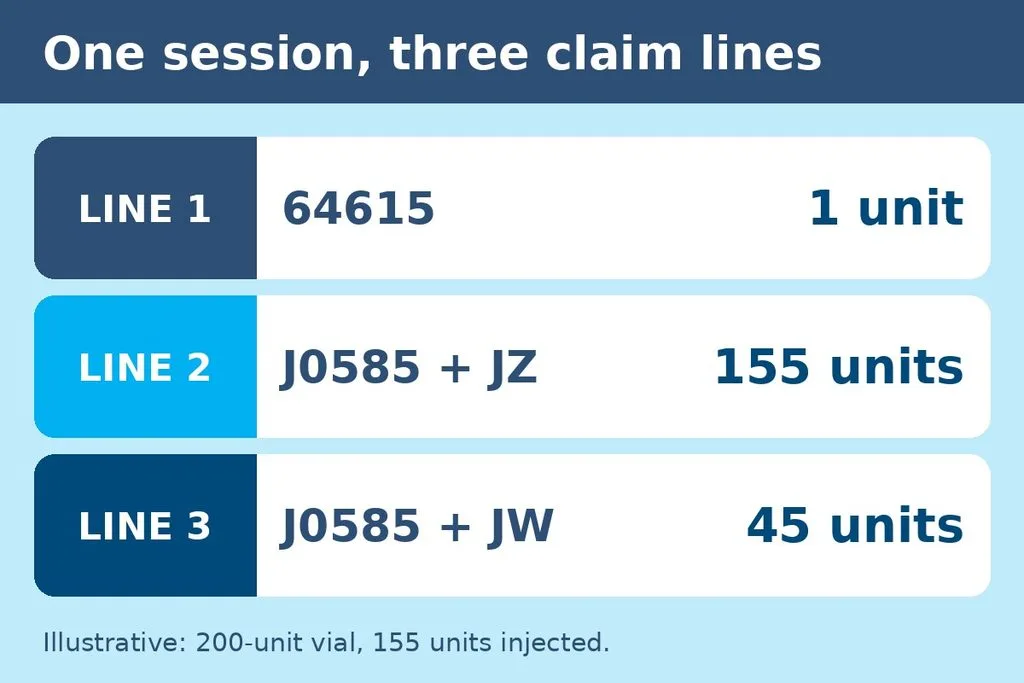
Formula: discarded units = labeled vial units − units administered. A 200-unit vial with 155 units injected leaves 200 − 155 = 45 discarded. The claim shows J0585 × 155 and J0585-JW × 45.
Example 2: Drug line value
Formula: drug payment = units × rate per unit. At an illustrative $6.00 per unit [D], 155 units equals $930. Where JW is paid, 200 units equals $1,200. Omitting JW forfeits 45 × $6.00 = $270 per session.
Anatomy of a Two-Code Botox Claim
Every chronic migraine session is billed on at least two lines. CPT 64615 describes bilateral chemodenervation of muscles served by the facial, trigeminal, cervical spinal, and accessory nerves. Report it once per session, however many sites you inject. The drug line, J0585, describes onabotulinumtoxinA per single unit. The FDA-approved label recommends 155 units across 31 sites [A], so claims usually show 155 units. Because 64615 is inherently bilateral, the American Academy of Ophthalmology advises against anatomical modifiers on it [G].
- Modifier 25: Add it to a same-day visit only when the visit is significant and separately identifiable.
- CPT 96372: Do not pair it with 64615; CPT guidelines and NCCI edits generally block it.
For wider context, see our neurology CPT codes guide.
Clearing Authorization Before Injection Day
Most denials start before the patient arrives. Commercial and Medicare Advantage plans commonly require prior authorization, often citing 15 or more headache days monthly and earlier preventive attempts [C]. Original Medicare does not require it for private office visits. However, CMS requires it when hospital outpatient departments bill 64615 with J0585 [A]. Strong medical necessity files record headache days, disability scores, and prior therapies. Our prior authorization services show how a dedicated team can own this step.
Example 3: The 12-week window
Formula: earliest next date = last injection date + 84 days. A January 6 injection plus 84 days lands on March 31. Booking March 24 risks a frequency denial.
Where Botox Claims Break: Denial Patterns and Fixes?
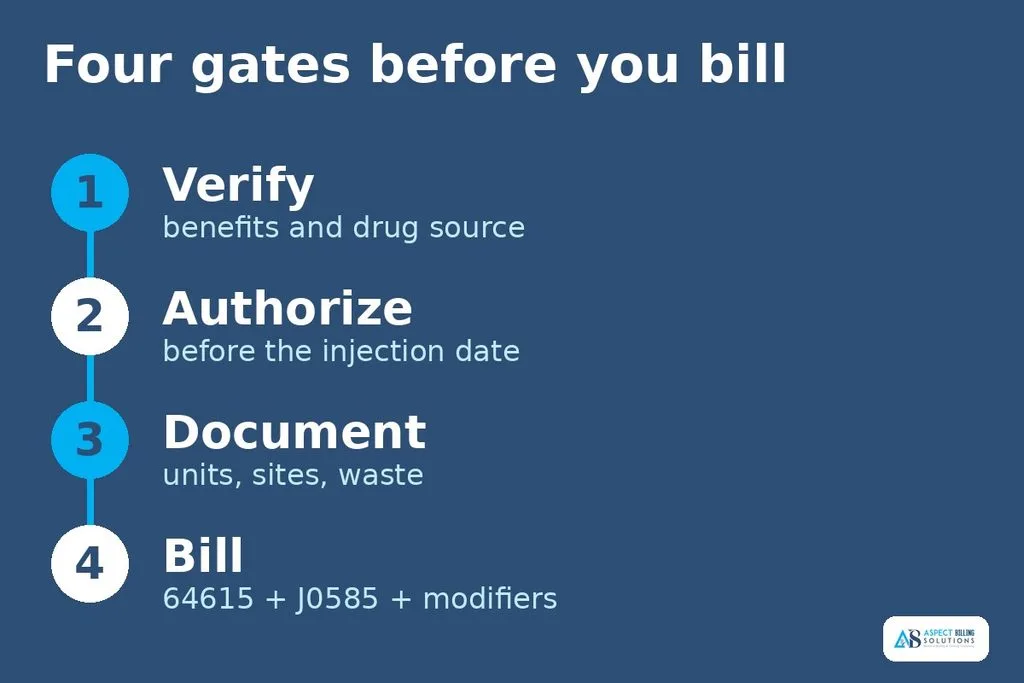
Denials cluster around four causes: missing authorization, unsupported necessity, bundling, and modifier errors. A solid denial management workflow tracks each cause separately. Measure Botox lines apart from office visits, since visit-level averages hide drug-line failures. Our list of common neurology billing mistakes covers related traps.
Table 3. Common Botox denial patterns (triggers are commonly reported [C])
| Reason (CARC) | Typical Trigger | Practical Fix |
| CO-197: authorization absent | Injection outside approved dates | Verify dates before scheduling |
| CO-50: not medically necessary | Diagnosis or headache days undocumented | Use a response-tracking template |
| CO-97: bundled service | 96372 or extra chemodenervation code added | Add a scrubber rule for the pair |
| CO-4: modifier missing or wrong | JW or JZ omitted | Prompt modifier by payer |
Example 4: Denial rate
Formula: denial rate = denied claims ÷ submitted claims × 100. Submitting 40 claims with 6 denials gives 6 ÷ 40 × 100 = 15%, above the illustrative 10% goal [D].
The Blended Average Trap
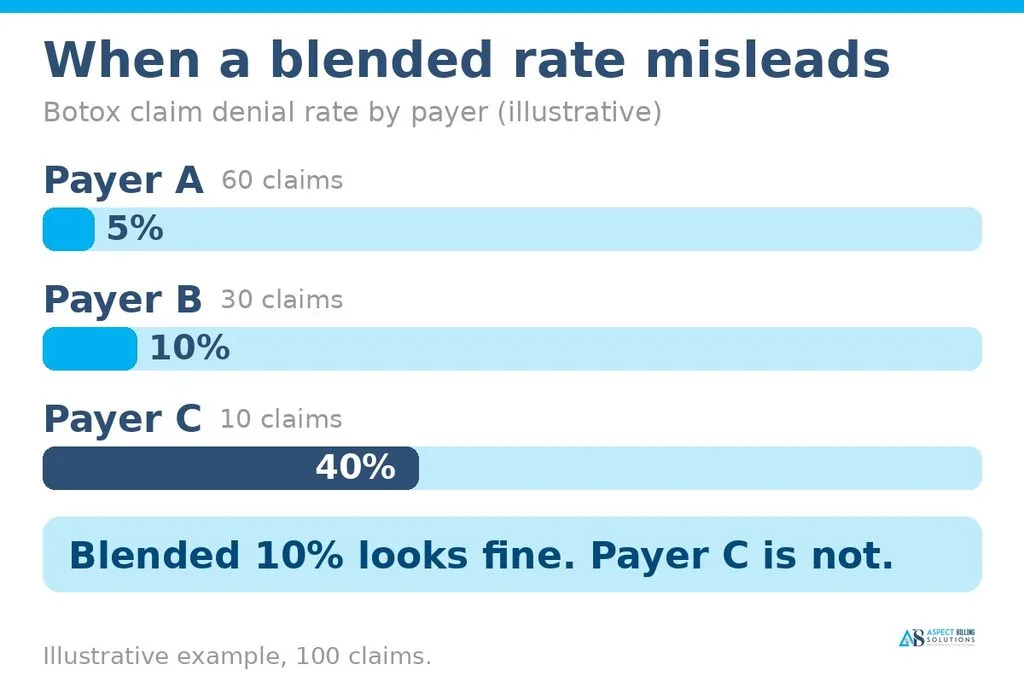
Illustrative scenario (not an actual client record): a practice bills 100 Botox claims. Payer A has 60 claims with 3 denials (5%). Party B has 30 with 3 denials (10%). Payer C has 10 with 4 denials (40%). Overall, 10 ÷ 100 gives a comfortable 10%. Yet Payer C is failing, and only a payer-level view shows it.
If the Payer Says No
Payers sometimes deny care the label supports. Work the denial in order. First, read the stated reason and request the written criteria. Second, answer point by point with the FDA-approved label, a three-month headache diary, prior preventive trials, and measured response. Third, request a peer-to-peer with a neurologist, prepared around diagnosis, failed therapies, and benefit. Fourth, watch deadlines. Original Medicare allows 120 days to request a redetermination and 180 days for the next level, per the CMS Claims Processing Manual [A]. Commercial plans set their own window in the denial letter.
Using These Benchmarks Fairly
A benchmark helps only when compared like for like. Match payer mix, practice size, patient volume, and reporting period. One missed target is a signal to investigate, not a verdict on your team.
How Long Fixes Usually Take?
Table 4. General planning ranges (not a guarantee for any practice)
| Fix | Early Signs | Fuller Results |
| Unit and waste scrubber rule | 2-4 weeks | 2-3 months |
| Authorization tracking queue | 4-8 weeks | One retreatment cycle (about 3 months) |
| Payer-level denial review | 60-90 days | 4-6 months |
If You Remember Three Things
- Match the waste rule to the payer: JZ or JW for Medicare, written policy for everyone else.
- Report 64615 once and J0585 per unit; confirm authorization and the 84-day window first.
- Track denials by payer; under 10% is an illustrative goal [D].
Self-Check: Is Your Botox Billing Healthy?
- Do you report CPT 64615 only once per session? (Yes / No)
- Do J0585 claim units match the documented dose? (Yes / No)
- Do you apply JZ or JW as each payer requires? (Yes / No)
- Is authorization confirmed before every cycle? (Yes / No)
- Is each injection at least 84 days after the last? (Yes / No)
- Do notes record headache days and prior therapies? (Yes / No)
- Do you avoid billing 96372 with 64615? (Yes / No)
- Do you have a peer-to-peer plan for denials? (Yes / No)
- Is your Botox denial rate under about 10%? (Yes / No)
Scoring guide: 8-9 yes answers suggest a strong process. 5-7 point to gaps worth fixing this quarter. 4 or fewer means a full workflow review is due.
Signs Your Team May Need Backup
- The same payer denies Botox claims month after month.
- Authorizations expire before injection dates.
- Aged receivables on Botox claims keep growing.
For Botox, look for support that reconciles drug units and waste against the injection note before each claim leaves, tracks authorization dates against the 84-day interval, and reports denials by payer. Ask who prepares peer-to-peer calls. Aspect Billing Solutions is one example of this structure. It provides HIPAA-compliant US medical billing and coding (ICD-10, CPT, HCPCS). Services include claim and denial management, eligibility verification, prior authorization, accounts receivable, and credentialing. Each provider gets a dedicated agent, so one person learns your payers’ waste rules. Fit and results vary by practice. See its revenue cycle management service for details.
Final Considerations
Botox billing rewards precision more than speed. Get the two-line structure right, confirm authorization before the needle, and reconcile units every time.
Know which numbers are firm. The 64615 and J0585 definitions, the 155-unit labeled dose, the 12-week schedule, CMS waste rules, and hospital outpatient authorization are published standards [A]. The 10% denial goal, $6.00 rate, lead times, payer criteria, and timeframe ranges are practical or illustrative targets [C][D].
Frequently Asked Questions
Botox injection billing for neurology (CPT 64615&J0585)
What is CPT 64615 used for?
It reports bilateral chemodenervation of head and neck muscles, typically for chronic migraine. Report it once per session.
Can J0585 and 64615 be billed together?
Yes, as separate lines. Payers often deny both when either line is wrong.
How many J0585 units are billed for chronic migraine?
The labeled dose is 155 units. Bill the units documented, plus discarded units where required.
Do Botox claims need JW or JZ?
Medicare requires JZ when nothing is discarded and JW for discarded units. Other payers vary, so check each policy.
Does Botox for migraine need prior authorization?
Commonly yes for commercial and Medicare Advantage plans, and in hospital outpatient settings under CMS rules.
What is a good Botox claim denial rate?
An illustrative goal is under 10%, measured monthly by payer.
What is a good lead time for Botox prior authorization?
Many practices start 3-4 weeks ahead, a commonly reported range.
What is a good documentation standard for reauthorization?
Record headache days and disability scores before and after treatment. A 50% reduction is a commonly reported response threshold.
Sources & Methodology
- (a) Published standards [A]: CPT and HCPCS descriptors; FDA-approved BOTOX label; CMS MM13056; CMS hospital outpatient FAQ; CMS Claims Processing Manual, Chapter 29; X12 reason codes.
- Society guidance [G]: American Academy of Ophthalmology coding guidance.
- (b) Named benchmarking data providers: none used.
- (c) Commonly reported or illustrative [C][D]: payer criteria, lead times, the 10% goal, the $6.00 rate, and timeframes, from industry billing guides.
- (d) Survey data: none used.
Results vary by practice. Figures reflect information available at research time (September 2026); confirm current payer policies.